St. Cuthbert’s Way, Day 1, Melrose to St. Boswells
Julie and I arrived in Edinburgh, Scotland, on Tuesday afternoon March 12. I had not slept since Saturday night and by then was barely functional but I wanted to stay awake until dusk. So I went downstairs to relax in the hotel dining area with a decaf cappuccino and my sister went to bed. Thinking I should eat something before I tucked in I looked at the starters menu. Chorizo tapas caught my eye and I placed an order to carry back to the room. I love Mexican chorizo but had never tried the very different Spanish version. Oh my goodness! It was phenomenal! I slurped down every last bite, wiped the bowl clean, and contentedly crawled into bed just as my sister was waking up to go downstairs for food. In the morning I found out that no one waited on her so she came back to sleep on an empty stomach.
Wednesday morning we called for an Uber at 9:00 and headed to Melrose where our pilgrimage would officially begin. Ian, the driver, was a wonderful host and on our 1 1/2 hour trip we learned quite a lot about Scotland and the area: Scottish buildings are all constructed from sandstone and those hills ahead change the weather patterns between Edinburgh and Melrose. We were quite excited to hear that it was lambing season. I ventured to ask, “Please tell me, what is the one thing an American should never do in Scotland?” Ian looked tentative but when I encouraged him he confirmed what I had already read, “Please don’t tell us about your Scottish ancestors.” Basically we are Americans; they are not interested in our family tree and it gets tiresome hearing us excitedly relate to them that our grandfather on our mother’s side was half Scottish.
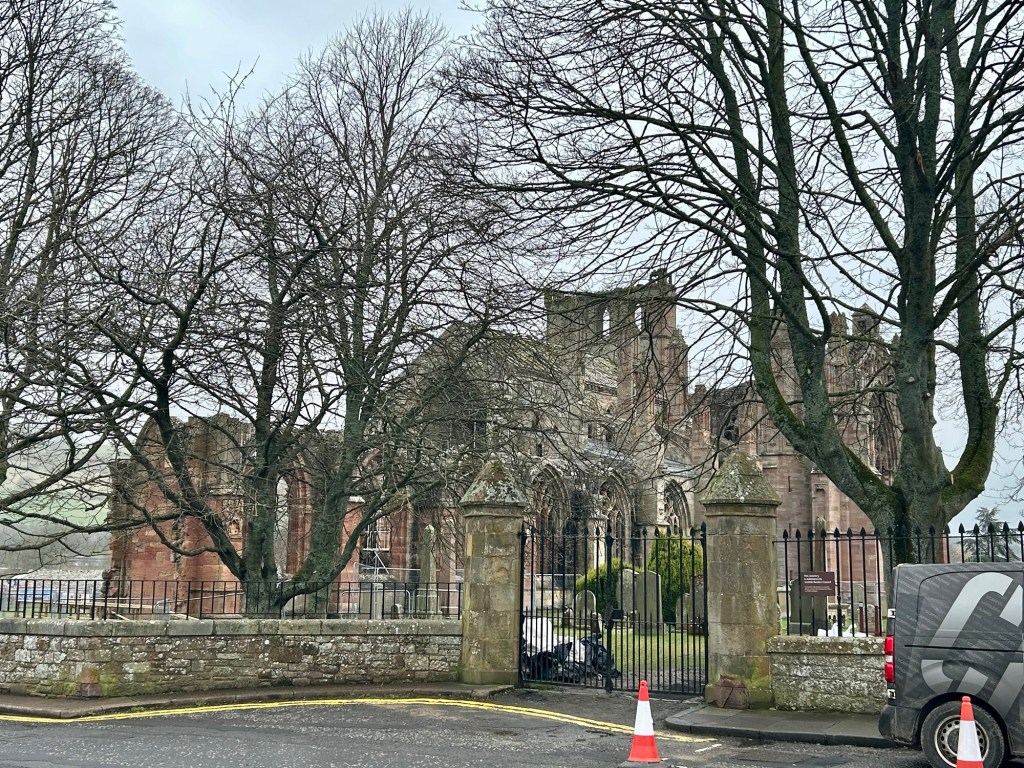
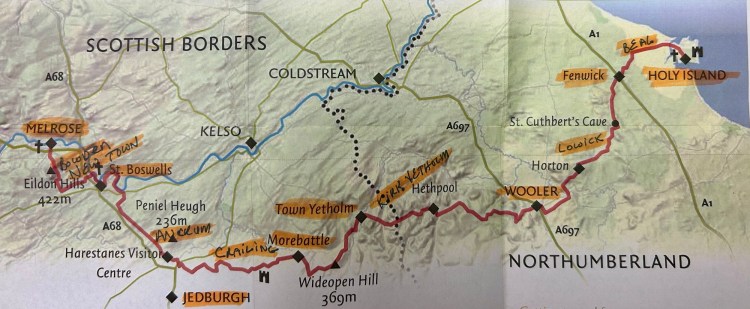
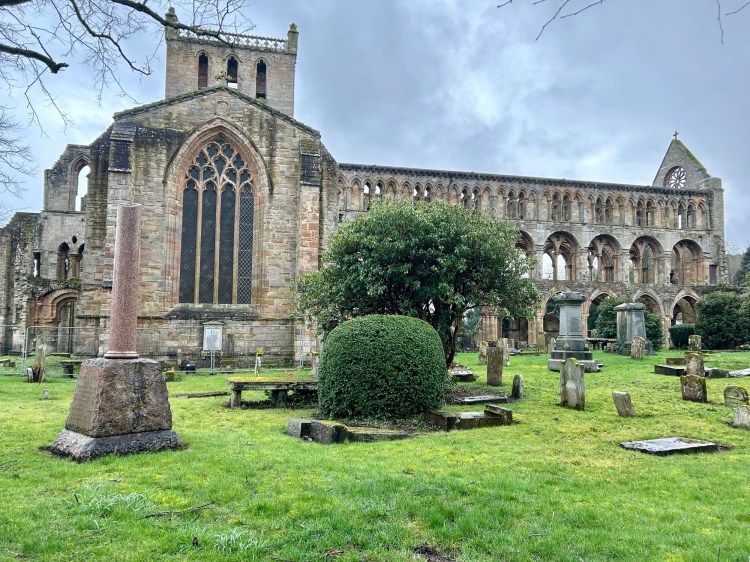
Ian dropped us off at Melrose Abby assuring us that we would do splendidly on our 62 mile endeavor. It was obvious that the abby was undergoing renovations and since exploring it would be somewhat limited we decided to skip that and get on with the the trek. After the kind ladies in the abby office and gift shop had directed us to the start of St. Cuthbert’s Way, they connected us with the inn in St. Boswells and recommended Eden Coffee House across the street as a great place for brunch. As we fueled up on freshly baked scones, back bacon (much more like ham than belly/streaky bacon), and eggs, Julie shared with me her vision for the coming days. She saw Lindisfarne and Holy Island as symbolic of Heaven and the trail would for her be a walk to Heaven. In that light she felt that starting out at ‘Eden’ (as in Eden Coffee House) was somehow meaningful. I was intrigued by that observation and after returning home googled the meaning of Eden:
“The late Dr. Myles Munroe explains how Eden in the Hebrew language is a word with five strokes. Each stroke has a meaning: spot, moment, presence, open door and delightful place. The word literally gives the understanding that God took the man and put him in a spot, for a moment, where the presence of God was an open door to heaven.” (https://destinyokc.com/blog/2021/3/2/open-the-gates-the-garden-of-eden)
Wow!!! Translated to our circumstance God literally put us in a spot (St. Cuthbert’s Way), and for a moment (eight days), the presence of God was an open door (thin space) to a delightful place (Heaven)!
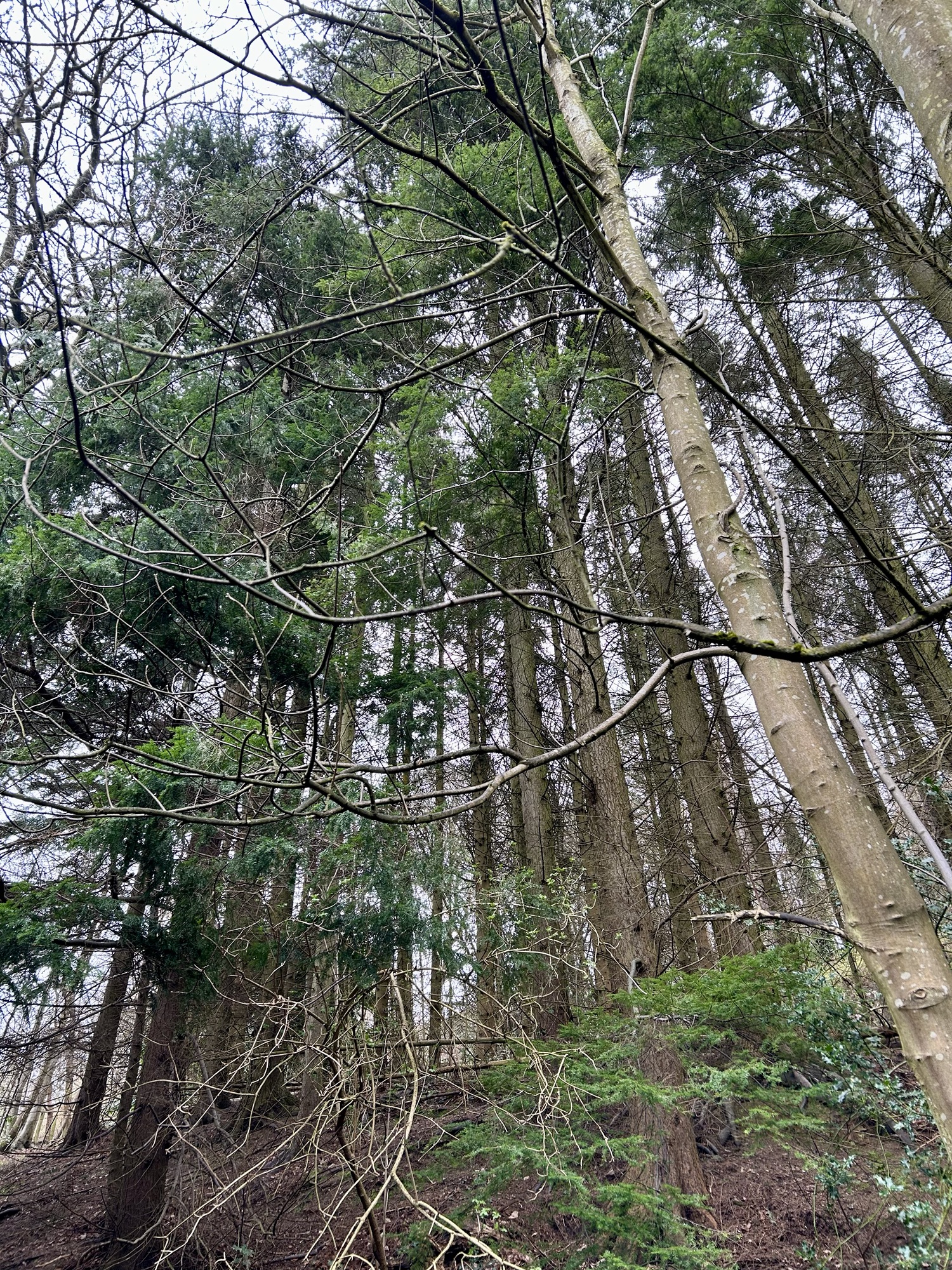
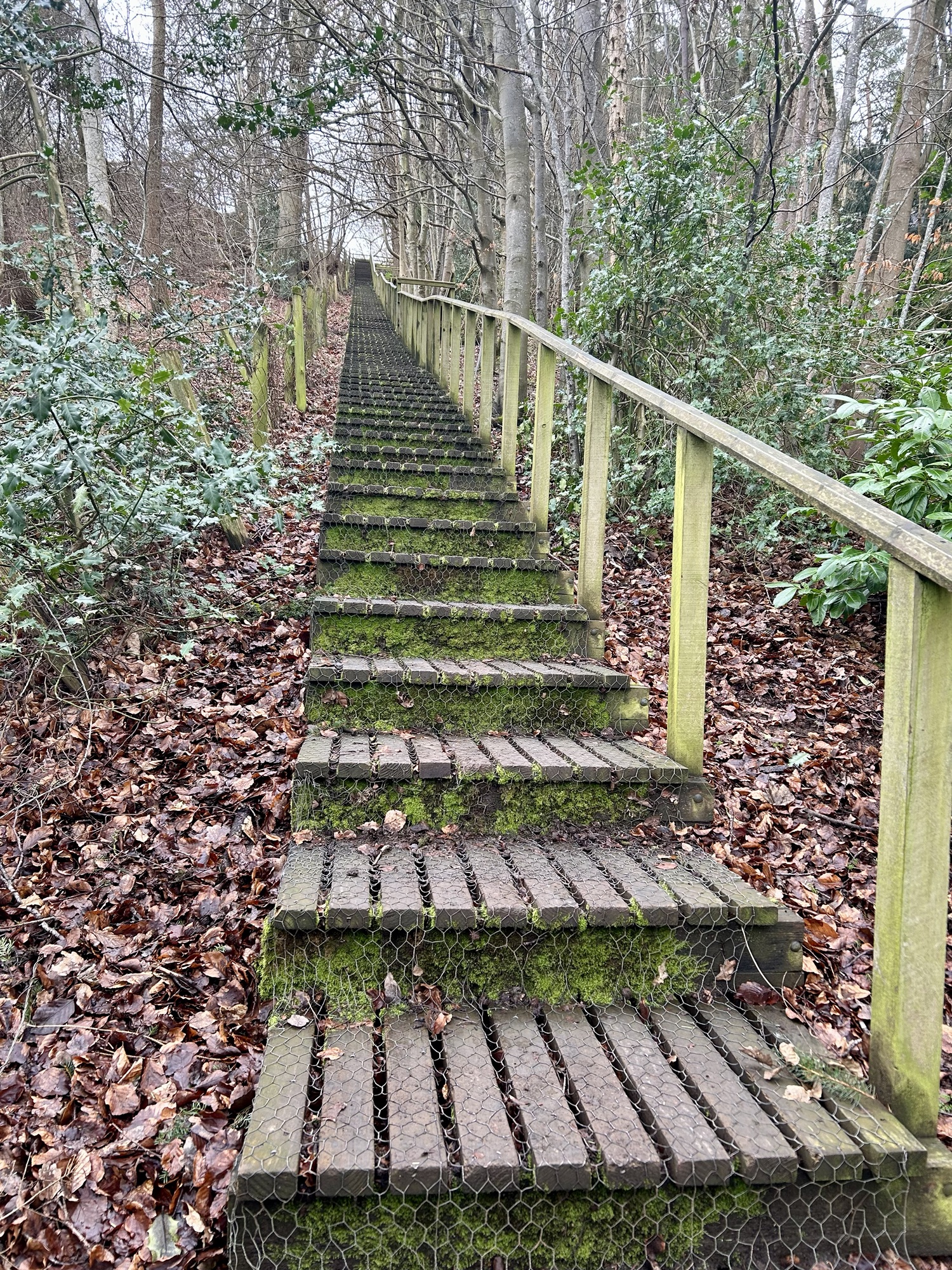
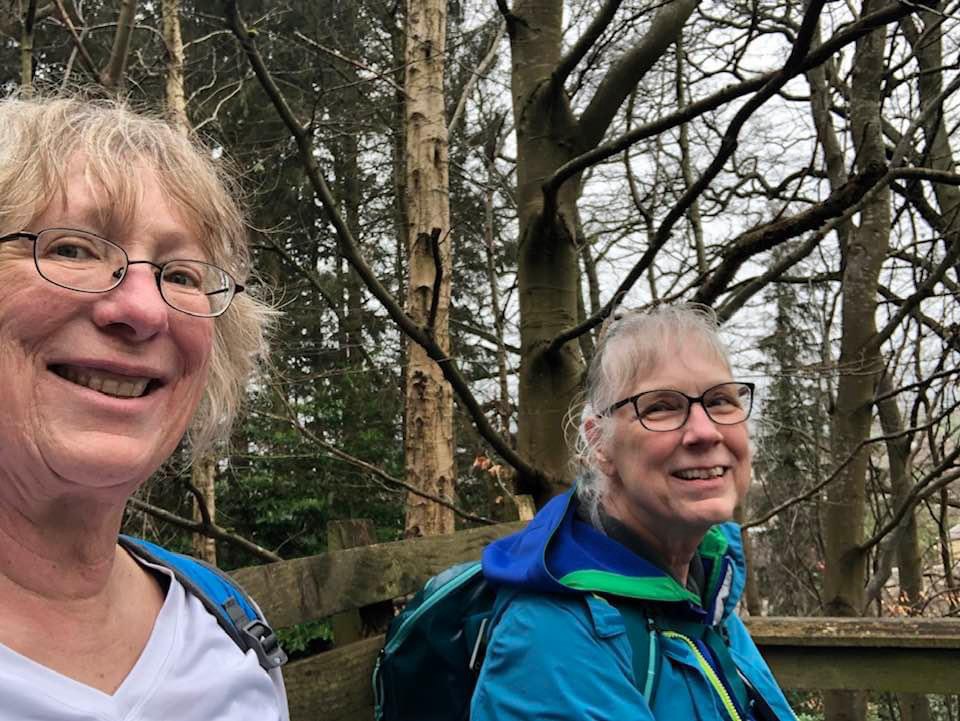
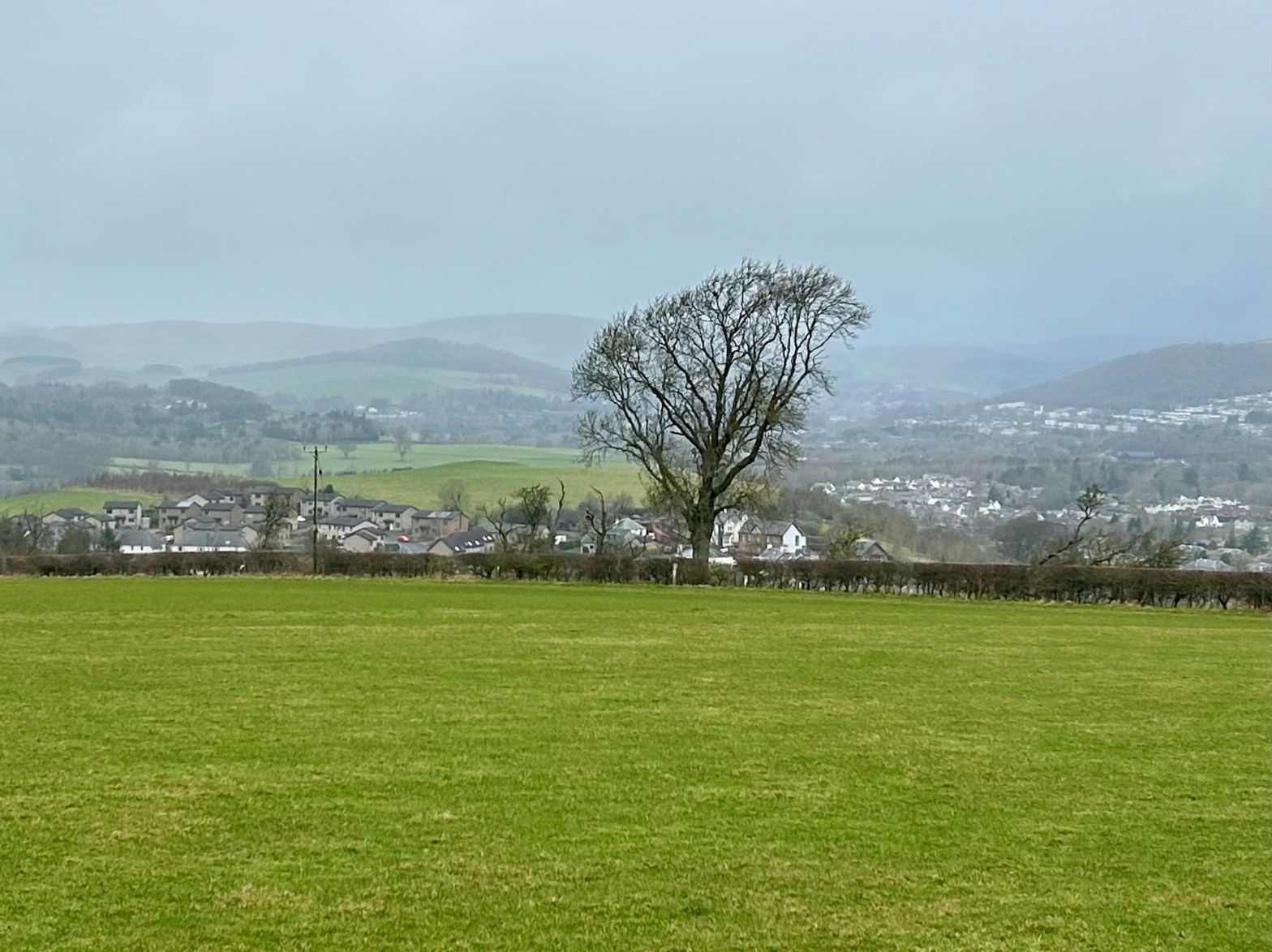
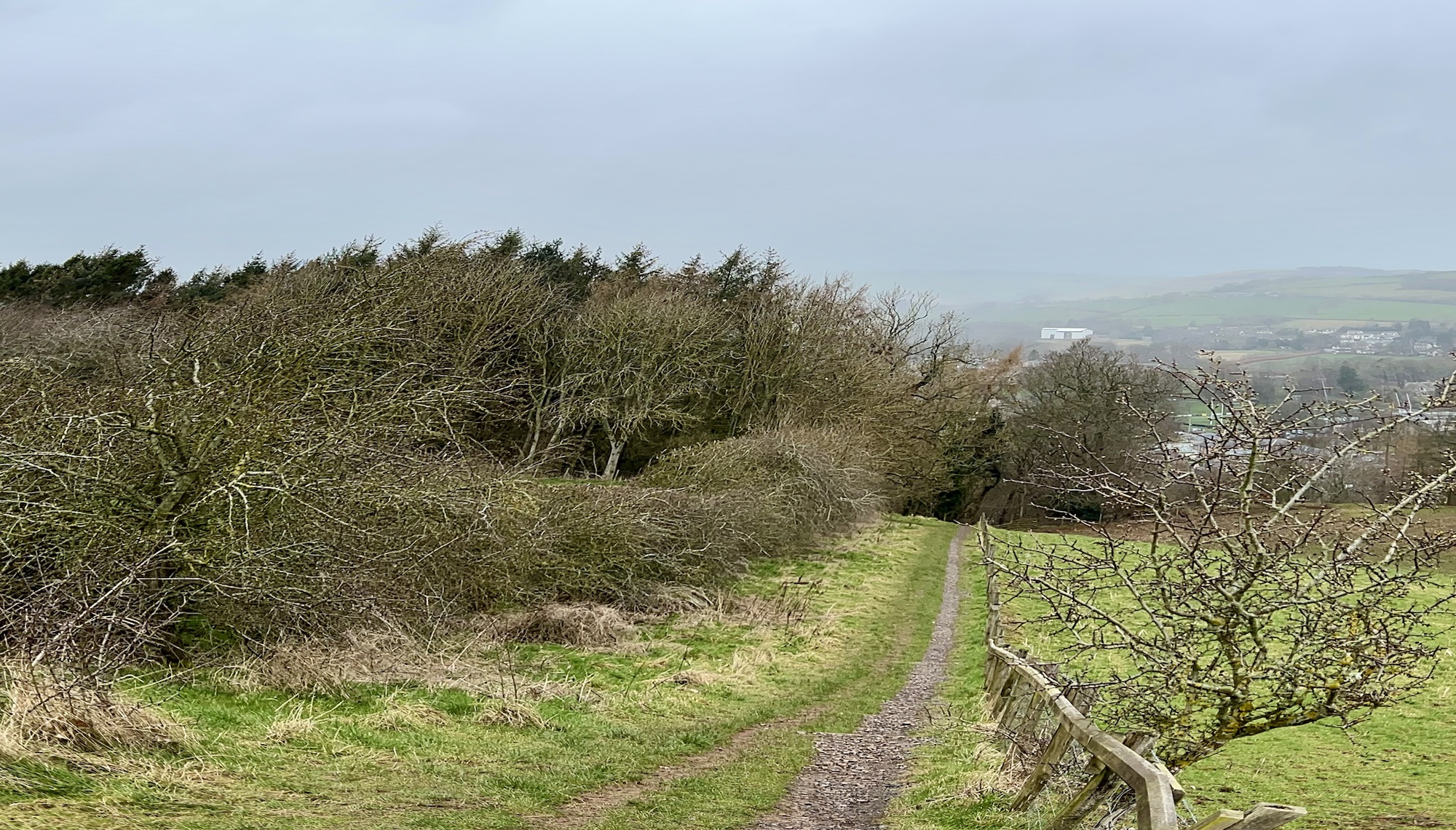
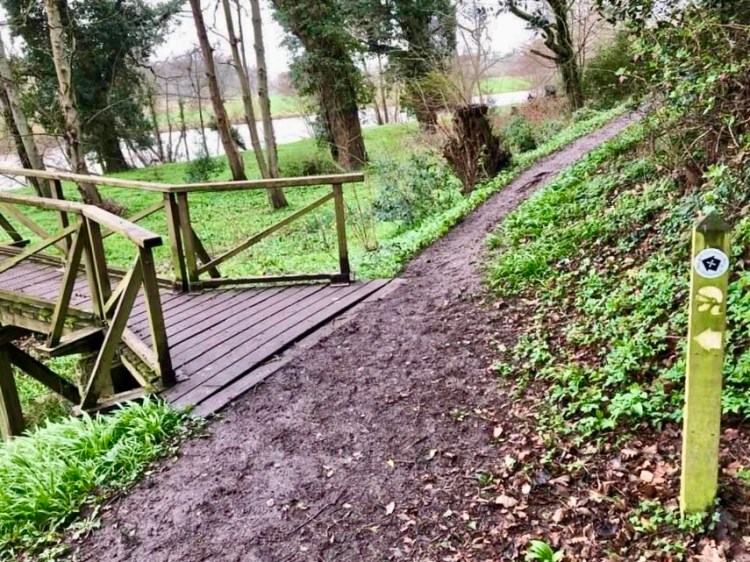
Heading up the street we found a sign marking the trailhead and, voila, we were on pilgrimage! As we stepped off the street we entered an Eden-like wooded space with the whooshing sound of a rushing stream and the joyous songs of a multitude of birds. Walking in amazement at the beauty of it all we soon found planked stairs leading uphill. We had read that for a while there would be benches and that pilgrims should rest on them even if they weren’t yet tired. So we heeded the advice, but it was hard to sit long because we were excited and, having no idea how long our day’s walk would take, didn’t want to be walking unknown paths after dark. Very quickly we were out of the woods and onto the beautiful, sparsely treed, rolling, Scottish hills that one so often sees in photos. The landscape was breathtaking, greener than I had expected since it was still winter, and the villages below became smaller and smaller as we climbed higher and higher. Soon I was wondering why it was already so strenuous; I had trained well enough to handle this. But, we frequently stopped to catch our breath and kept on climbing. We had read that at about the halfway point of today’s walk the path would level out and slowly descend to the town of St. Boswells so there was no trepidation at all.
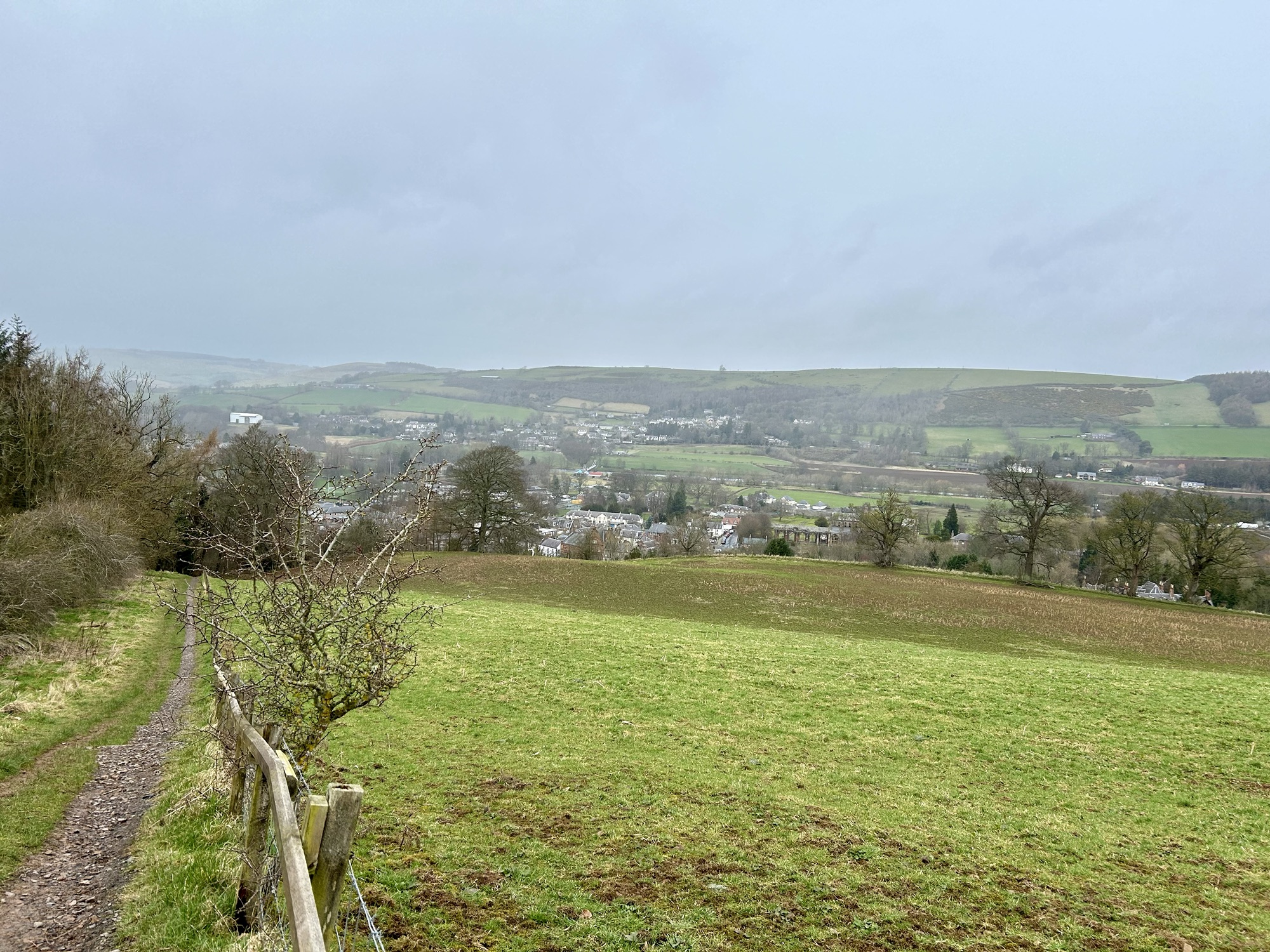
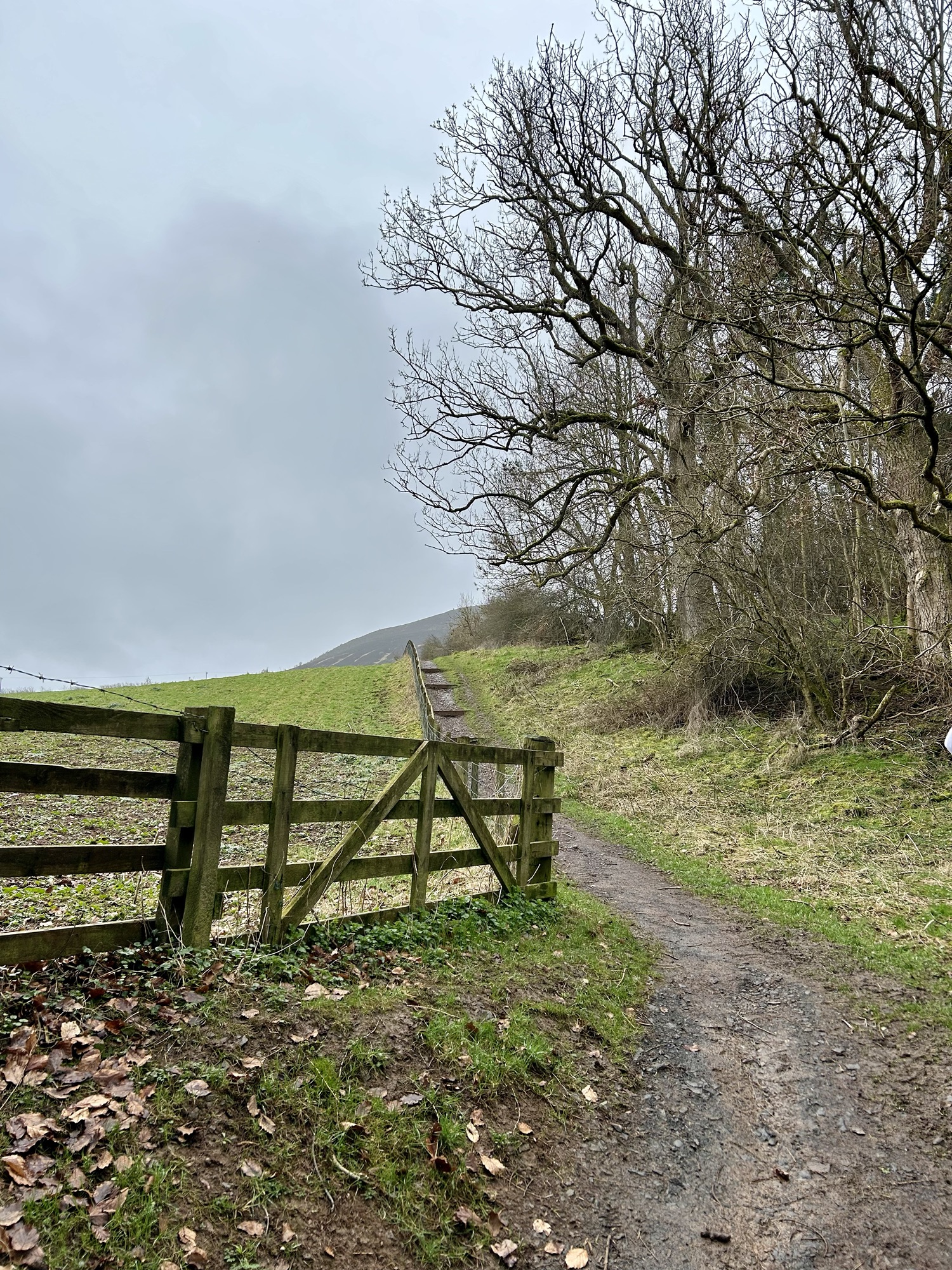
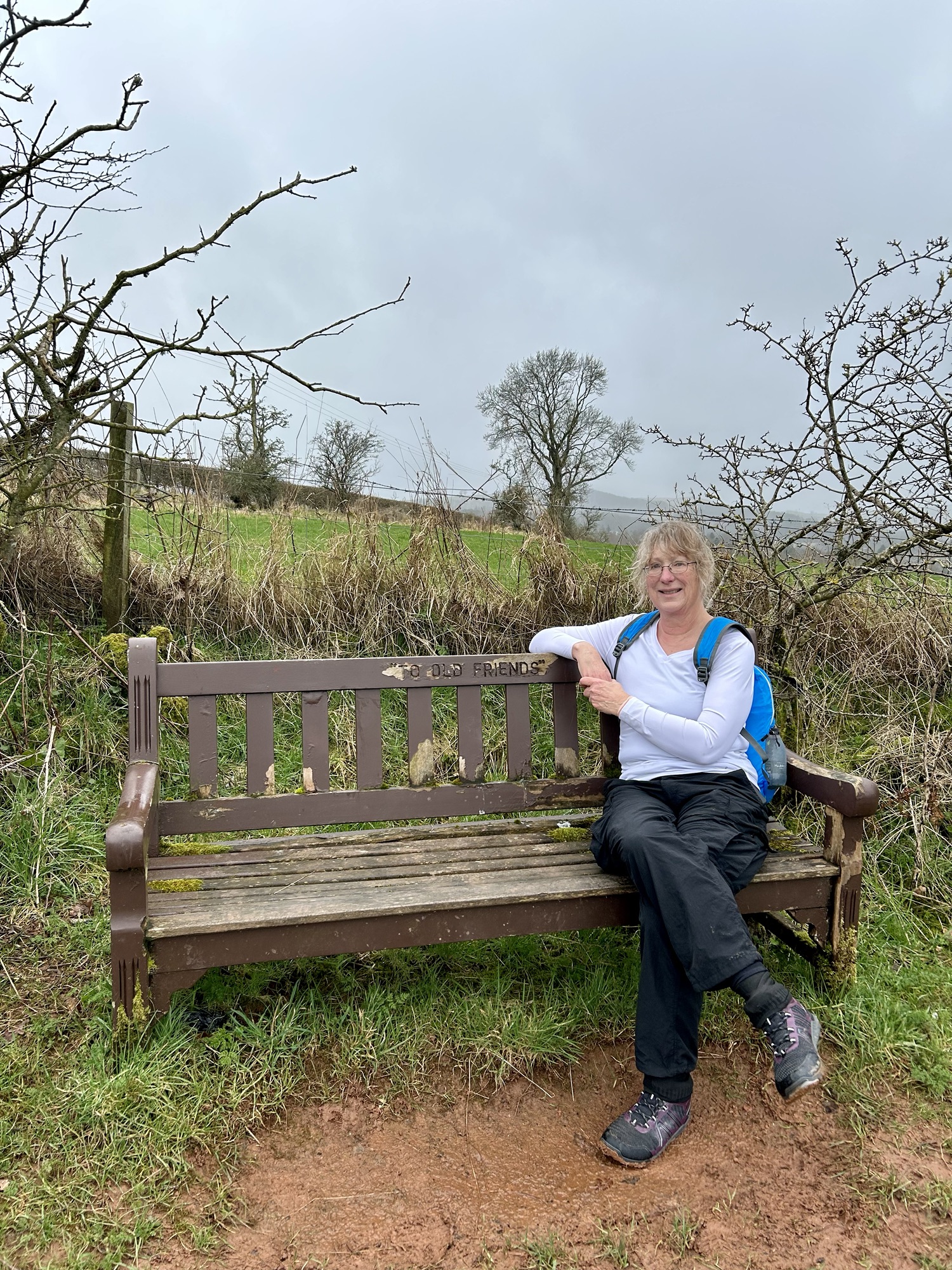
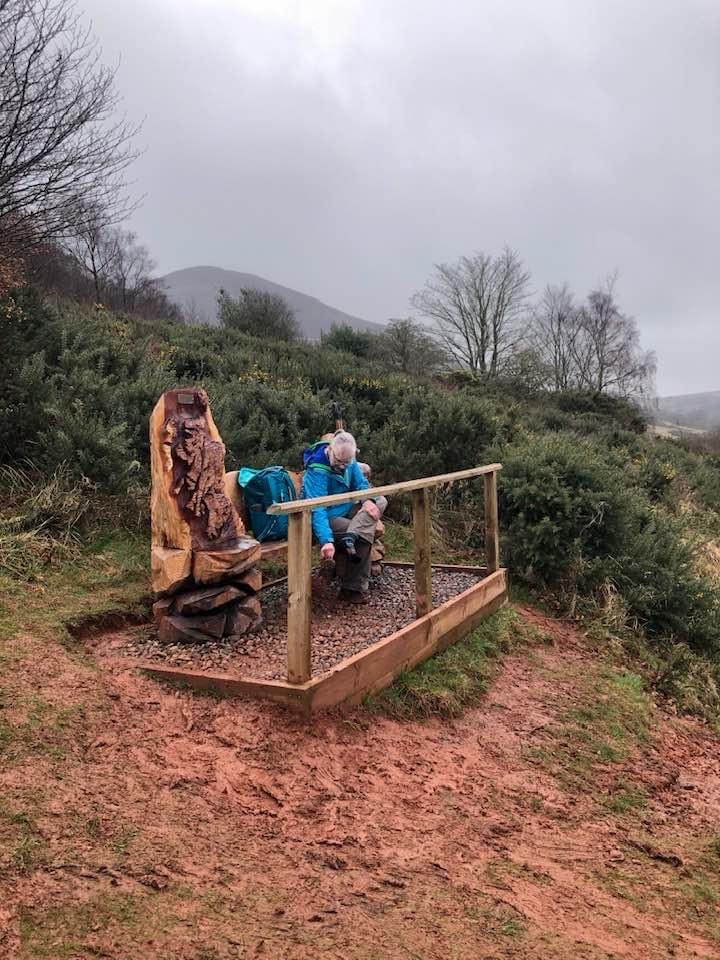
As we ascended the path became more muddy. I had started the day in my barefoot runners but after they slogged down in a seemingly bottomless mud pit I sat down at the, thankfully, nearby bench and changed into my boots. As I was changing, a day hiker coming downhill stopped to chat. She informed us that we were close to the highest point of the trail, that just a bit ahead we would go “through the saddle” between two peaks and then be headed down to St. Boswells and our room for the night.
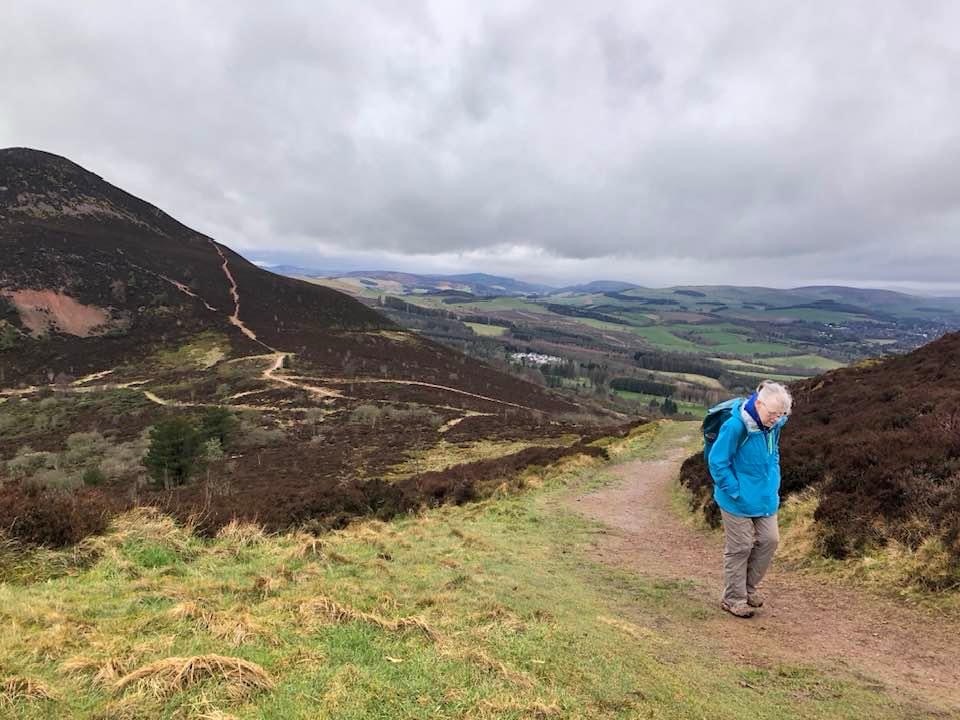
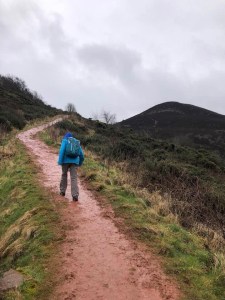
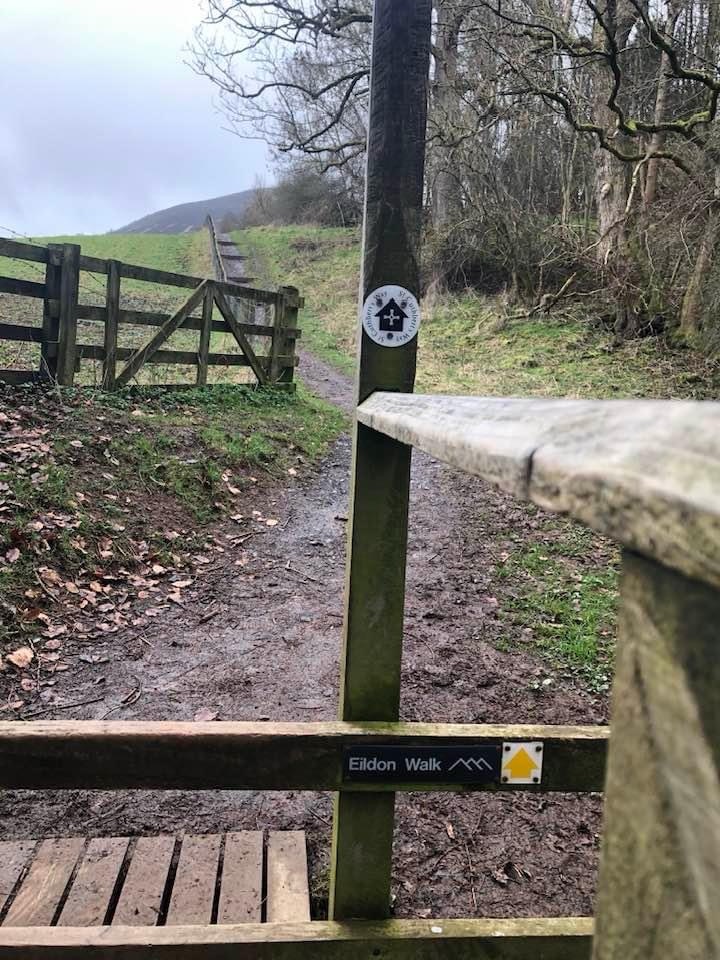
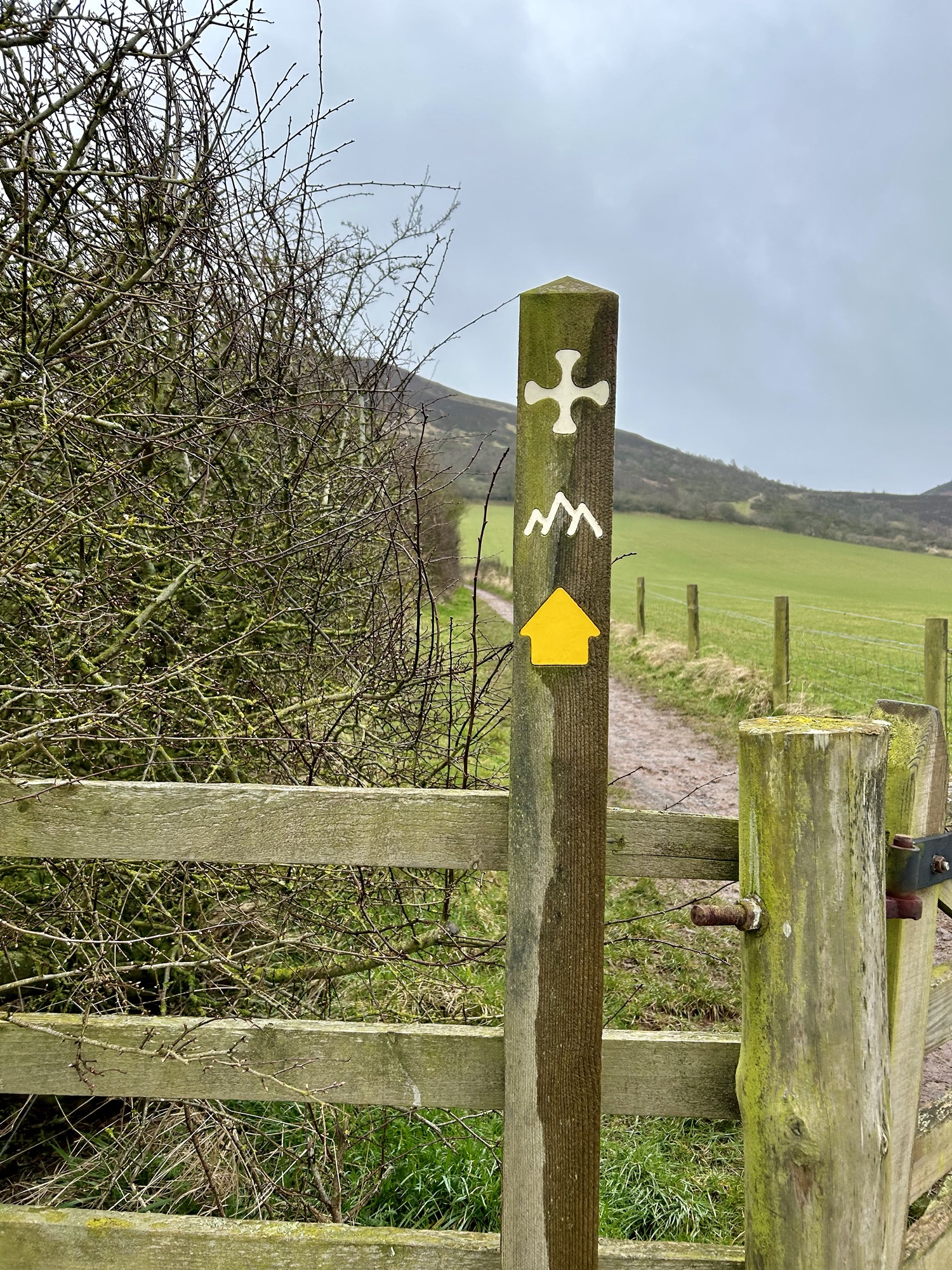
Off we headed, up, up, and up until we came to a trail sign. We stopped and I took a photo of it and we discussed which path we should follow. The trail emblem pointed one direction but it seemed to me (who has no internal compass at all) that it was pointing back in the direction of Melrose. The other direction had a mountain emblem and it pointed towards the saddle. I had no idea that there were other trails so said that we should follow this one to go through saddle. At that point I rapidly began tiring. We trudged on upward until there was a flat space. As we stopped to look at a carved rock that read “follow the trail” I suddenly was dizzy and my legs became like rubber and almost gave way. Although it had begun raining and the wind was getting quite strong I told Julie I needed to rest. We spread out the metallic emergency blanket I had in my daypack and sat down to eat a snack and drink the tea I was carrying in my Thermos. While we rested we questioned which direction the rock wanted us to follow since it didn’t provide an arrow; there was a very rough trail rising steeply behind it as well as a more appealing one heading straight ahead. Sitting there I remembered that my intention had been to choose a verse in the morning to mediate on through the day as a breath prayer. What came to mind in the moment was this paraphrase from Psalm 136 and it became my meditation for most of the pilgrimage: “The Lord is good; His love endures forever.”
Ready to move on I realized that I could not stand up and Julie had to grab my hands and pull me to my feet. As we packed up we discerned that the wide smooth path must be the correct one because the other looked treacherous. Neither of them passed through the saddle. I headed on up and surprised by my strength and speed decided that the now brutal wind had actually pushed me all the way to the top. On the mountaintop was another rock with the same inscription, also devoid of any arrow indicating where the correct trail might be. There on the peak we were in a full-on rainstorm and the wind was fierce. Evidently gusts of 20-35 mph are normal. That wind was far stronger. I felt disoriented. Walking around I didn’t see anything looking like a trail. Finally Julie arrived at the peak and said, “How did you get up here so fast? I barely made it because it is so steep.” I merely said, “I don’t know, I think the wind pushed me up.” She walked on past the stone “sign” and just stood there. And I just stood and looked at her thinking, “Why is she standing over there?” Finally pushing head-on into the wind I walked over to her and saw that she was on the trail.
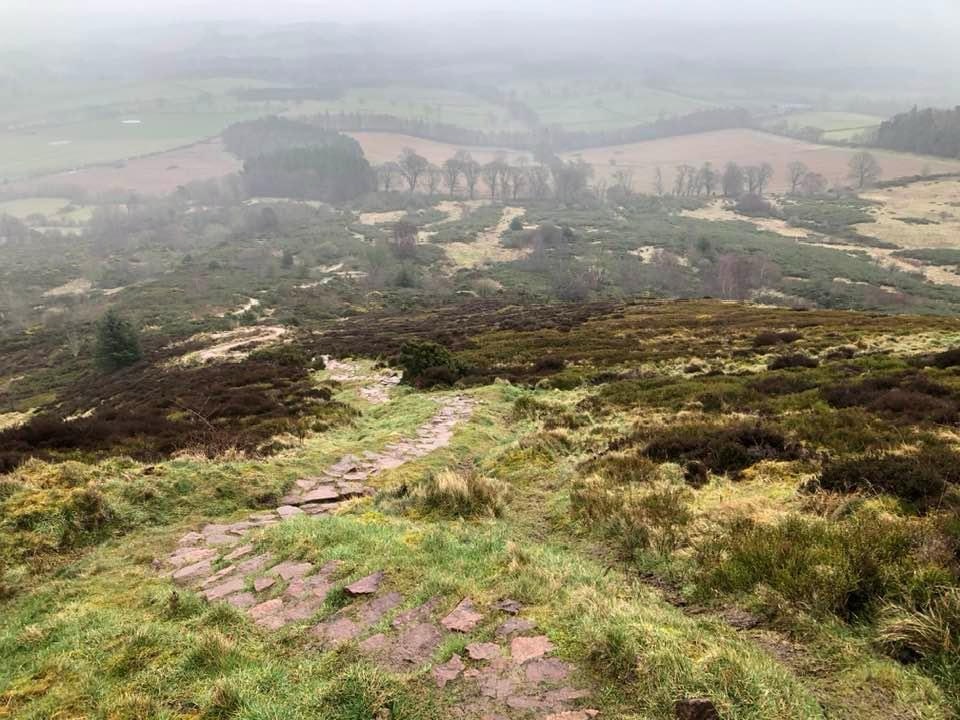
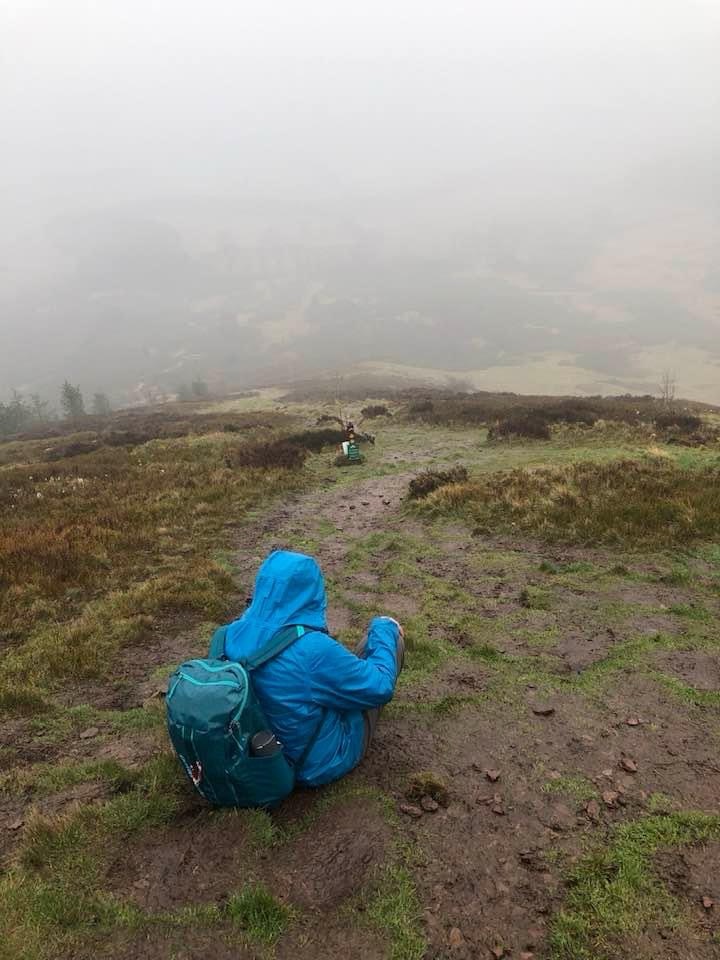
As we started our decent we discussed whether going uphill or downhill is the hardest. I said that for me downhill is definitely easier. That was not to be the case on that hill. The descent was precipitous. And it was extremely slippery. Very quickly my breath prayer became, “Oh, God, help me” and then just “Oh God…” The incline was so steep that with vertigo I did not feel stable enough to walk. Julie tried to hold my arm but that didn’t help. So she let me hang onto her sleeve and that gave me stability enough to ease one tiny footstep in front of another down the hill. Occasionally the trail seemed less steep and I felt capable of walking on my own so I let go. And then invariably fell on my rear. And each time I fell I could not get up on my own; my sister had to pull me up. I could not have made that walk alone and my sister was incredibly patient, encouraging, and positive. Sometimes I thought I saw the trail leveling out ahead. But no. It went on and on and on all the way down to a road at the bottom of the mountain.
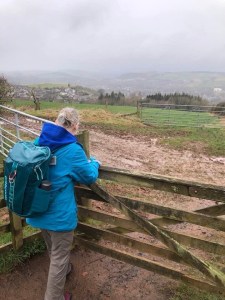
The road was paved but trafficless and there was a gorgeous horse ranch on both sides. The owner was out working so I asked him how far to St. Boswells. “2 1/2 miles that way,” he replied. He then pointed out that Melrose was the opposite way. I said that we had reservations in St. Boswells and asked if there was a way to call a taxi. He simply said no. So we walked a little ways up the road and sat on the curb. I had brought my old iPhone 5 and equipped it with a GB sim card at Heathrow Airport. Pulling it out I tried to book an Uber. They located us on “no name road” and said that no car was available. I truly did not believe that my rubbery legs could take another step but there was no other option than to try. And, phenomenally, as I started walking my legs felt stronger. And, we walked all the way to Buccleuch Arms Inn, St. Boswells. Our average walking speed for the day was one mph; the vast majority of that time was on the downhill stretch. The irony is that even though we walked the wrong trail and it was far more difficult, we still got to the desired location; and although we walked far longer in time, in distance we walked less than a mile extra. Throughly exhausted we checked into our room and I went straight to bed leaving Julie to dine alone that evening.
Symbolism
The pilgrimage, for me, was an allegory of my life. I will tell the story of each day’s trek and following each daily description I will share the particular symbolisms and their meanings as God has shown me for the events and places of that day.
- The trailhead in Melrose begins with my birth (1950) and early childhood Rushing water, bird song, lush forest all refer to beauty, joy, and peace. I am grateful to have had a beautiful childhood.
- The uphill trek, childhood, was beautiful but tiring and strenuous. I’m not sure why; I did not have a traumatic childhood in any way, but perhaps because because I felt that perfection was expected of me I became a people-pleaser and that was exhausting. My parents were very strict, and I perceived them as concerned about what others would think.
- The muddy spot and changing shoes refers to when I reached puberty. Self-consciousness and low self-esteem began during that time. I was well trained to be obedient—obey the rules, do whatever was required of me—rather than to make wise choices. Navigating my teenage years was difficult and confusing.
- The wrong turn at the trail sign happened when I was 19 and dating my husband. My parents invited his parents over for dinner. The next morning my mother informed me that he would be asking me to marry him and that I would say yes. Which he did and I did; I don’t remember that it even occurred to me that I could say no. I was frightened and I cried out for God to be with me; the two days before the wedding (1970) I lost five pounds from the stress, but I compliantly did as I was told. The correct signpost would have led to a much easier, happier life.
- The flat place where we stopped was the beginning of the marriage. The storm began there.
- The dizziness represents the sense of disorientation that hung over me for many years.
- The weakness and inability to stand up symbolizes the transition from controlling parents to a controlling husband. I became totally dependent, unable to make a decision on my own, to speak up for myself, to determine my own destiny. I thought that was the way it was supposed to be; I thought it was my wifely role.
- “The Lord is good; His love endures forever.” This is the beginning of God showing me that He was with me always. He was loving me in the midst of poor choices, in the pain and in the disillusionment. He would never leave me or forsake me. He has walked beside me through every single moment of my life.
- The walk up to the peak symbolizes the good parts of my married life. There were many. God’s Holy Spirit was carrying me along and there were abundant joys: three amazing children and all of their progeny are at the top of the list, I loved being a mother; playing and joking and laughing with them have been my greatest delights; fulfilling God’s call on my life even during the marriage, in spite of it all, has been incredible; there was truly abundant joy even in the midst of great sadness.
- The storm, dizziness, and disorientation at the peak transitions the allegory to the downhill trek which represents the hard parts of the marriage.
- My sister, Julie, is a symbol of the Holy Spirit in my story. On the peak she is standing at the beginning of the downhill trail, guiding me and waiting for me to come alongside her. The downhill trek was physically harder than anything I’ve ever done. It had to be in order to symbolize how hard my married life was. The trek was exhaustingly difficult to symbolize how incredibly hard my life was through those years. It seemed eternally long to symbolize all the years of the marriage. The vertigo symbolized thirty years of feeling disoriented and confused because of the years of gaslighting and mental abuse. I learned to never trust my opinions, to not fight because I was never allowed to win, to tolerate his excuses because he wasn’t going to change. In order to survive I suppose, I learned the art of self-deception so well that I didn’t even know I was deceived. Yet I was so weak that I couldn’t even pick myself up when I fell. Growing up it was emphasized to me that one should never speak of family things outside the home, and that one should never speak poorly of their husband especially to their mother. And for me divorce was never an option. Therefore in my mind I saw no options that would bring help or bring change to my circumstance. My sister, as I said above, symbolized the Holy Spirit’s presence with me. She was my guide, helper, comforter, and displayed the Fruit of the Spirit as she patiently, kindly, lovingly, humbly, gently, faithfully, and importantly joyfully (remember her mantra was “thank You” and “this is so beautiful”) picked me up and helped me along every step of the way.
- The moral of this allegory is that God has walked with me every single step of my life. He has rejoiced with me in the good and He has wept with me in the bad. He has never turned away, He has never forsaken me. He walked beside me when I could walk, and He carried me when I could not. Through it all He has cradled me in the palm of His huge, gentle, safe, loving hand. In St. Cuthbert’s day people often traveled the rivers in tiny boats called coracles. They are large enough for only one person and are shaped somewhat like a baby’s cradle. The palm of His great hand has been my ever protecting coracle as I’ve traveled the sometimes treacherous and often peaceful river of my life here on Earth.
- The paved road and my renewed strength I think must refer to my receiving the Baptism Holy Spirit (as in Acts 2). When that occurred in 1972 everything changed—the marriage wasn’t much different, but on the inside I had new strength and overflowing joy.
- St. Boswells symbolizes Cartagena, Colombia (1986-1991), and moving into missions work. Ministry and especially missions was my preordained destination. The road there took a bit longer and was much more difficult, but in the end God brought me around to the thing for which He had created me.
If this had been the end of the pilgrimage it would have been so worth it all because of all He showed me. But! There are still seven days more!

 Coffee, Tea, and Reverie