The virgin’s scream pierced the darkness
and startled restless livestock.
The curse of Eve had traveled history
to even the stable in Bethlehem.
The newborn cried to clear his lungs
and gasped His first of earthly air.
His damp body shivered in unfamiliar breeze;
she wrapped him tightly, held him to breast.
He suckled, hungrily seeking comfort
in that strange, dark stable;
the human nourishment soothed an unfamiliar gnaw
in the belly of He Who is the Bread of Life.

The baby caught her loving gaze
and feeling safe and warm he cooed.
Across the stable a roosting dove cooed
in harmonious melody with its Creator.
Joseph shuffled and rustled and cleaned the manger,
lined it with the earthy scent of straw
to make a bed for the baby Savior.
And the sheep bleated and the cattle mooed,
their sleep disturbed by the unexpected,
when the Son of God become the Son of Man.

How did it feel to leave your glorious home,
and the loving embrace of your Father,
to shiver in the dark and the cold and the dirt,
embraced by a dust-formed mortal?
How did it feel to leave your heavenly home,
angelic host singing your praise,
to sleep on a bed made of animal’s feed,
dove, cow, and lamb singing praise?

Yet you came and You loved
and you served and you gave;
you suffered as frail earthly man
walking Earth as in an alien land.
How did it feel to suffer rejection
and quietly give your life in our stead?

But death, hell, and the tomb
had no hold on perfection.
Evil trembled in defeat as
holiness pierced the darkness.


How did it feel to crush the serpent under your feet?
How did it feel to set your children free for eternity?
Maoist Banda, Gurkha Khurkuri, and the Monkey Temple
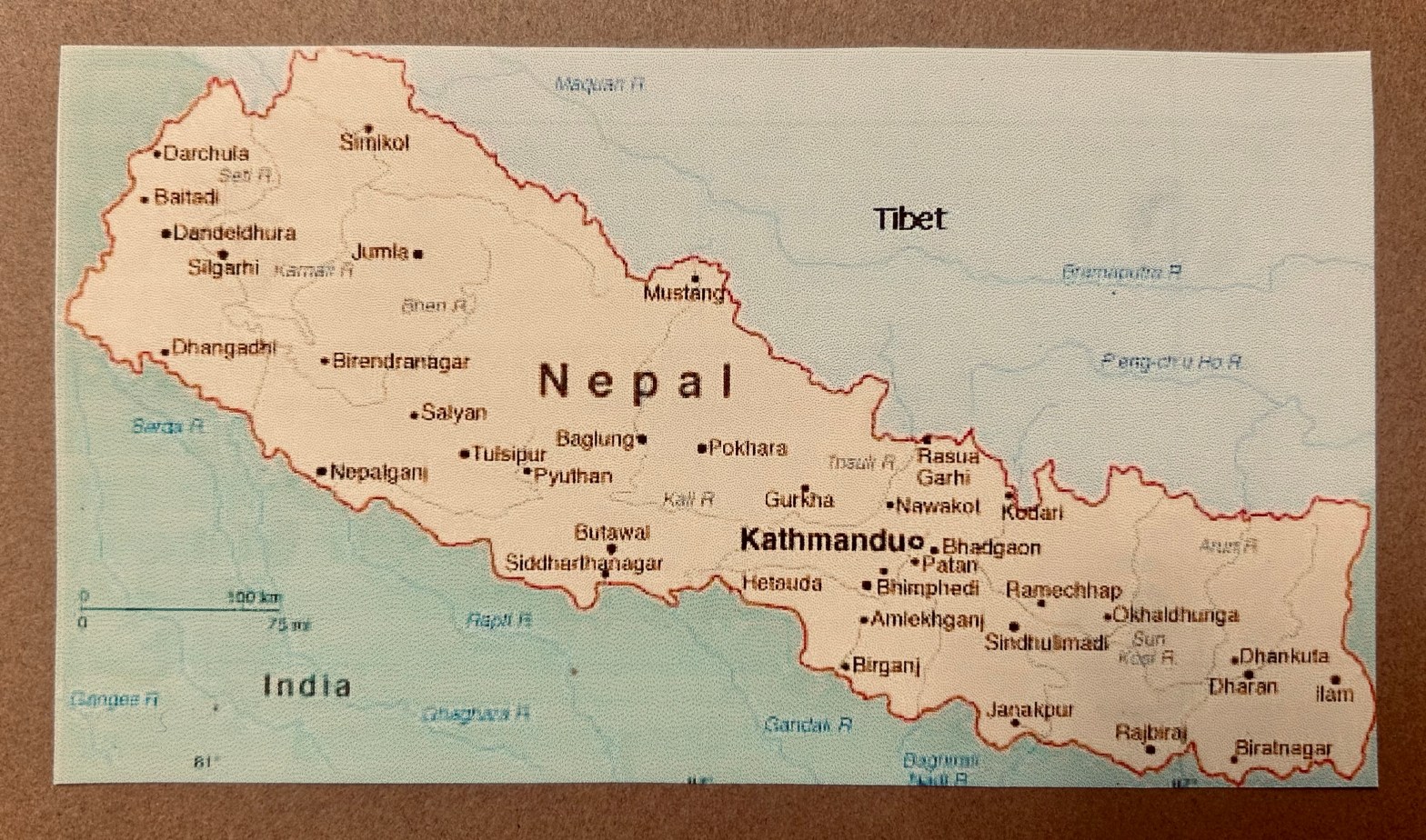
Our final days in Nepal would involve many hours in Robby’s SUV crisscrossing the Himalayan Kingdom and would bring many more adventures packed into a tiny timeframe. But Thursday would be more relaxed as we spent the day exploring the town and her many kiosks and small shops full of so many trinkets, from strings of beautiful glass beads for crafters to brightly colored fabrics and elephants carved from sandalwood and soapstone. We were separated from India by only the Mechi River, and in the afternoon we crossed on foot the nearly 2000-foot long bridge as far into India as the Indian immigration post. From there we prayed for India. I was amazed to, for a few minutes, plant my feet on the soil of that exotic nation. Little did I imagine that in just a few years I would cross that bridge again but from the Indian side.
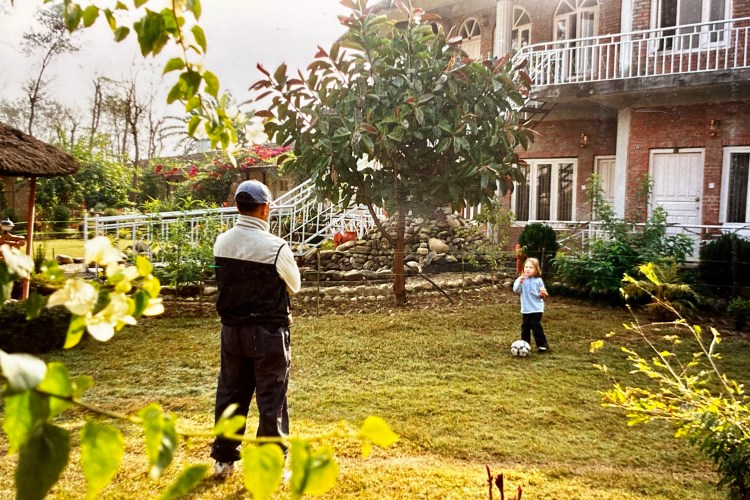
Robby and Abbie playing soccer
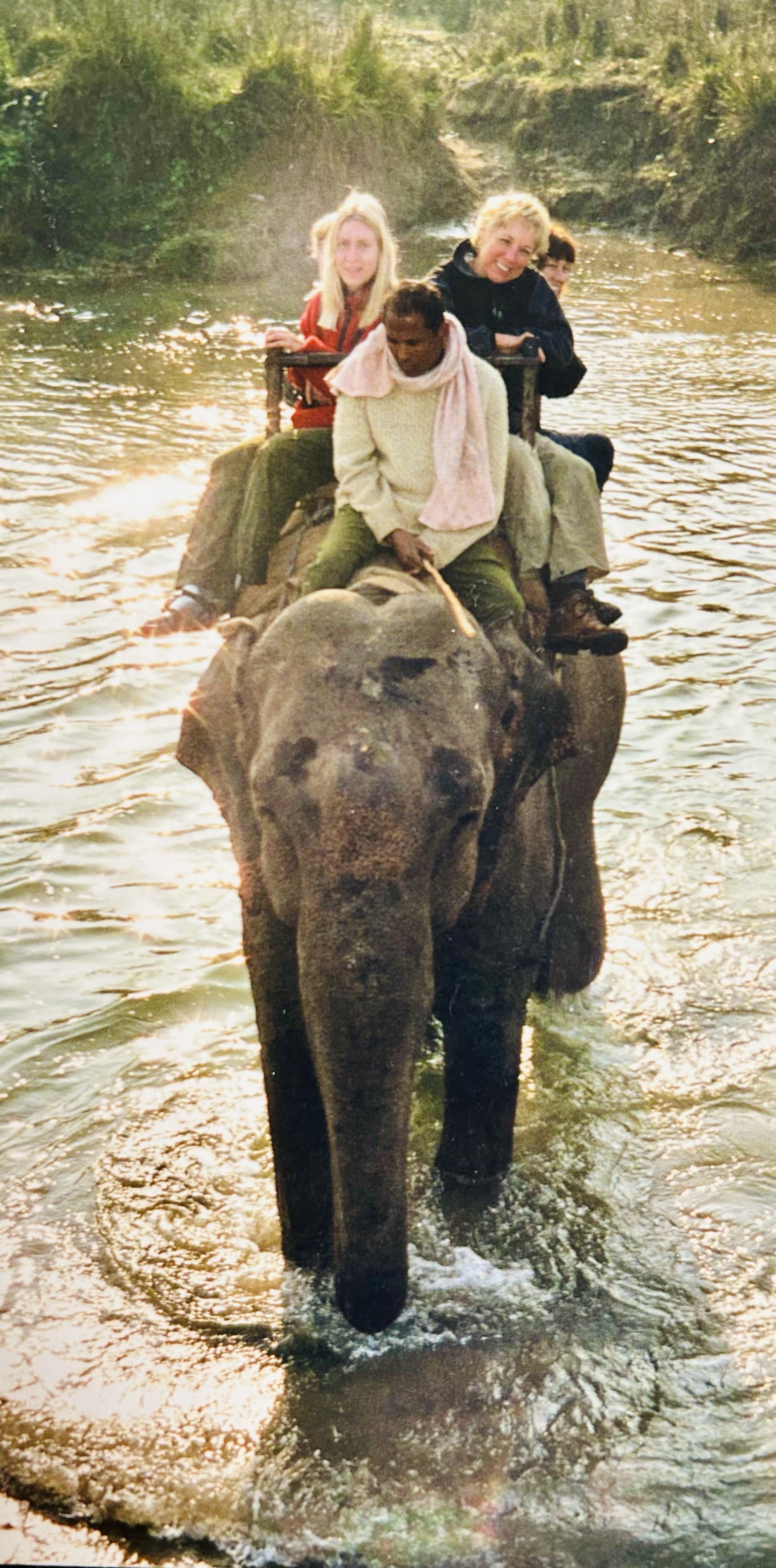
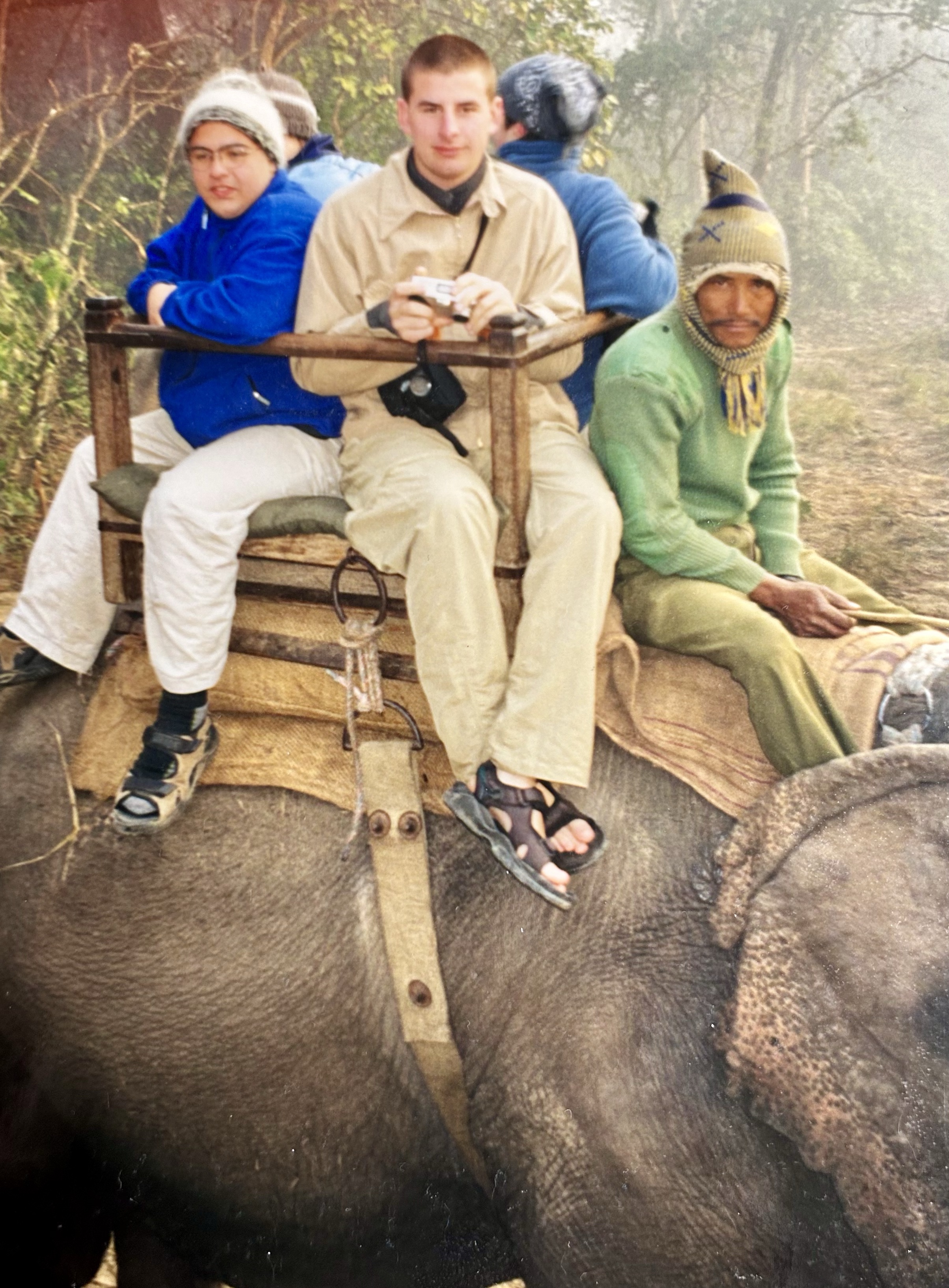
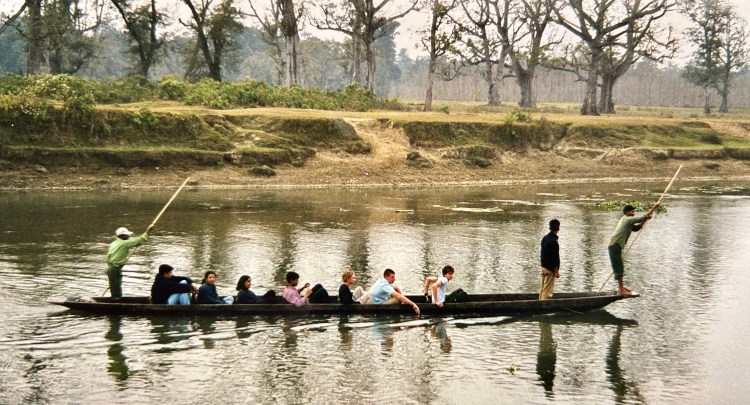
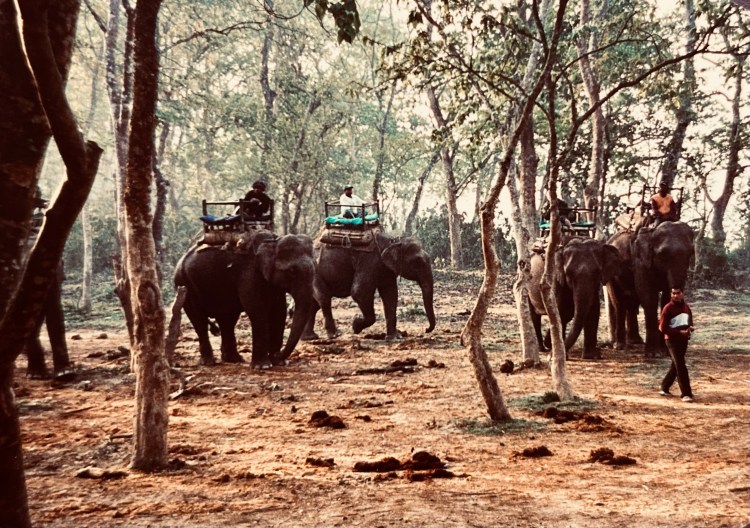
Friday was spent in the car heading southwest to Chitwan National Park, a second visit for me to the jungle region. In the evening we found lodging at a lovely resort with a huge dining area where we were provided bounteous, delicious meals of curried chicken and vegetables and the ever present dal bhat. My second elephant safari greeted us early morning. Thankfully this ride was only an hour and not as exhausting as my previous two-hour adventure had been. Canoe rides on the river provided gharial crocodile viewings. Then after visiting the elephant breeding center we revisited Pastor S and his family. We were pleased to find them and their churches doing well. Once again they hospitably served us tea and biscuits (cookies) as we chatted. After we had prayed for them and their work in the Chitwan area, Pastor S surprised us with gifts to carry home to each of the four churches in Alaska represented by our team.
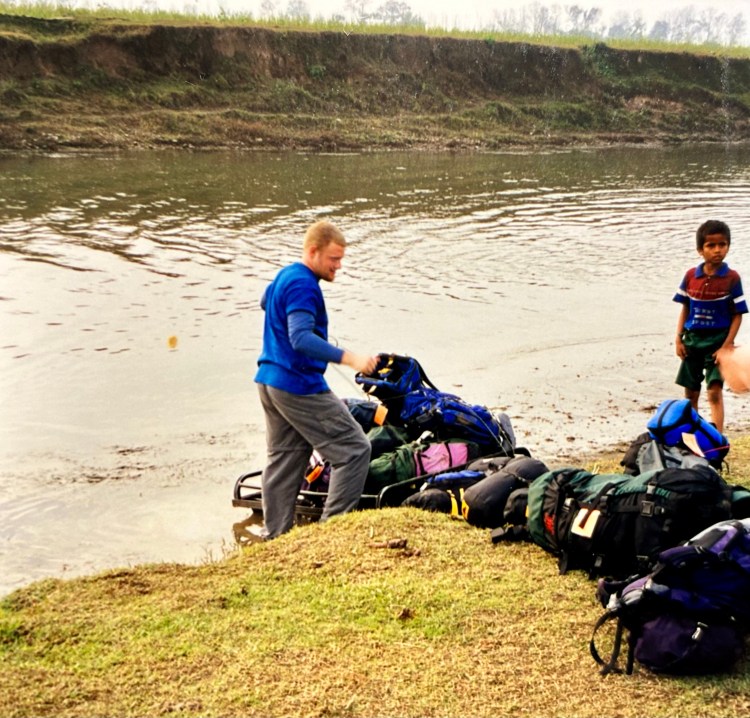
Sometimes when your SUV is fording a river the luggage slides off the rack.
New Year’s Eve fell on a Sunday and we set out early for the drive to Pokhara, the town from which my treks had originated on my first adventure in Nepal. Our first assignment there was to pray over a new property which in a few months would house a new Bible school for training pastors in that region. The plan was to stay in Pokhara for two nights to visit Gurung villages in the area. But then news came that the Maoist Party had declared a two-day banda. Banda is translated in English as a general strike however the word means closed. Closed is, in my opinion, the more appropriate usage because for two days the kingdom would be completely shut down—shops, services, even driving a car is prohibited during a banda. (The conflict had begun in 1996 when the Maoists initiated an armed insurgency to overthrow the monarchy, capture State power, and form Nepal into a people’s republic. The conflict lasted until a Comprehensive Peace Accord was signed on November 21, 2006, giving the Maoist Party a role in the Nepalese government.) As Kathmandu would be a safer place for us to ride out the banda we headed back in order to be there before morning when the strike would begin and arrived at Student Guest House at midnight.
Kathmandu awoke to a very quiet New Year’s Day in a city that is normally inundated with a cacophony of honking horns, unmuffled engines, and the calls of street vendors. Anything we did for these two days would have to be within walking distance, so we spent time sipping tea and dining in the many fun cafes as well as exploring a plethora of shops—trinkets for tourists, art shops filled with stunning paintings of the Himalayas, cashmere and pashmina shops galore, and..khukuri knife shops. All made for wonderful browsing and gift shopping for friends and family back home. The authentic (there were, of course, the knock-off shops) khukuri shops were fascinating to browse as the shopkeepers educated us by recounting exotic tales. The khukuri is a hand crafted, Nepalese Gurkha knife. Their forged steel blades are razor sharp and heavy, and with wooden or bone handles they are incredibly beautiful. During our times of relaxing and chatting our Nepali friends told us about the Gurkhas. The Nepalese soldiers serve their country’s military but some also form a unique unit in the British Army. They are among the finest and most feared soldiers in the world. A famous saying is, “If a man says he is not afraid of dying, he is either lying or is a Gurkha.” The Gurkha motto is “Kaphar hunnu bhanda marnu ramro—It is better to die that to live like a coward.” We were told that when a new Gurkha is sent to battle he is sent off with no weapon. He will only acquire a weapon by killing the enemy with his bare hands and taking their weapon as his own. We also learned that Nepal’s fight for independence from India had instigated a military strategy to move the country’s time fifteen minutes forward, a change that remains to this day. When one is traveling it is usually much easier to find gifts for female friends and relatives. In Kathmandu that is not the case. The khukuri knives I brought home to my male relatives were probably the most appreciated gifts I have ever given.
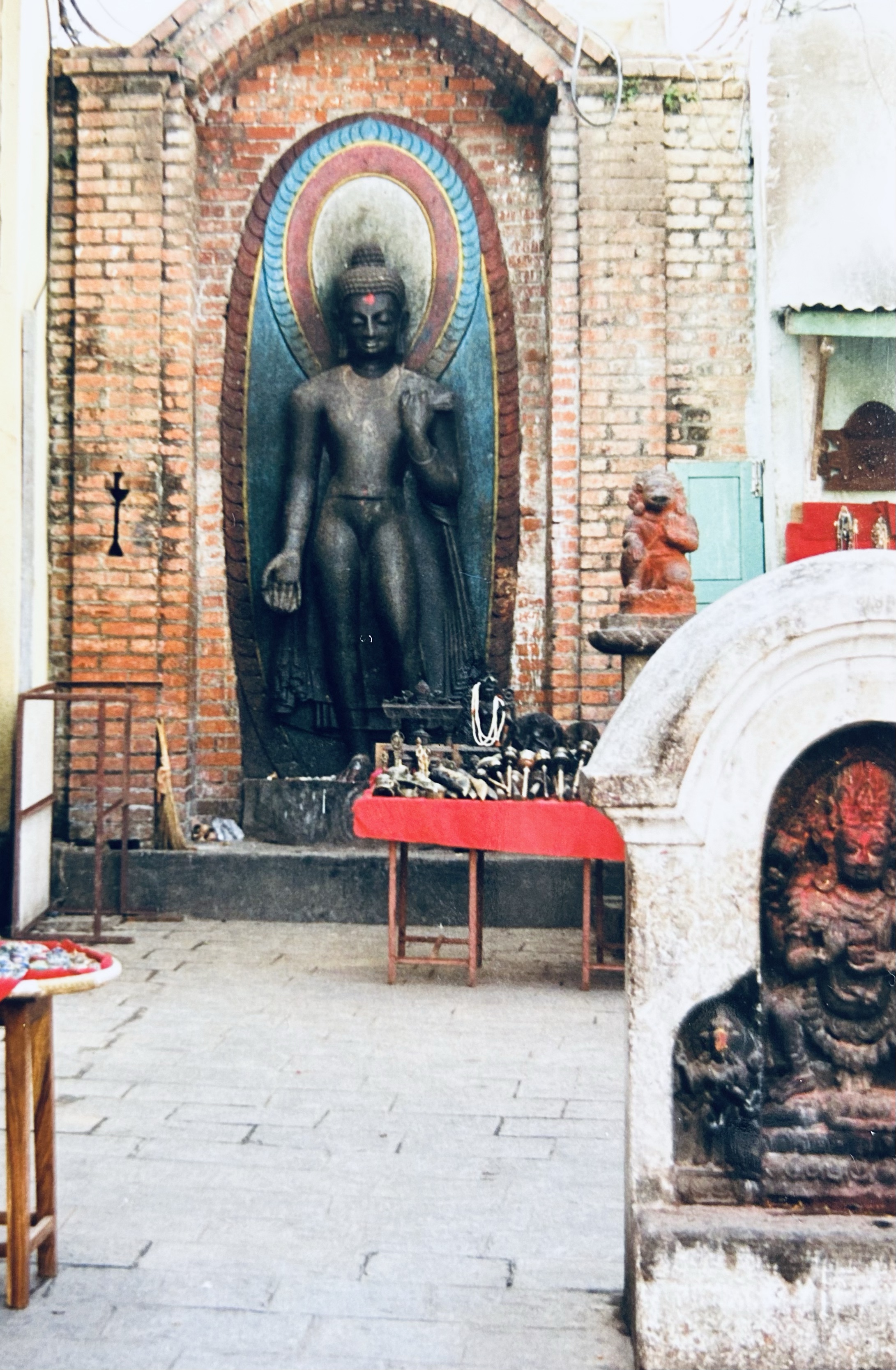
offering to the smallpox goddess
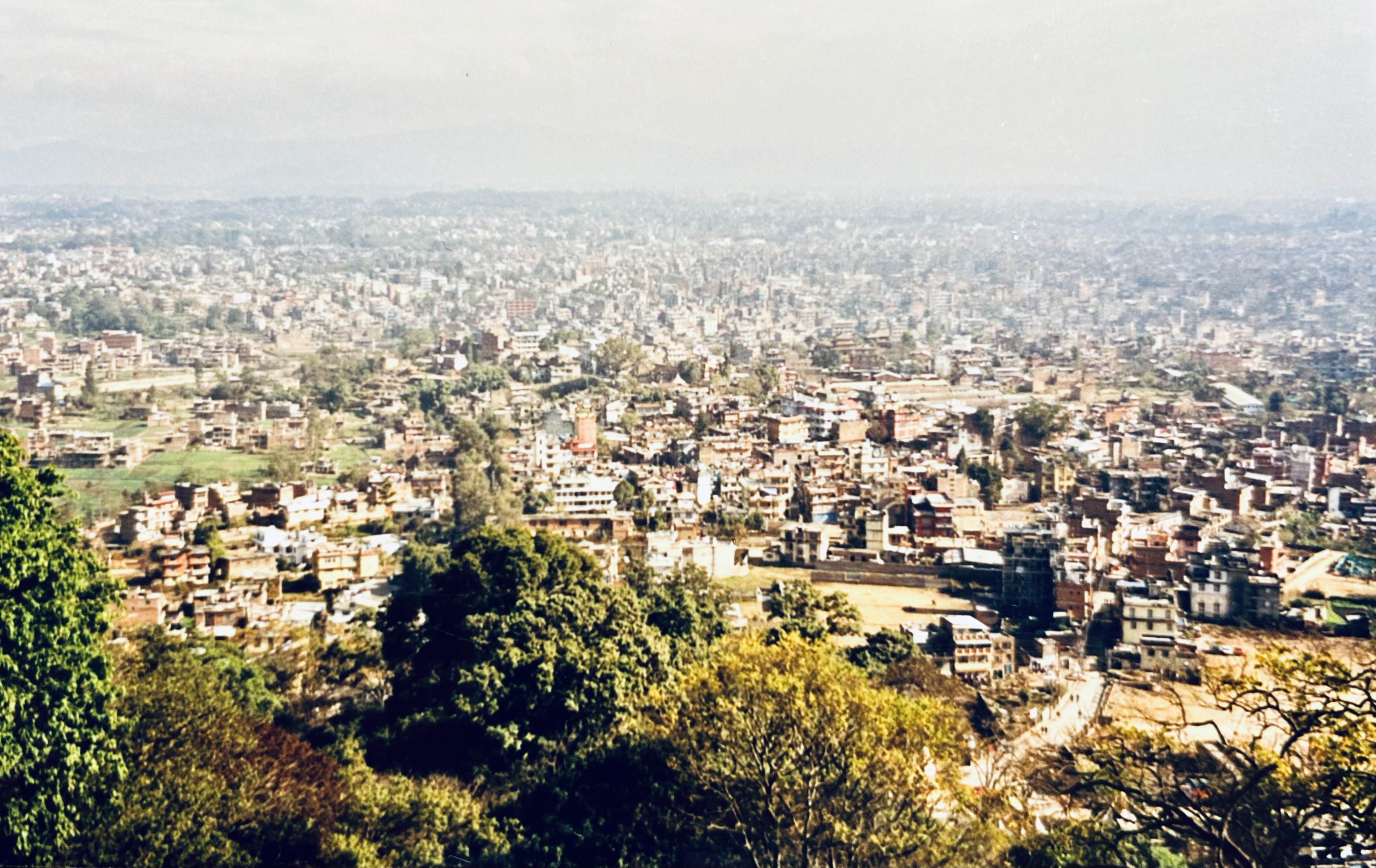
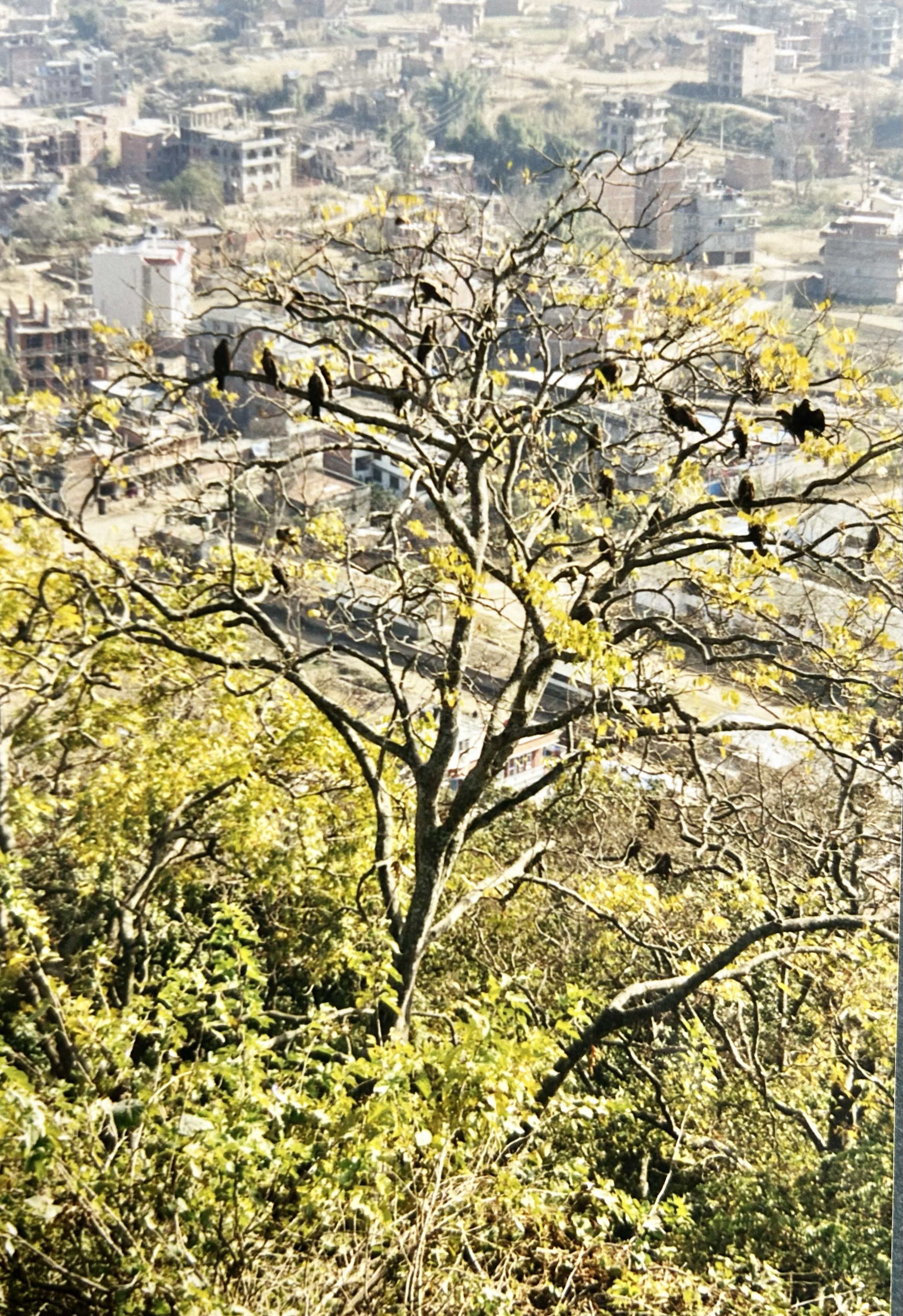
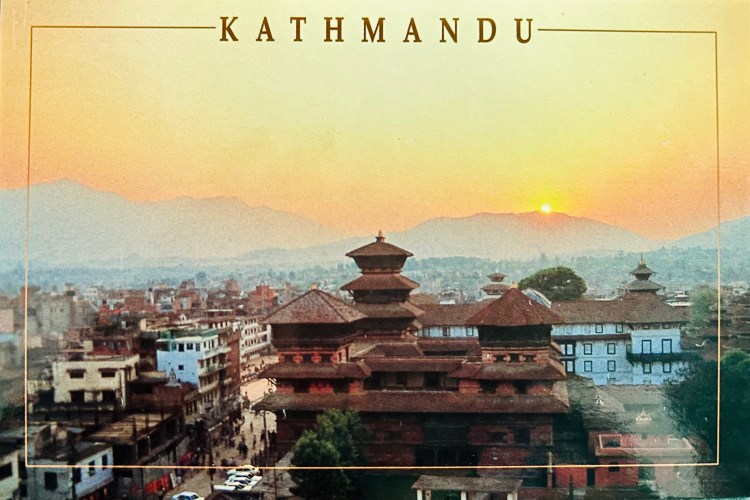
the city of Kathmandu as seen from the Monkey Temple
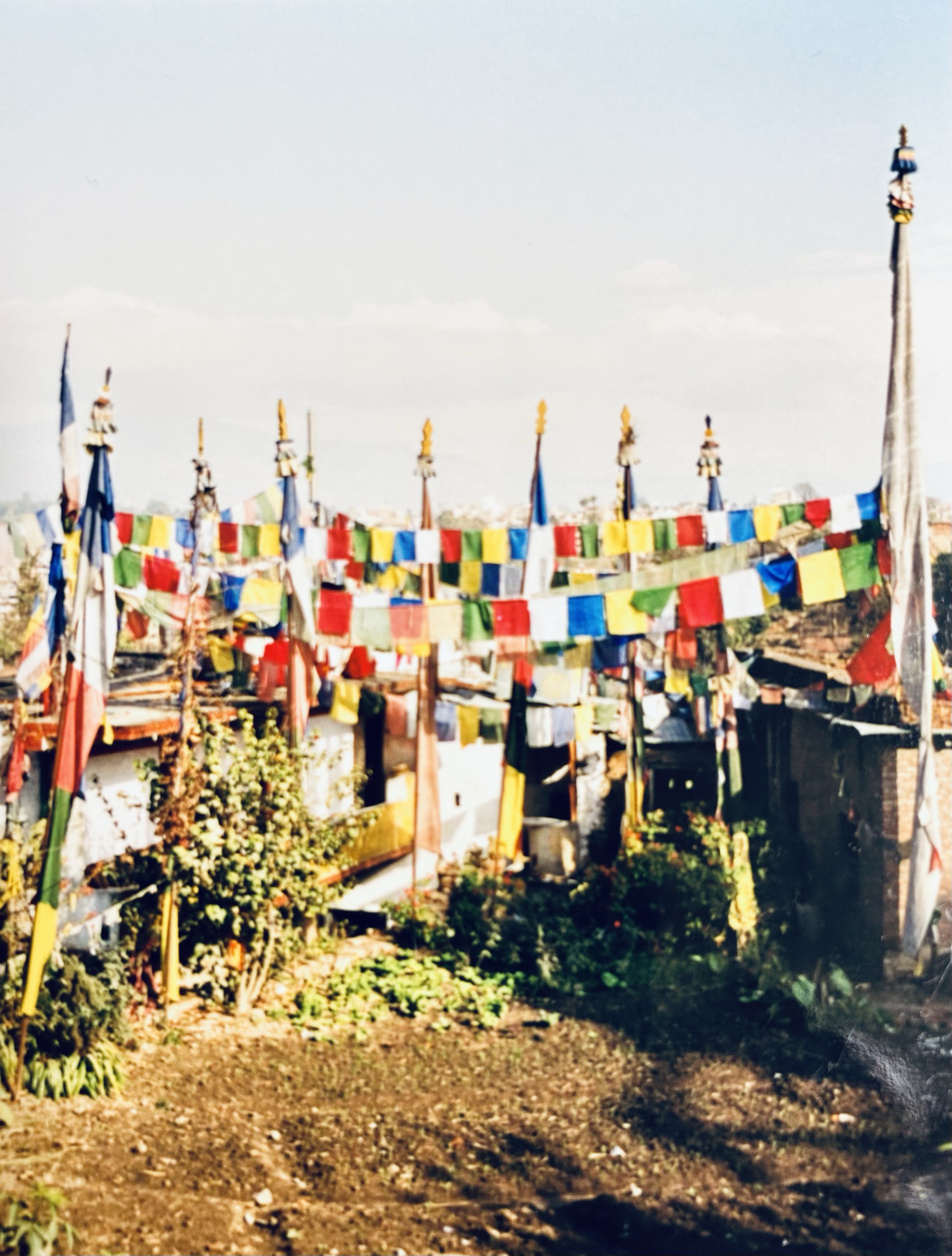
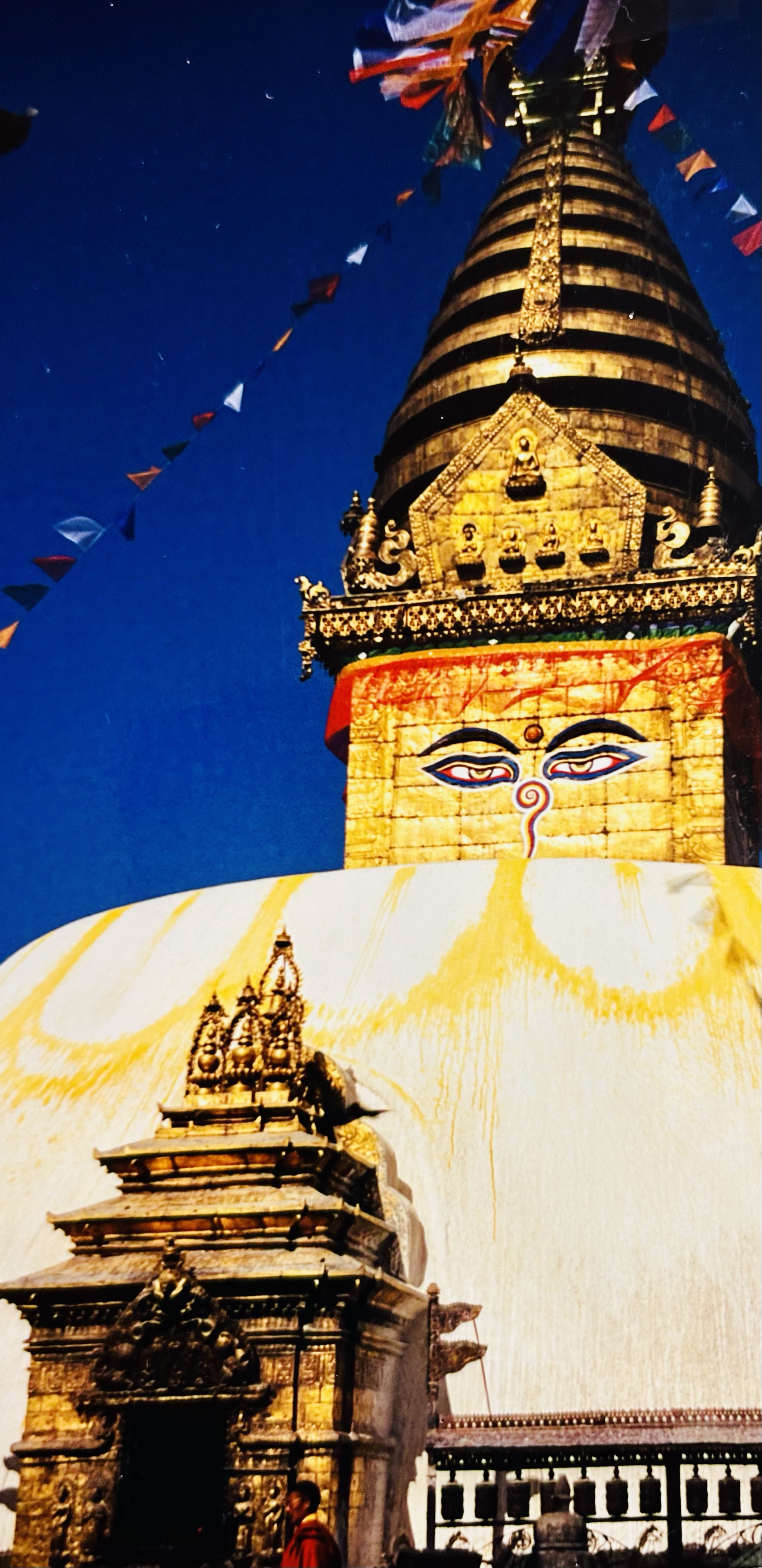
Later that afternoon we trekked to Swoyambhu Mahachaitya, the Monkey Temple, to prayer walk. Swoyambhu is on a hill in the city and from the base to the temple itself there are 328 steps; I know because I counted every single step. Somewhere I read that it is called the monkey temple because when a Buddhist deity visited, his head lice fell to the ground and turned into monkeys. (Monkeys are considered holy to Tibetan Buddhists and to Hindus.) Allegedly it is those head lice turned monkeys’ descendants that currently populate the temple area. The primates aren’t vicious but one must take care because many have been trained to steal the bags of temple visitors. Inside the temple area is a Hindu shrine to the goddess who is credited with stoping a smallpox epidemic. As we stood and watched a Hindu priest burning incense and making sacrifices before the idol, I thought how strange to have a Hindu shrine to a Hindu goddess inside a Buddhist temple complex. I have since learned that it is not that unusual; the two religions sometimes intermix since Buddhism proceeded from Hinduism. When several of us had finished praying we gathered into a group and waited for the others. A monk came over and stood by us chanting loudly. When we realized that he was chanting over us Levi tried to get him to leave but he would not budge. So we began singing worship choruses however the monk did not stop chanting until we left.
The first day of 2001 as well as the first day of the banda, though impromptu, was a full and incredible day. That night however Abbie was very sick, vomiting with 104 degree (40 C) fever. We prayed for her as we went to bed that night and fell asleep wondering what day two of the banda would hold.
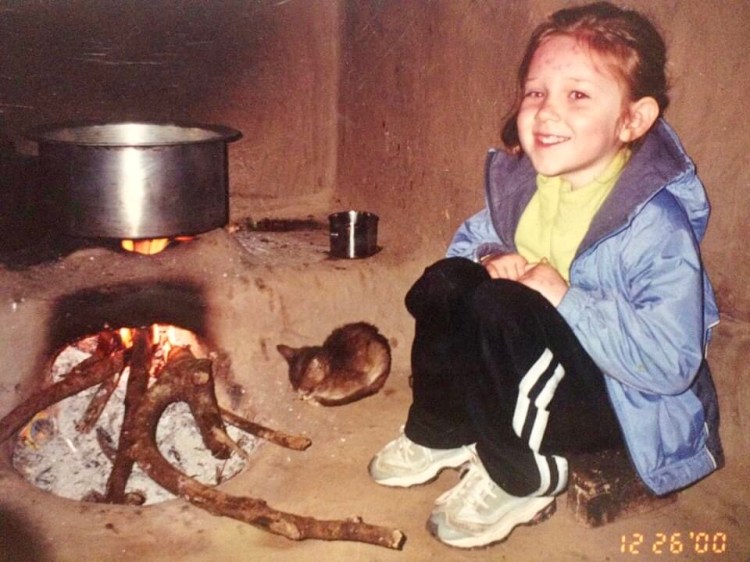
Abbie and a kitty warming by the stove as a pot of morning tea boils. If you look closely you can see the bed bug bites on her face from the guest house in Damak.
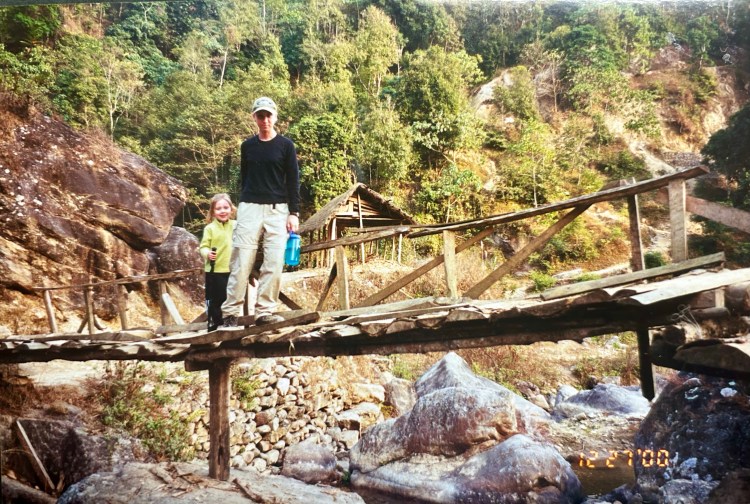
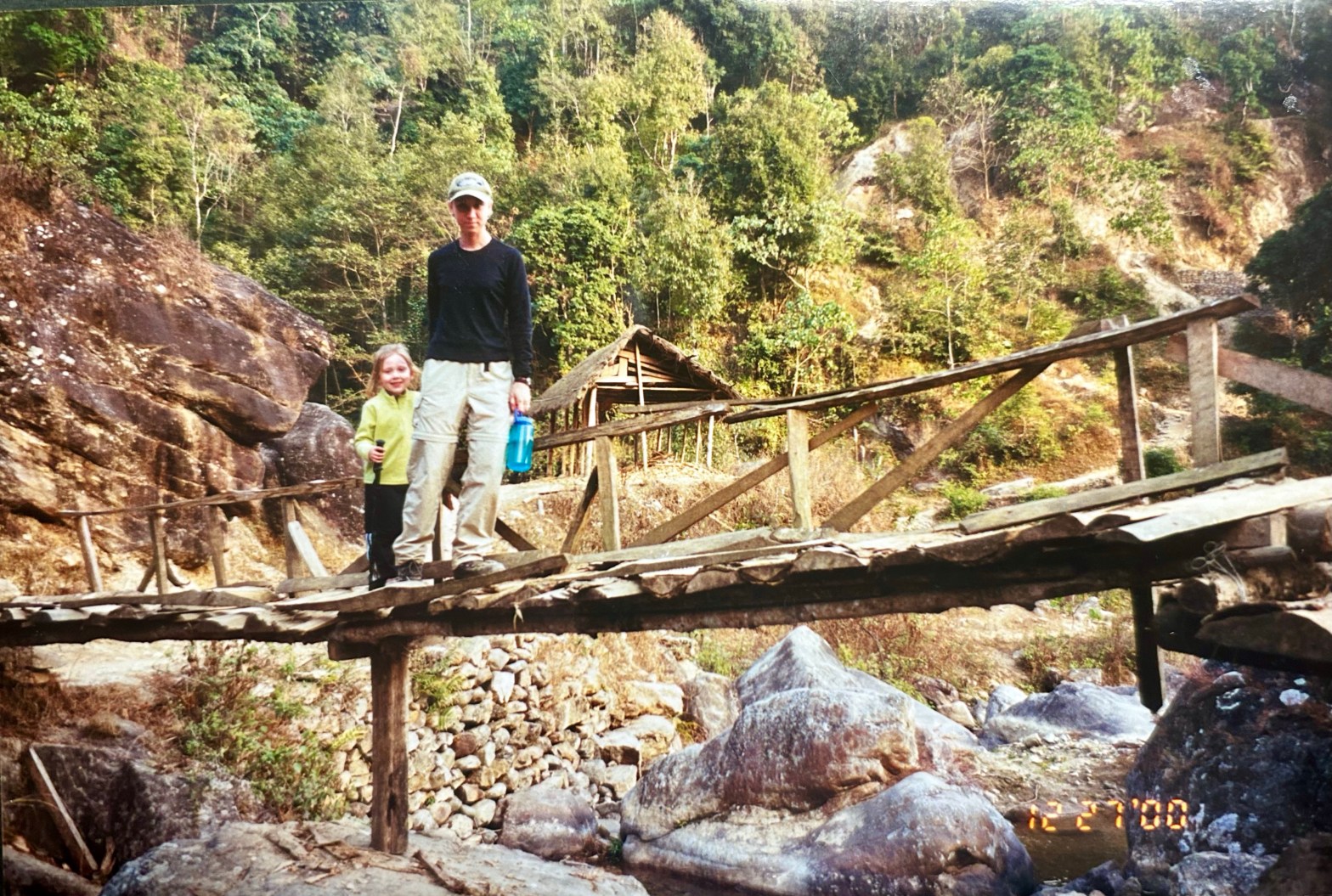
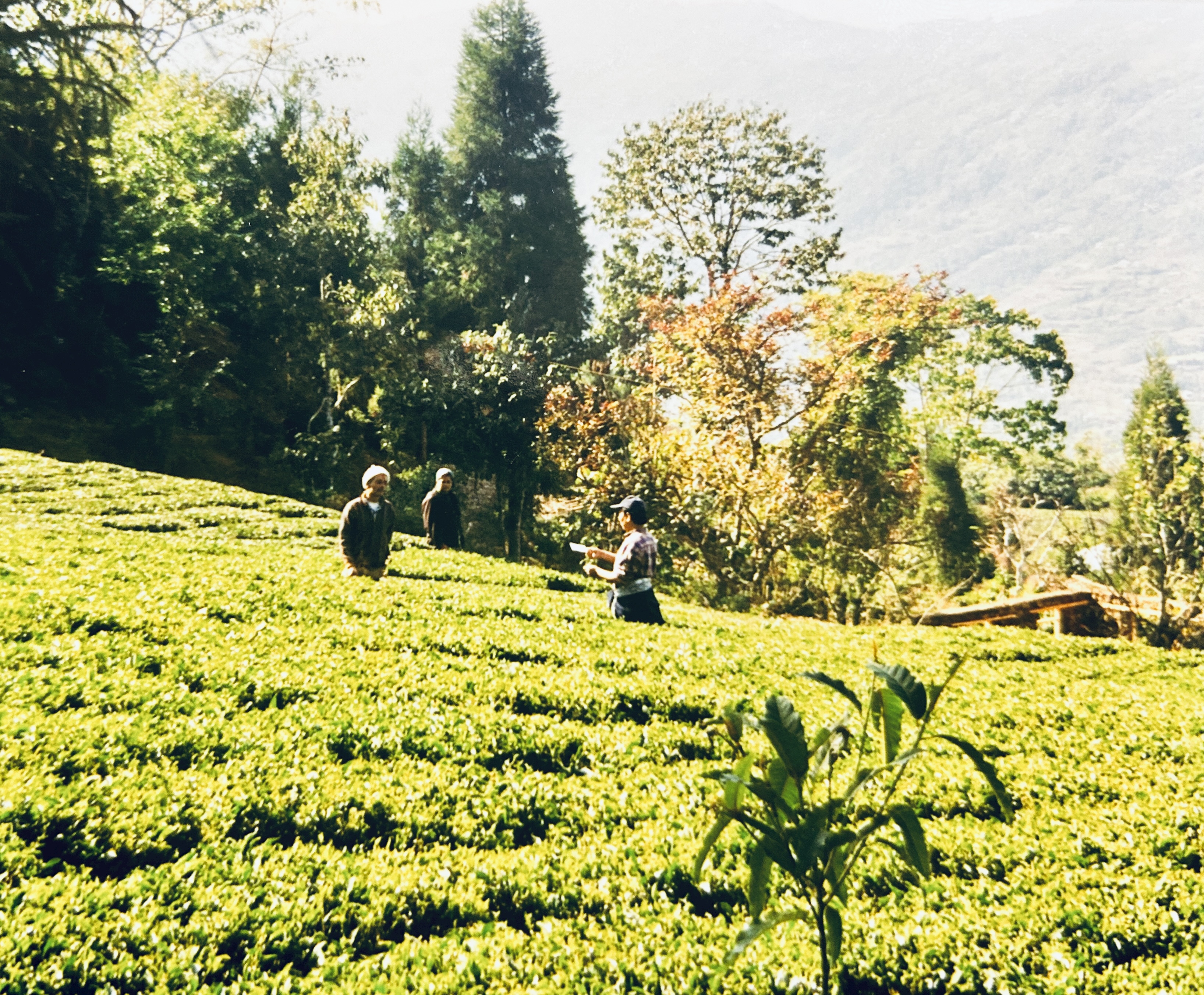
December 27 dawned chilly on the hillside, and we warmed ourselves around a fire and sipped steaming cups of Ilam tea while breakfast was prepared. After eating, the joint Nepali and American team hiked up to the mountaintop where we would be able to overlook the border with India.
Along the way we prayed over the land on which we placed our feet. We came upon an animistic shrine enclosed in a black metal, picket-like fence with a gate, bringing to mind an English garden. Upon opening the gate and going inside to pray against darkness we encountered six tridents of differing sizes, various rocks, sticks, and other symbolic religious articles including incense as well as two Shiva lingam idols. Inscribed on the rocks were “Shiva” and “the lion is king”. When asked what the tridents represented Robby, our leader, said they refer to Shiva, one of the gods of the Hindu triad.
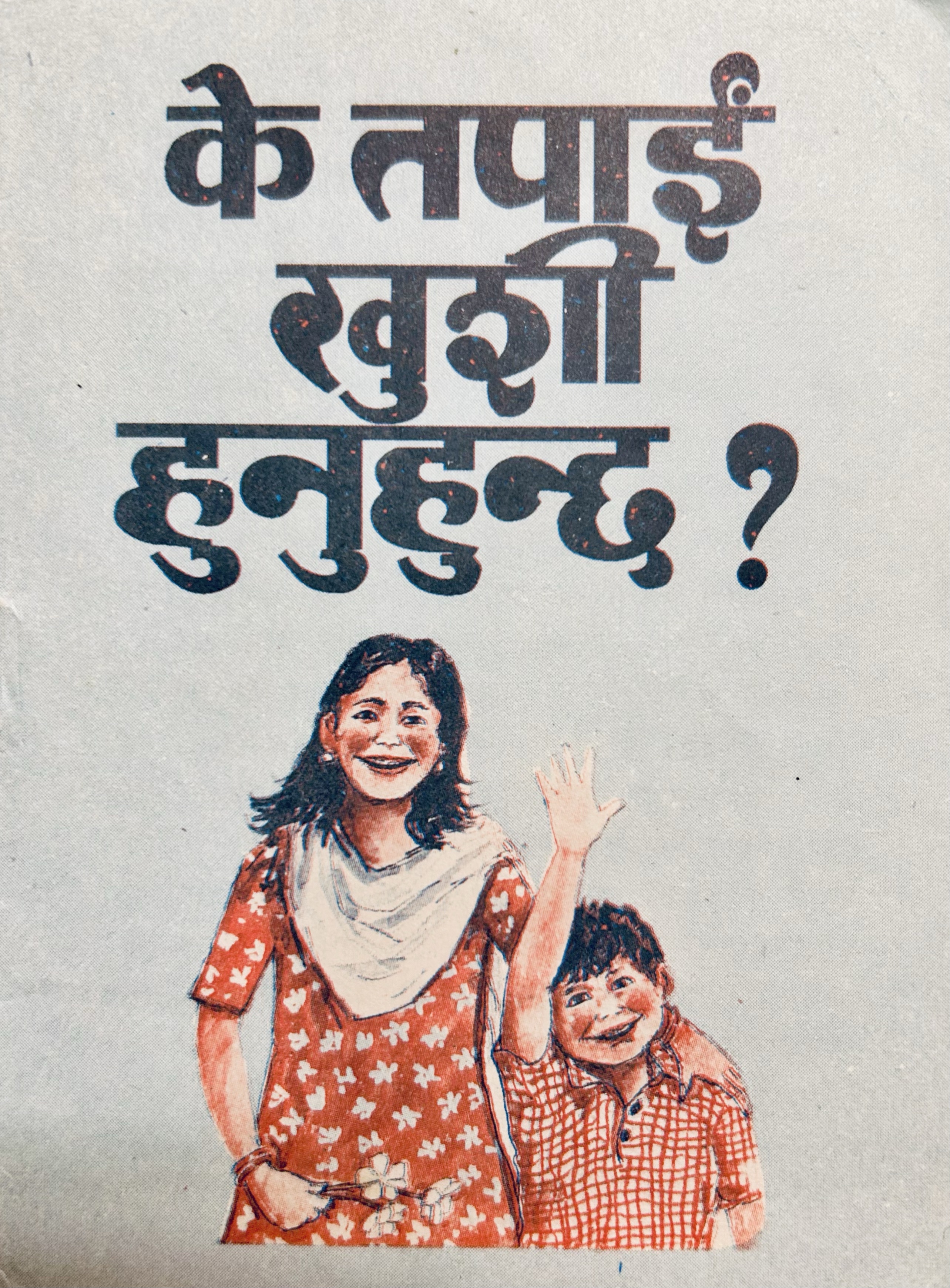
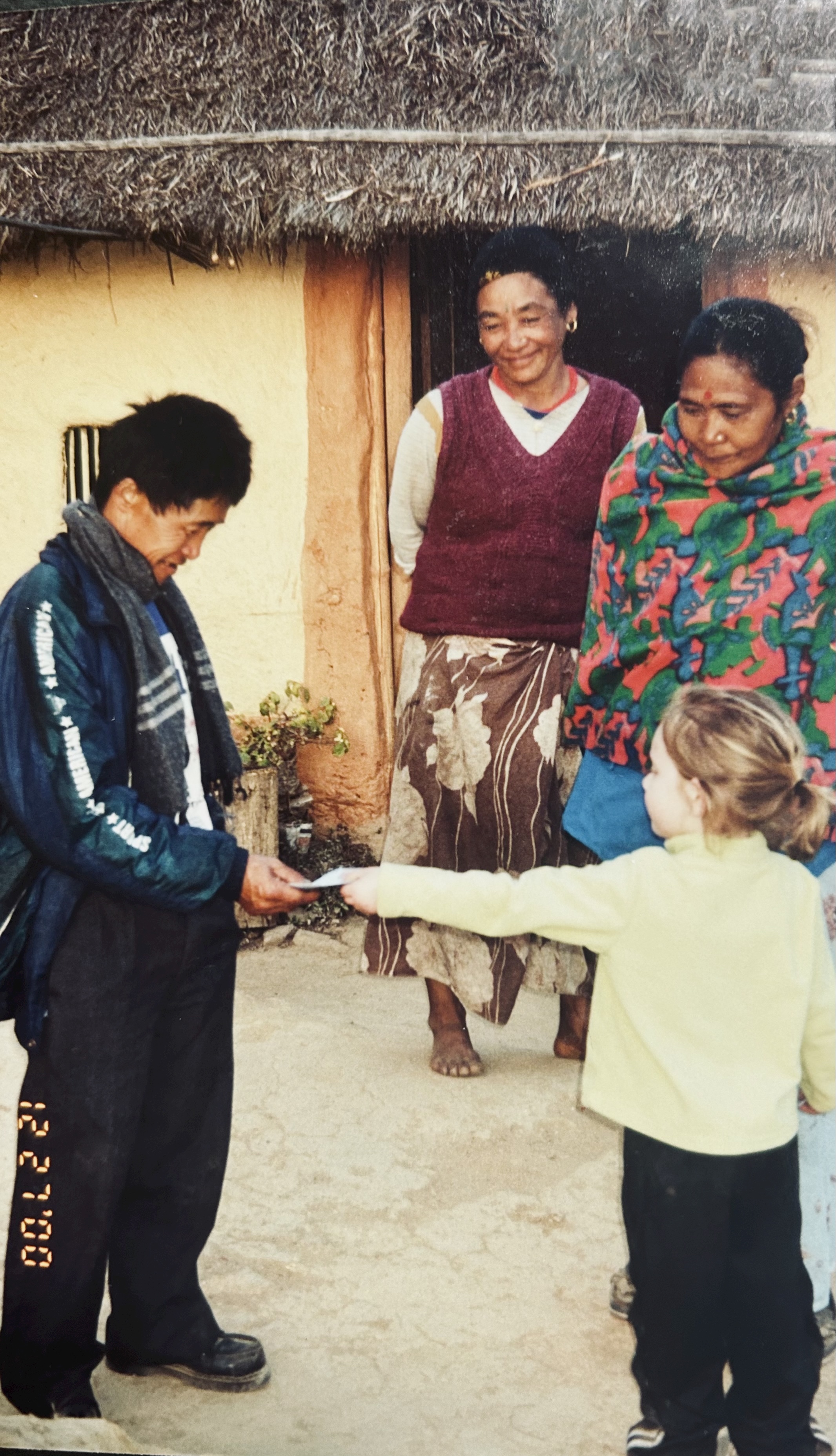
As we continued towards the peak we talked with the tea farmers and their families that we met along the way, sharing with them Jesus and pamphlets. There was not much receptivity to our message. We stopped by a school and talked with the teachers but they also were not open.
Upon reaching the top, prayers were sent out over the valley. We spoke against animism, shamanism, affliction, and deception. We discerned that affliction was holding the people in bondage to shamanism as there were no doctors in the area. While we prayed Emma saw black, smokey forms moving across the sky like a herd of demons returning to their home in the Himalayas. She then prayed against alcoholism and adultery. On the walk back to the house we stopped and talked with a man I had encountered earlier. He was Buddhist and appeared to me to be a shaman but he listened with interest to what we had to say.
Back at the house we enjoyed lunch and from there we ladies along with a couple Nepali men (Most of the guys stayed for another night.) trekked back down to the road and from there traveled to a border town with India where we found a lovely guest house. It was built of wood and quite cozy. The wooden staircase to the second floor where we would sleep was .. disconcerting. In South Asia very often stair steps are not uniform. These steps’ risers were each of varying height and the tread shorter than my boots were long, so going down I had to turn my feet a bit to the side to keep from losing balance.
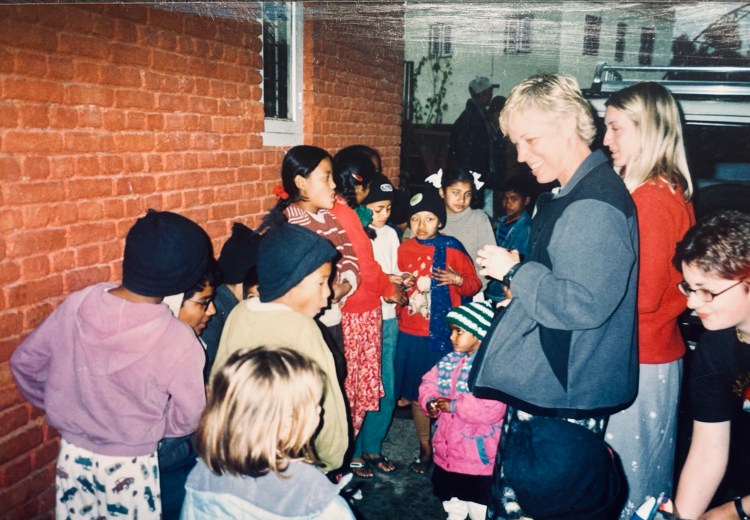
Singing and playing with the local kids at the Nepal-India border
I was super excited to have a proper bathroom but thrilled to get a hot shower. Emma and I were sharing a room and she allowed me the first shower. I relished every second under the hot running water but noticed that the wet and soapy tile floor was extremely slippery. Forcing myself to not linger so there would be hot water for everyone I hurriedly dried off, noting to myself that I needed to warn Emma to be careful. But there was some distraction and I forgot until she was already showering. And then my heart stopped when I heard the horrific boom. I ran to the door shouting, “Miss Emma, are you all right?” No answer. I banged on the wooded door screaming, “Miss Emma, Miss Emma,” but still not a word from the other side. So I turned the knob and peeked inside and to my horror she was lying on her back with her head just below the ceramic toilet. (In South Asia most bathrooms are wet rooms with no partitions around the shower.) I grabbed a towel and threw it over her and ascertained that she was not conscious. Running down the hallway for help I could only think, “what can we do, there is no 911, what if she dies”?! I was mortified. I found Katie and we ran back finding her still unconscious, but thankfully she woke up in a few minutes. Emma had slipped on the wet tile floor and her head walloped the ceramic commode in the exact place of her earlier concussion in the car just a few days before. It was also her second or third fall on this trip. She was under such attack and clearly that prayer warrior was shaking the spiritual powers of the air and they wanted to take her out.
Thankfully God kept her safe. And thankfully our intercessors back home were working hard. Two of our intercessors were Wanda and Nitza (who is now with Jesus but while here on Earth was a powerful woman of prayer). When I returned home they both gave me notes of their daily times of intercession. I am including just a few entries from their journals.
“ – He is filling you with divine compassion for the lost and he wants you to have full confidence in him and draw near to him that you might receive full joy because of his strength.
– His word says that you are preparing the way for all hindrances to be removed so that you might go in and possess the land for him.
– All hindrances are removed in the name of Jesus and he is in the process of purifying you. Also HE HAS CALLED YOU OUT for his service.
– Very intense pain in arms, back, neck, headache to the point of numbness yet still intense pain. Heard not only spiritual growth but victories and healing. He has chosen you once again. As I was praying got stopped by intense need for Abbie, directly (for God) to place ministering, protecting, and guardian angels around her. To come to her aide and to also assist her in how the Lord is wanting to use her to win souls.
– Still intense pain but hearing obedience is better than sacrifice. He is saying you have obeyed and he will be faithful.
– Pray for protection and health and heard once again to place those ministering angels for spiritual victories, knowledge, and salvation. Truly believe that you are covered with the blood and he is just reinforcing the need to keep you held up so your shield and armor are on.
– Intense pain calling me to cry out for his protection and provision.
– Felt like someone might have let down their armor and the Lord was just reminding me to pray for your protection to put on the whole armor. Still having intense pain in back, legs, arms, hands.
– Psalm 91:11-16 — He that dwells in the secret place of the most High shall abide under the shadow of the Almighty. For he shall give his angels charge over thee, to keep thee in all thy ways. They shall bear thee up in their hands lest thou dash thy foot against a stone. Thou shalt tread upon the lion and adder, the young lion and the dragon shalt thou trample under foot. Because he hath set his love upon me, therefore, will I deliver him: I will set him on high, because he hath known my name. He shall call upon me and I will answer him. I will be with him in trouble. I will deliver him and honor him with long life will I satisfy him and show him my salvation.”
Some might think that intercession is the easy part of missions, almost like a copout. They are wrong. Intercession is hard work. Just as we in Nepal were feeling the attack of the enemy trying to prevent what God intended to do, the other part of our team praying from the other side of the globe in Alaska was undergoing similar retaliation in an attempt to hinder their prayer. I, for one, am extremely grateful that those ladies stood firm. Perhaps Emma survived and was able to return to minister in Nepal a few months later because of the faithful intercession of our friends back home. If you are an intercessor please know that you are an essential part of accomplishing the will of God on this Earth.
The day after Christmas began very early for our team and with the dawn came some wonderful surprises. Daniel G (the Lion Tamer), who had stayed behind in Kathmandu because his family was ill, had arrived in the predawn hours. And, I discovered that not only had Leona sent a birthday cake for Robby but there was one for me as well. And so, before breakfast the morning following Robby’s celebration of his fiftieth birthday, I celebrated my fiftieth birthday with marvelous friends and chocolate cake transported all the way from Kathmandu. I was truly surprised and felt wonderfully blessed. What an amazing birthday it was!
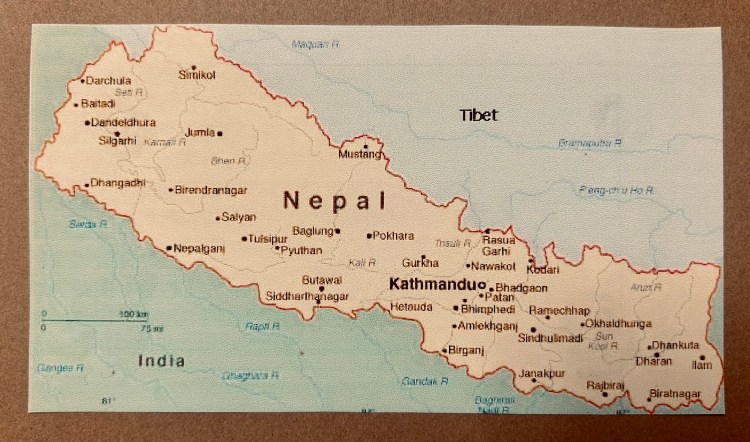
At eight am, after breakfast and Nepali milk tea, the Nepali team and American guys headed northeast from Damak to Ilam tea gardens bordered on the east by Darjeeling, India, also known for tea production. The 79 kilometers (49 miles) is a two-hour drive. Mr. G, the driver, returned for us ladies and Robby at noon.
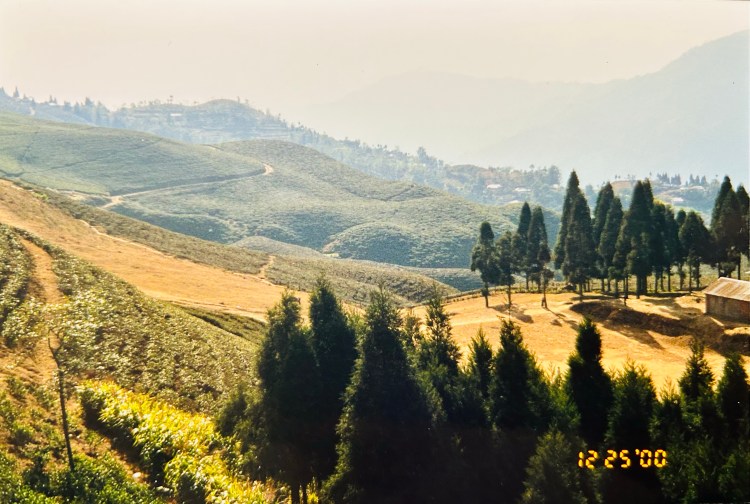
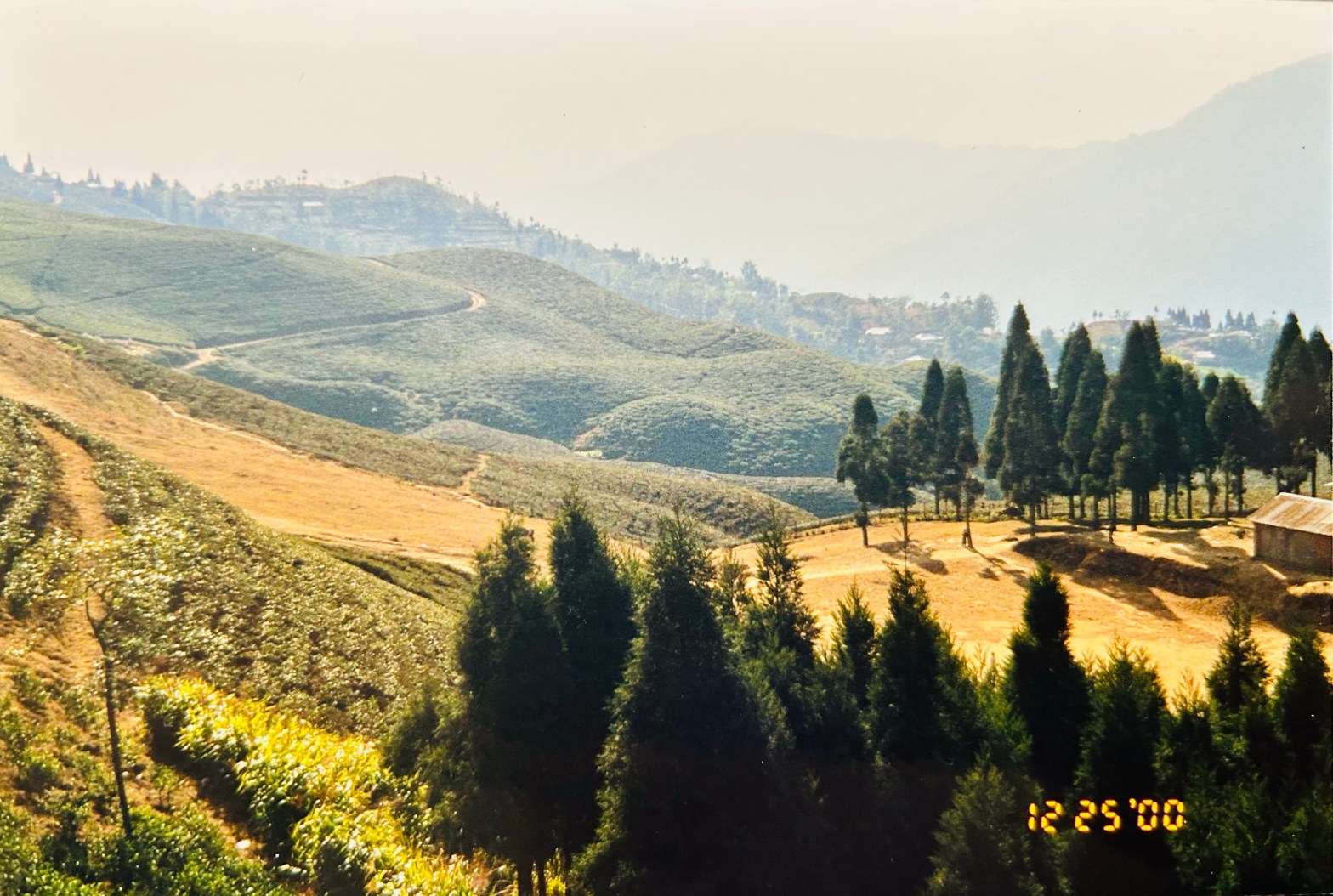
As we approached the tea-bush covered hills the scenery was verdant and stunning. Tea gardens are incredibly beautiful, lushly green and meticulously manicured with randomly spaced trees providing just the needed mix of sun and shade for the bushes to thrive. At the entrance to the tea growing area there was a lovely park where we stopped and met up with the men.
We ladies hopped out of the vehicle and, as you might guess, looked for the rest room. What we found was the most terrifying toilet I have ever, ever seen. But we had no choice. It is pretty easy for men to find a place to go, but for us girls this was the only option. Our toilet consisted of a huge, open-air pit which was several feet deep and at least ten feet in diameter, dug in the ground, and surrounded on three sides by flimsy bamboo “walls.” Lying across the center of the pit about six-inches apart were two strips of four bamboo poles each tied together with hemp rope. The required process involved carefully walking to the middle of the pit, one foot on each of the bamboo strips. Once well over the cesspool below, the idea is to squat and then somehow relax enough to do your business. We girls deliberated for quite some time about whether there might be another option and, after nixing that hope, about whether we could hold it. But anticipation of the two-hour trek ahead negated that idea as well. So we did what we had to do. We formed a wall of women on the open side of the toilet for privacy and one by one took a deep breath and tenaciously ventured out trying not to visualize the very real possibility of where we could end up. Quickly we discovered that not only were the poles round but they were incredibly slippery due to all the previous visitors who had missed. Finally the last person successfully made it back to solid ground and we were all relieved physically as well as emotionally.
It was a lovely two-hour walk. Along the trail we occasionally passed a house where there would be a wooden bench thoughtfully provided beside the trail for weary travelers to sit and rest for a few minutes. At last we arrived at the house where we would stay. Our host family was the first Christian family in the area. They were friendly, hospitable, and seemed genuinely thrilled to entertain this huge group. Their small two-story house was clean and nice with a metal roof indicating a level of affluence (most rural homes have thatched roofs). Goats, chickens, and cows roamed freely and there was even a fish pond. In addition to the house for sleeping there was a cooking house and an outhouse toilet. Lacking electrical service as well as lanterns the only lights were small oil lamps. It was a lovely family and they hosted us like royalty.
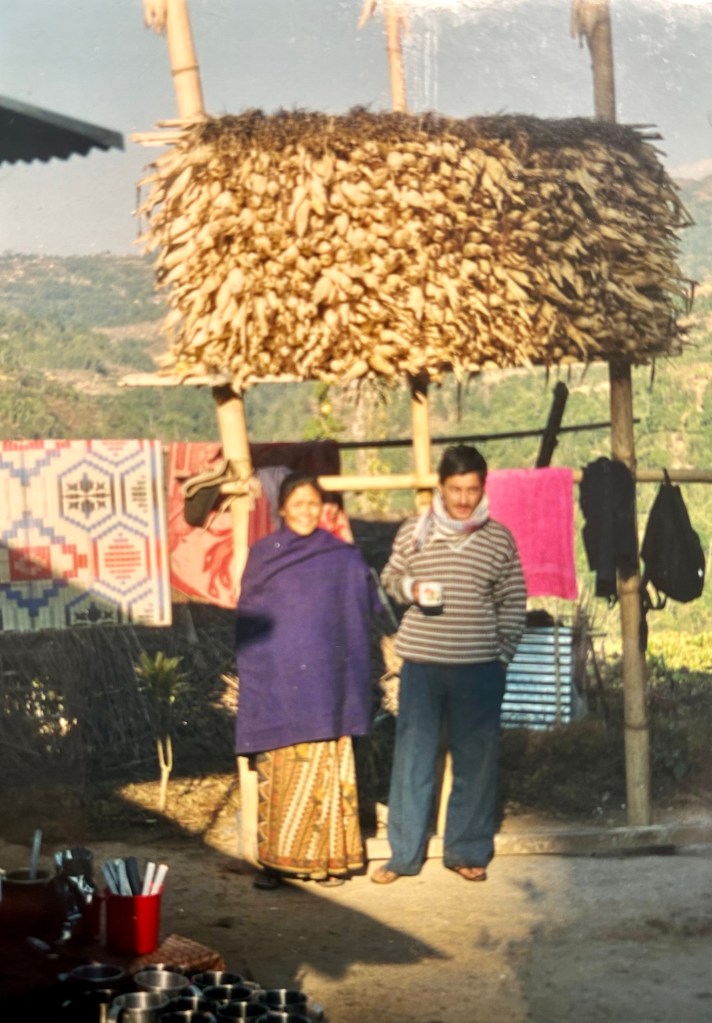
our hosts
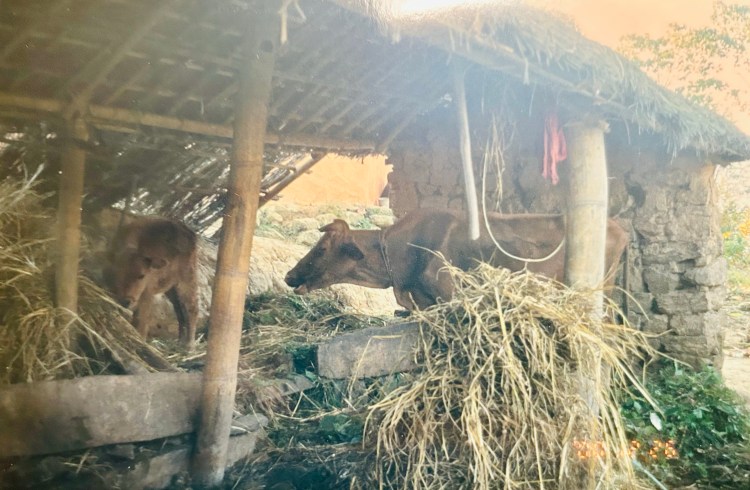
the stable
That evening they presented us with a delicious Nepali feast. We ate sitting on logs facing the cooking fires. All of the neighbors had come to observe the foreigners. They stood with the family in a line behind the cooking fires. The children were very amazed. They adults were saying, “How do they live? They eat like birds!” We were saying, “I feel like we are at the theater and the movie is us!” It was a wonderfully hilarious experience!
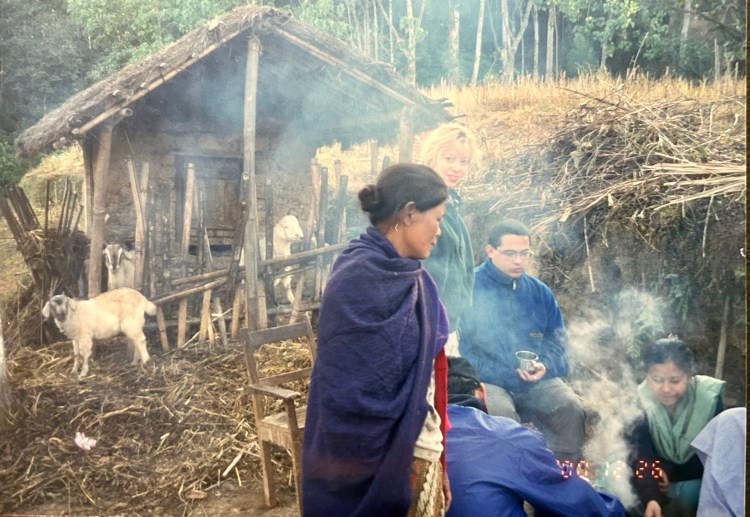
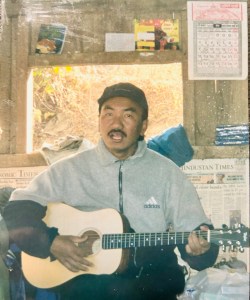
warming by the fire
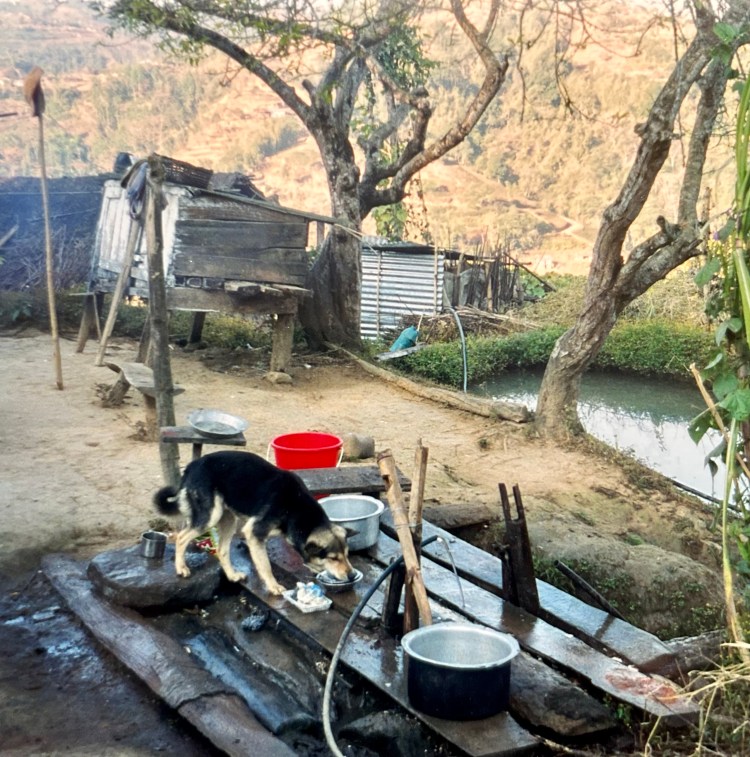
This is the water source and therefore where dishes are washed. After dinner I, for whatever reason, decided that I should be a polite guest and help out. So squatting in boots Nepali style I washed all the dishes. And for whatever reason I really enjoyed the “adventure” of it. I am sure that my hosts were thoroughly mystified by my actions. (The fish pond is pictured on the right.)
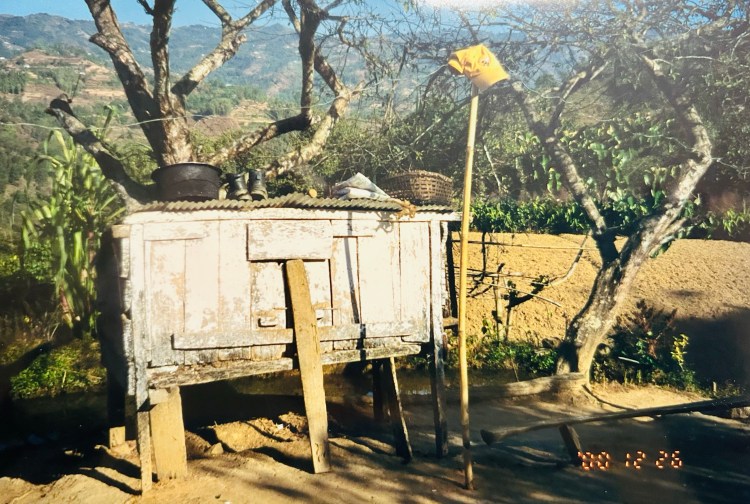
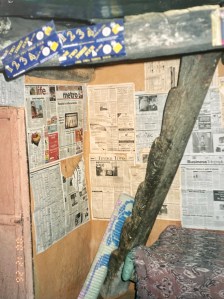
These are the “stairs” to the second floor room. The house is wallpapered with newspapers.
After dark we all sat around the fire worshipping and sharing the Word together, hopefully bringing encouraging fellowship to the local believers. Full of the love and joy shared together that night we all prepared for bed. The men found places to sleep outside and in the cooking house. The female family members as well as Songita and Rebekah from the Nepali team slept in the upstairs room. We American girls had the privilege of the downstairs room. There were enough handcrafted wooden, single beds for all but two of us. So Katie, Abbie, and I shared a bed which brings us to one more comical story for the day. We laid out our sleeping bags onto the bed, then Katie and five-year-old Abbie bedded down with their heads at one end, Abbie next to the wall and Katie on the outer edge. I crawled in between them with my head at their feet. It was tight. As we wiggled around getting comfortable Katie’s sleeping bag slipped off the bed sending her crashing to the wooden plank floor and the whole room into uproarious laughter. Hearing the ruckus, Deepak came running in to see what had happened. Horrified at the sight of Katie on the floor he tried to pull the bed away from the wall thinking that would give us more room. However the bed was nailed to the wall. So he starting trying to knock it loose. Horrified that he might damage the bed or the wall, we finally convinced him to let it be, that we could make it work and would be just fine now. And with that we settled in, thoroughly exhausted after a long but thoroughly amazing day, and having no idea what the morrow would hold we were immediately sound asleep.
Christmas Eve dawned hot with cloudless, cobalt skies and excitement my heart for the day ahead. Immediately after breakfast we headed out to Khundunabari for our fourth Bhutanese camp visit where we would minister in the small, thatched-roofed bamboo church located just off camp property. Our team participated in Sunday morning worship and it was delightful but the local atmosphere was dark and oppressive. Looking around at the people gathered I thought they were blind; their eyes were totally blank. After a while I noticed their eyes moving as they looked around so I concluded that perhaps the heavy oppression over them caused the void in their eyes. At the end of the service we had the opportunity for one-on-one ministry and thankfully saw some breakthrough.
As we ate lunch with the congregation Robby told us the story of their pastor. She was an elderly lady and extraordinarily dedicated to the Lord and to the work to which God had called her. The previous year she defied the no-outreach law and went into town. While talking about Jesus to those who would listen she was arrested. Her crime? Witnessing outside the camp. After serving eleven months in prison and just before our arrival, she was released and already was back to pastoring her flock. She was relentless in serving though the job was tough and even now as I type her story I feel humbled to tears and I honor her perseverance.
After lunch we did an outdoor program with the children. I do not remember the topic but I do remember that five-year-old Abbie wore a sheep costume for her part in it. I remember for two reasons. It was scorching hot and Abbie complained about being miserable in the wooly costume–it may have been the only time she complained on the entire trip. And, when I think of Kundunabari and the people there, in my mind I see them literally as sheep.
We returned to Damak drained from the heat and from the spiritual struggle. But even so in the evening we went out into the town and did a program on the street for the children we could gather up from the neighborhood. Oddly that program was much easier that the earlier one at the church.
On return to our guest house that night there was a message for Katie. The headmaster from the large school where we had presented yesterday phoned while we were out. His message was the most wonderfully perfect ending to an already amazing Christmas Eve. The headmaster wanted to know Jesus. He had read from the Bible that Katie gave him and said that it is the most amazing thing he had ever encountered. He also shared that he had two dreams about Jesus that night. Being a teacher he was eager to teach the Truth to the 98,000 Bhutanese for whom he was responsible. Wow.
first food ceremony
Christmas Day also broke hot and sunny and we traveled to a nearby town for Christmas worship with a church pastored by Bala’s brother. Bala, one of the Nepali team with us, has several brothers. Their mother is a widow who raised all of her boys to love God and all of them serve in full-time ministry. When I think of her I think of Susanna Wesley. Our team again participated in the meeting and it was refreshing to worship with the vibrant congregation. At the end of the meeting we celebrated Pasne, a “Rice Feeding Ceremony”, at which a baby receives their first solid food. The pastor prayed for the baby and then every adult in the room including we foreigners fed the baby a tiny spoonful of rice.
After the service we did a presentation outside with the children and had barrels of fun playing with the kids. The highlight was, perhaps, Levi’s demonstration of how to put a chicken to sleep. While we all watched in amazement, Levi picked up one free-range chicken after another, gently tucked its head under its wing, bent over, and while holding the chicken around its torso gently swayed it from side to side for a minute or two. Then gently placing each chicken on the ground, to our astonishment every single one was asleep. Christmas dinner was shared together and consisted of roasted goat, chicken, curried vegetables, bread, and aachar (South Asian pickle which bears absolutely no resemblance to American pickles). For the first time we were served food with no utensils and the sight of that group of Americans learning to eat Asian style with their right hand must have been hilarious.
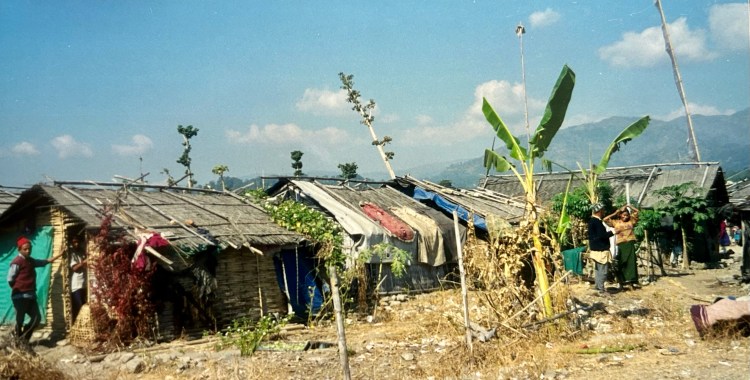
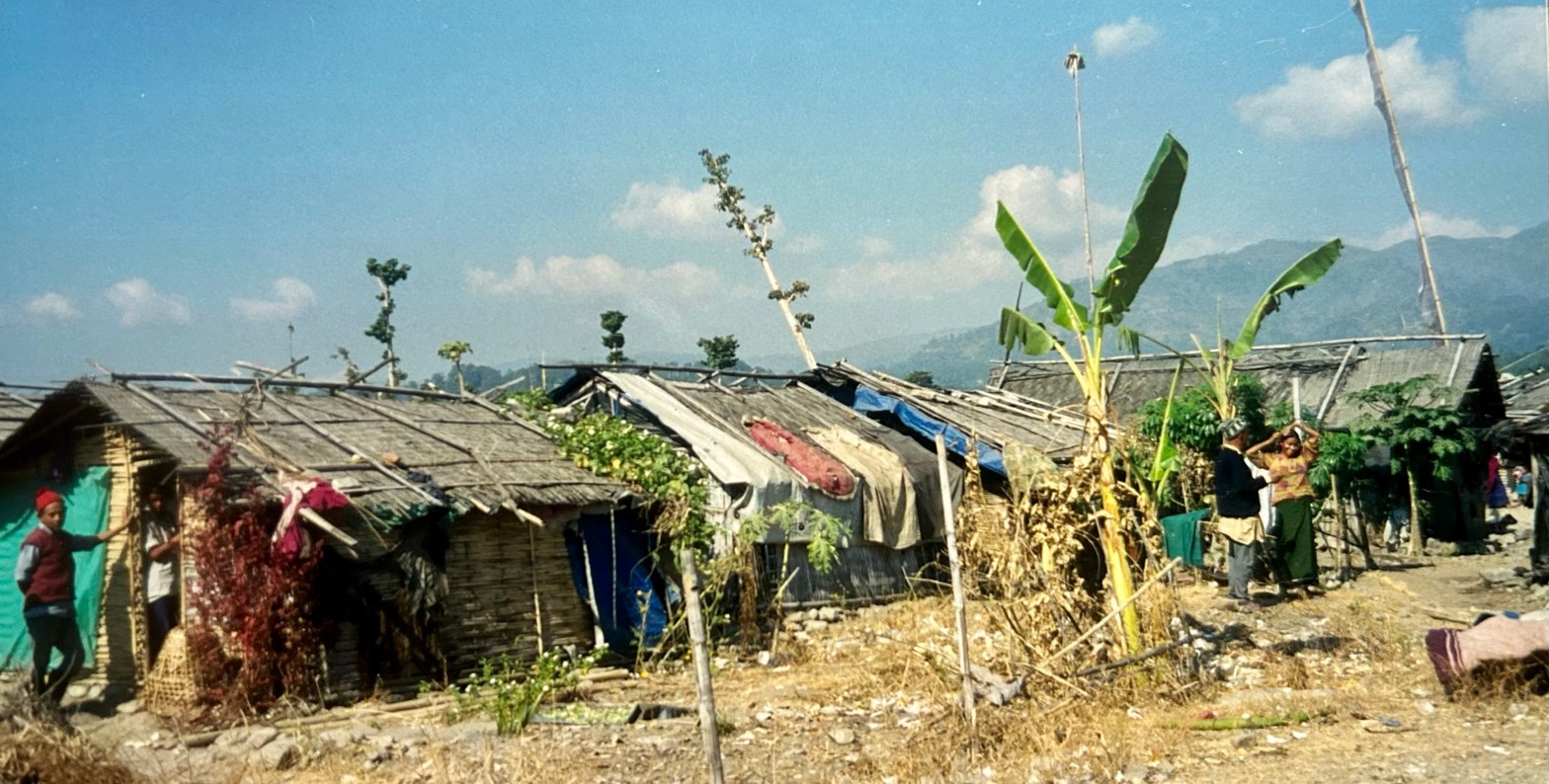
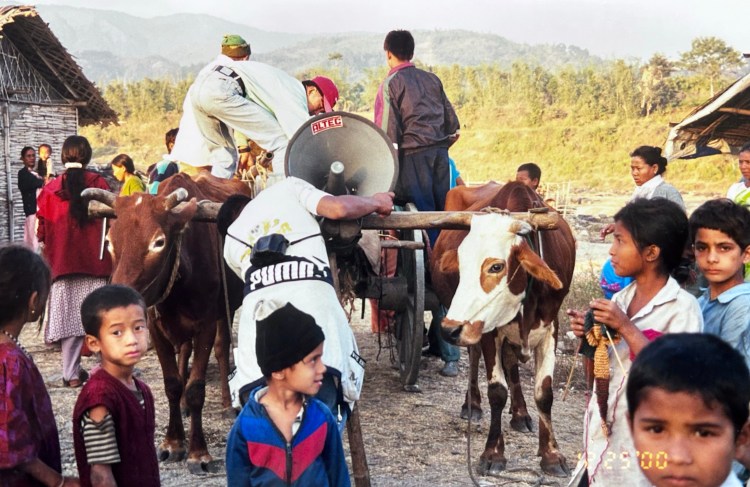
In the late afternoon we headed back and visited our fifth refugee camp, Timai. Timai was much sparser that the previous four camps we had visited, bleak and dusty with no gardens and no shrubbery or vegetation growing around the bamboo huts. As we were arriving we were greeted by the astonishing sight of festive Christians joyfully returning from a Christmas Day picnic along with a wagon pulled by two cows. Atop the wagon was a loudspeaker blaring Christian music.
The pastor was away but we were able to talk with John, the youth pastor. He was twenty-five and had recently earned a Bachelor of Divinity in India. While in India studying he was jailed for fourteen months. His crime? Practicing his Christian faith. John shared with us that they had just conducted an outreach on December 9 and that it had gone very well. After the outreach he had a dream that a team from America was coming; we were that team he said. We prayed over many from the camp and when we prayed for Pastor John, Miss Emma prophesied that there would soon be a move of the Holy Spirit among their people. He invited us to come back and do a children’s program for them. I was heartbroken when he was told that it was not possible; we would be leaving in the morning for our next engagement.
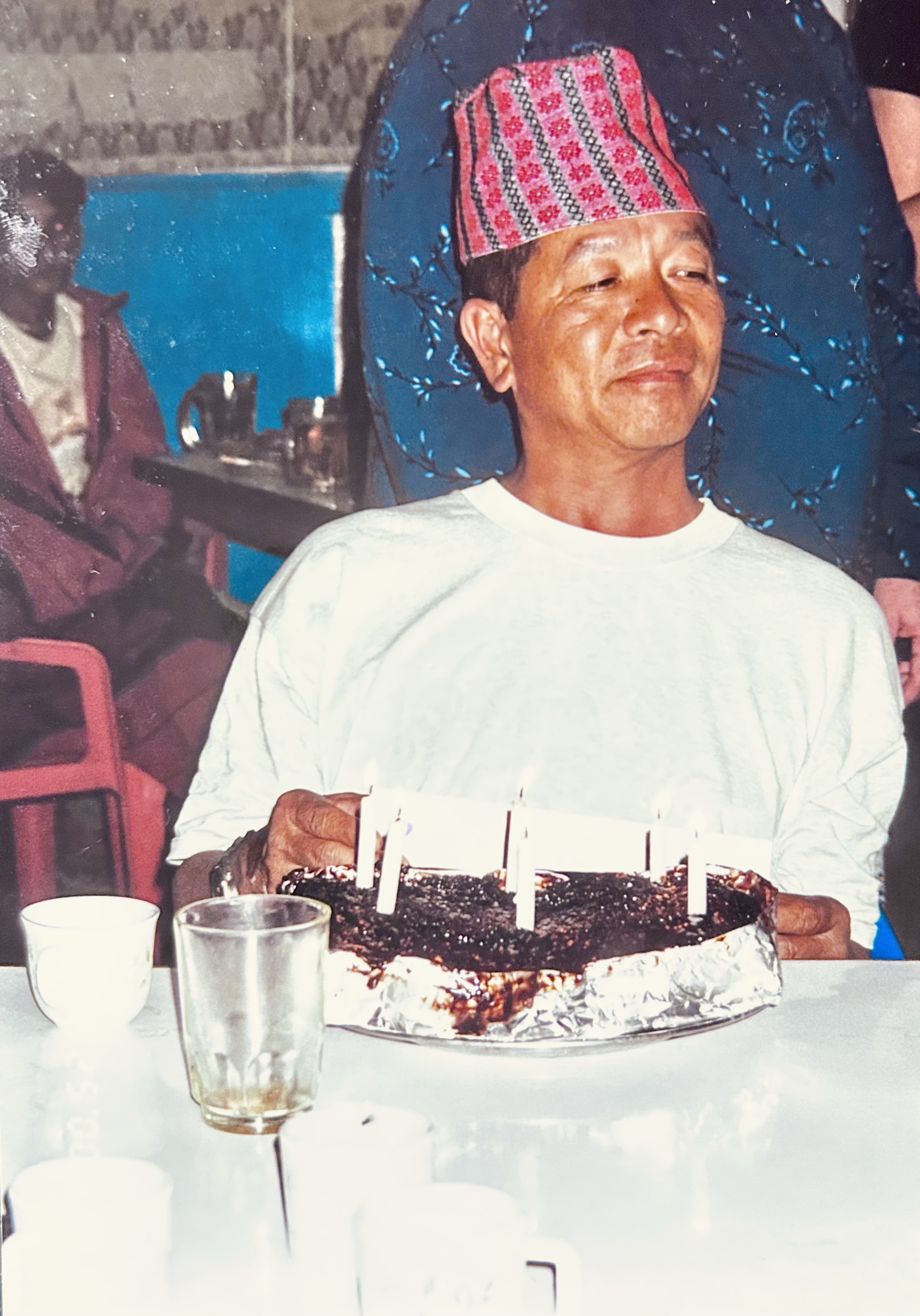
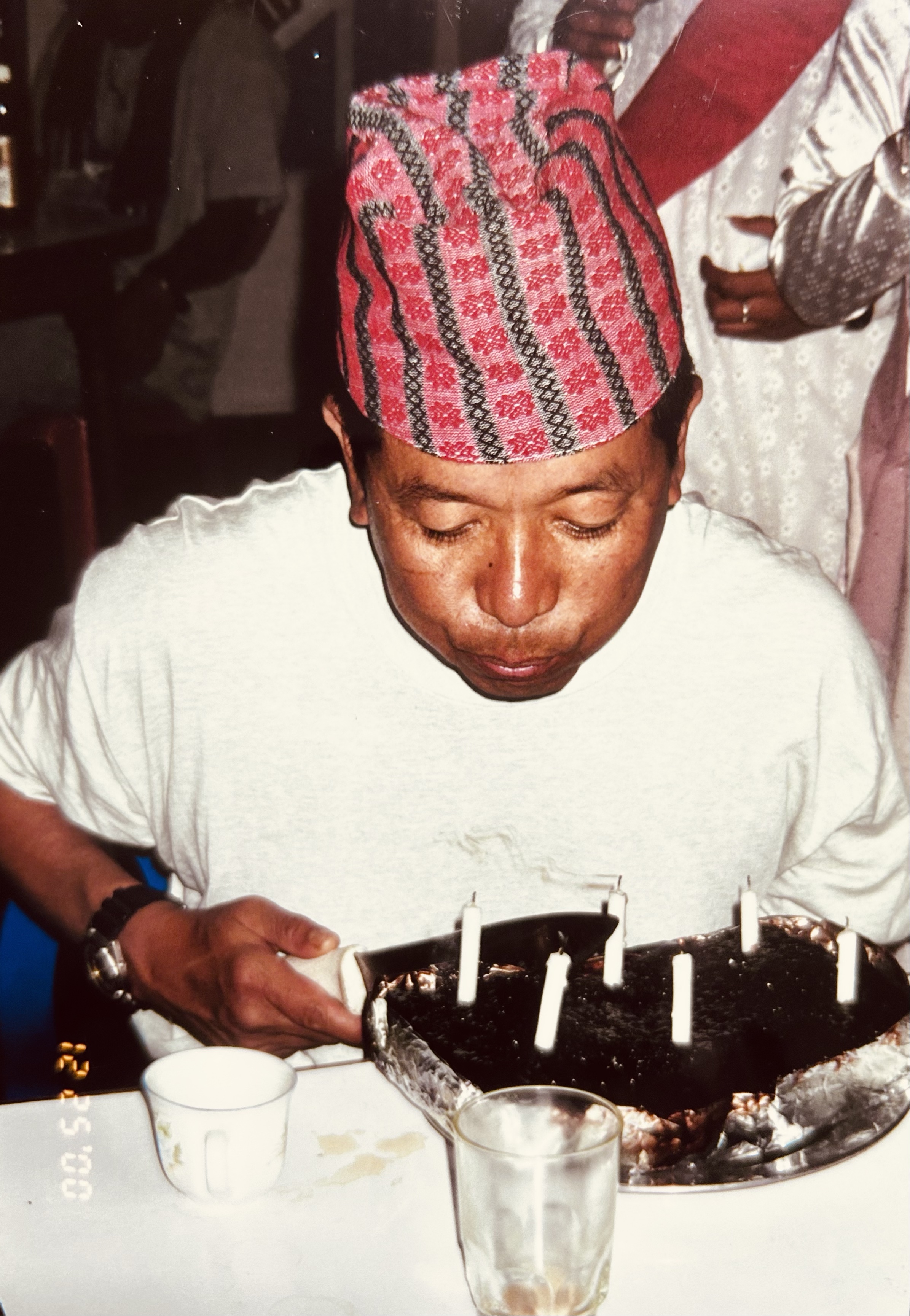
Back at the tea house in Damak we concluded “the most wonderful day of the year”, Christmas Day, with a birthday party for Robby. Robby, as many South Asians, didn’t know the day of his birth; he knew the season and the moon but not the day or year. So after choosing to follow Jesus he chose to celebrate his birth on the day that we celebrate the birth of our Lord, and not knowing his exact age he supposed that he was about fifty. And so that Christmas evening we celebrated with Robby his fiftieth birthday with a chocolate cake that Leona, his wife, had sent all the way from Kathmandu.
We were “up and at ‘em” early on Thursday, December 21, and departed Kathmandu for far east Nepal at 9:00 am. The day was uneventful, full of conversation and watching the changing scenery. As evening fell the drive was feeling more dicey. The highway was narrow, curvy, and pitch dark; we quickly learned that when the sun went down road crews left everything sitting in the middle of the road ready for the next morning. By everything I mean piles of sand and huge rocks possibly placed to keep vehicles from hitting the piles of sand, or at least that is how it appeared to me. Mr. G, our driver again this trip, was experienced and excellent at navigating the situation but had to drive very slowly for safety. Then, just a couple hours out of Damak where we would be based for the next few days a rickshaw burst out from the darkness into the beam of our headlights. We missed him by inches! The rickshaw driver was safe but when the car swerved to avoid calamity Miss Emma’s head slammed into the window. Instantly an enormous egg emerged on her forehead, probably concussed, which gave her pain for the rest of the trip. It was an enormous relief to finally reach Damak and our guest house.
The men who went ahead of us by bus were supposed to have arrived at 3:00 am but they encountered more serious difficulties on their journey. A bus traveling ahead of theirs hit and killed a little girl on the road requiring a twelve hour delay for all of the cultural rites, ceremonies, and procedures to be performed on site. The offending bus would have to be burned as it was now considered “bad luck”. Back on the road again everyone soon fell asleep. At some point the bus stopped to fuel up. Levi woke up and quickly slipped out to run to the toilet. As he stepped down from the bus he very wisely looked back for the bus number because it was only one in a long line of busses. In just a couple minutes he was jogging back to the bus and to his horror he saw that every one of the busses bore the same number. Panicking he jumped on bus after bus looking for the familiar faces of our team. Then he saw the first bus rolling out. Freaking, he sprinted to the moving bus just in time to jump on. Thankfully it was his bus and and thankfully he had found it in time. As he boarded he looked and everyone but the driver was still snoozing soundly. The realization that no one would have had any idea where he was or what had happened was sobering. (This was pre everyone carries a cell phone days.) Finally, everyone aboard and unharmed, they arrived in Damak at 3:00 pm still several hours ahead of us.
In Damak town center they were burning an effigy in protest against a Bollywood star who had insulted Nepal.
Damak is a small town with more of the feel of India. The guest house where we stayed houses UN people when they visit the refugee camps. But it was bare bones. And infested with bed bugs. Poor Abbie, my granddaughter, got the brunt of that. She looked like she had chickenpox. She however was not daunted; after returning home when people saw the photos and commented on how awful that she was covered in bites, she dismissed that with an “uh, it was nothing.” On that note before we checked out we all hung our sleeping bags in the sun and managed to not bring home a single bug.
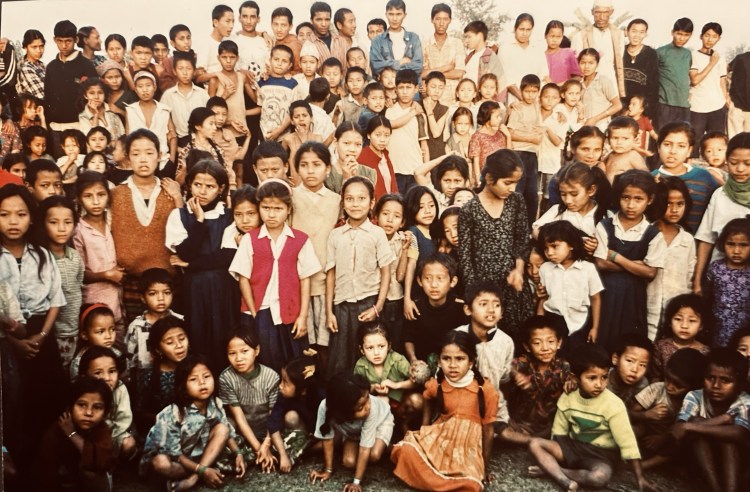
On Saturday, Christmas Eve Eve, we began our visits to the seven Bhutanese refugee camps. We were able to visit three of the camps (Beldangi I and II and Patri) doing school presentations and meeting with leaders. The response was astounding. By the end of the day Steven was finally feeling better. Others had fallen ill, however everyone was still able to go out and do what they had come to do in the camps, in the town of Damak, and in Dharan located on a nearby mountainside. I wrote of our visit to these camps in a previous blog, Out of the Mouths of Babes, so rather than repeating myself the link is inserted here for you to read. In my next blog I will describe our visits to the last two camps that we visited. https://jackietallent.com/2022/07/11/out-of-the-mouths-of-babes/
Beldangi II
Beldangi II
Beldangi church. On the ground freshly harvested basmati rice is drying and will be sold as the refugees cannot afford to eat basmati.
Inside Beldangi church praying for leadersschool assembly
At some point in time Indian believers went to Bhutan and visited the Bhutanese people of Nepalese descent living there. As a result many of them become followers of Jesus. Beginning in 1991 some 108,000 Nepali Bhutanese were ousted from Bhutan and fled to Nepal in what has been called ethnic cleansing. After arriving in Nepal seven camps were built to house them. The refugees were required to receive special permission to leave the camps or to do anything out of the ordinary. Because churches were not permitted in the camps the believers set up small bamboo churches just off property.
In 2007 relocation to eight Western countries around the world began. (Around 6000 still remain in two camps.). The vast majority were brought to the US. They became Americans, obtained citizenship, bought homes, were elected to office, and they planted churches. Christianity Today magazine’s April 2023 issue tells the amazing story of the Bhutanese Christians in America and their fervor to reach out to their neighborhoods, planting churches in a way that should inspire all of us to step it up! https://www.christianitytoday.com/ct/2023/april/bhutanese-nepali-refugees-christianity-evangelism-resettle.html
After we returned home Katie and her band wrote a song about the refugees, the trafficking victims, and the orphans whom we encountered on this trip. It never fails to move me to tears when I listen. I hope you enjoy it too.
Just a few weeks after returning from my first visit to Nepal, Katie asked me, “Mom, I want to take another team to Nepal over Christmas break. You wanna go?” As I was longing to take the spirit of the Christmas season to a place that had never known a Christmas my response was quick and it was positive! Almost immediately our days were filled with preparations for Christmas in the “Magical Kingdom” of Nepal. This trip would focus on school assemblies, visits to as many as possible of the seven Bhutanese refugee camps on the far eastern border of Nepal, and as always prayer walking and intercession. Proverbs 18:16 advises, “Giving a gift can open doors; it gives access to important people!” (NLT). Pleas went out and plastic totes began filling with first aid supplies, medicines, toothbrushes, shoes, and whatever else we could present to school headmasters and their young students along with candy, balloons, props and tools for ministry to children. Weekly team prayer would be crucial to the success of our upcoming journey and we also enlisted vital prayer partners to stand with us throughout our preparations and journey to the other side of the globe.
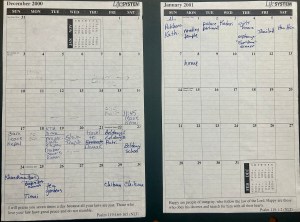
And then, just like that, at 11:45 pm on Saturday, December 16, 2000, our eager team of twelve including five-year old Abbie flew out of Kenai Municipal Airport to meet the 3:00 am Anchorage to Taipei flight. After an extended delay in Bangkok we arrived in Kathmandu at 3:00 am on Tuesday the 19th. Bone-tired we stumbled into our rooms at the Student Guest House in Thamel where finally we slept hard. A hearty breakfast and luscious milk tea were served to us on the roof of the guest house at 11:00 am while the welcome December sun warmed on our still weary bodies.
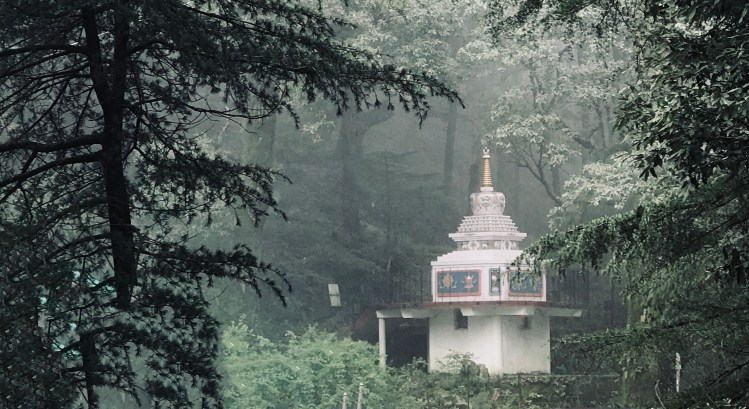
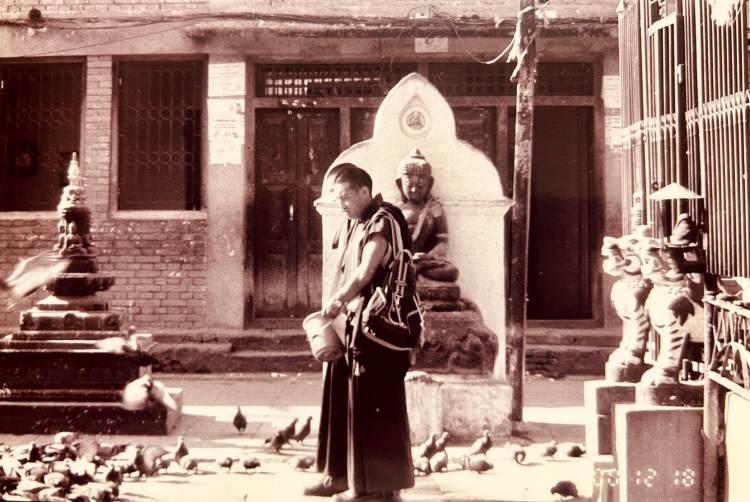
The afternoon was spent praying at key religious areas around the Thamel sector of Kathmandu. First stop was a Buddhist stupa near our guest house. We prayed around the stupa inviting the presence of Almighty God to overcome the darkness. A western tourist was very agitated and accused us of trampling the holy site. After a bit, undeterred by her rebuke, we gathered and prayed over the land in all directions.
– Towards the North we prayed against darkness and bondage, that they would be confined like a black hole, and then we prayed release of Light and Freedom.
– Towards the South we prayed against deception and for release of Truth.
– Towards the East we prayed against idolatry of the sun and the militancy which was arising in the nation and then prayed that the knowledge of the Son would rise over the land.
– Towards the West there was a school. We prayed against the god of education and then prayed for the students of the school.
While standing on the north side of the stupa we noticed men tearing down a brick building behind us and felt led to release angels to tear down the stupa as well.
We then walked to Durbar Square, an area dedicated to idols and temples, which had become popular with the ‘60s’ migration of European hippies who traveled overland to Kathmandu. (Many of their left behind vehicles were still belching smelly, black pollution throughout the city.) Along the way we prayed against the many idols which we passed including the “toothache god”. I watched the people worshipping and noticed that their faces without exception were sad and empty.
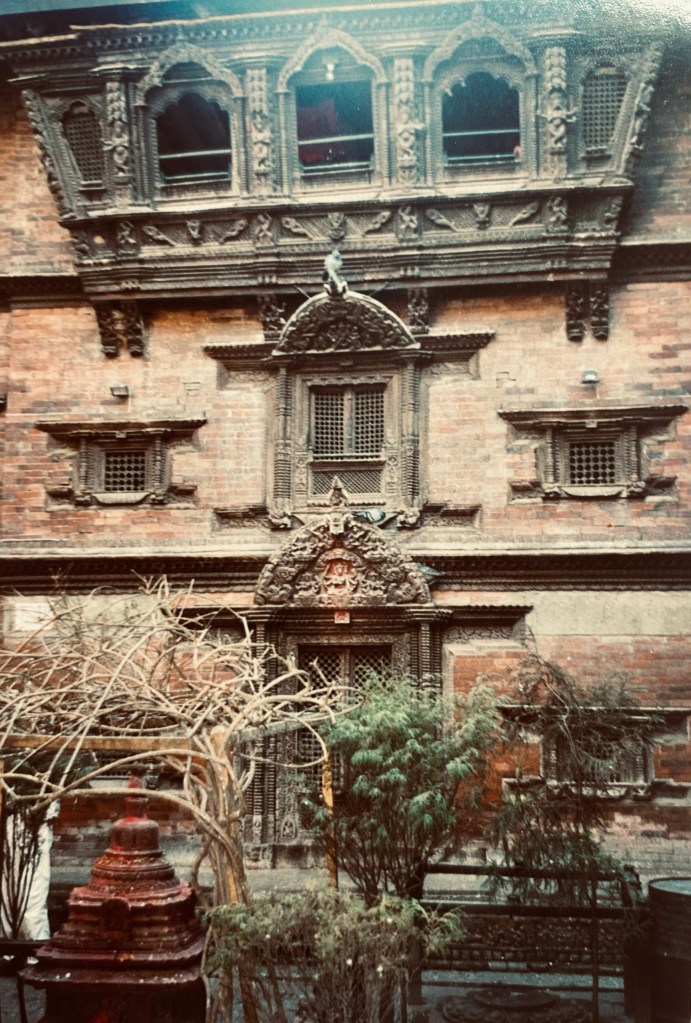
On arrival in Durbar Square we first visited the palace of the Kumari, the “living goddess”. After a lengthly wait during which she was being prepared for her scheduled appearance, the Kumari emerged at an upper balcony window for only a brief moment and it was clear by her facial expression and demeanor that she was not pleased to be making her required presentation before the public. After the brief glimpse we walked over to a brick temple and up the steep stairs to the top. Halfway up one of our team, Steven, began vomiting. Deepak, one of the Nepali leaders, told us that vomiting was a fairly common physical reaction for a Believer when encountering such oppression.
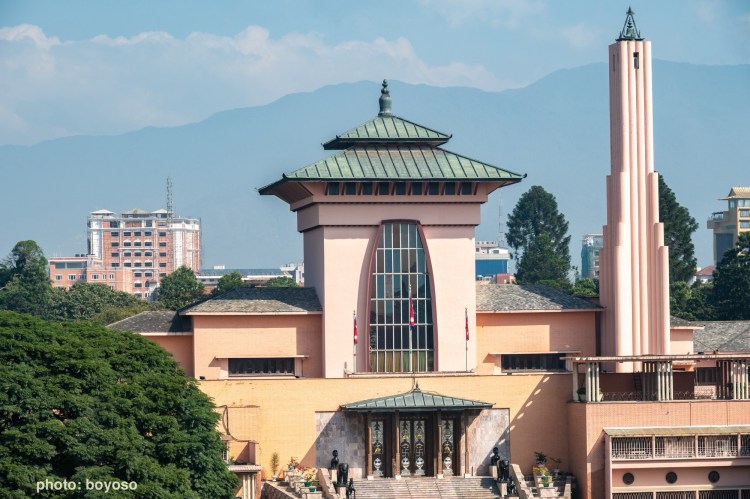
Kumari, the Living Goddess, is a young virgin who after being chosen is believed to be indwelled by the goddess Durga. She is chosen from a Buddhist family, will serve as a Hindu goddess, and be worshipped by followers of both faiths. Chosen from girls as young as two-years old Kumari Devi serves as goddess until she reaches puberty. A girl with no physical imperfections or disease and with all of her baby teeth intact is chosen. She will then need to pass various tests. First she must show no fear during the events of Black Night when 108 buffalos are slain while frightfully masked dancers perform by candlelight. If she passes that test she must then spend a night in a room filled with severed buffalo and goat heads. If that test goes well she will then be required to identify personal items of the previous Kumari in a process similar to the choosing of a new Dalai Lama. She is then considered approved as Durga’s choice for incarnation and will enter her palace (pictured above) which she will only leave a few times each year. Her feet will never touch the ground during her incarnation as goddess. It is believed that she can bless her worshippers and heal them if they touch or kiss her feet in respect. Twice daily she will acknowledge onlookers from the center balcony window, however the onlookers are not allowed to photograph her. She never smiles as the goddess’s smile is viewed as a curse. Her tenure will end when she reaches puberty and a new Kumari will be chosen.
As vespertine darkness fell on our first day in country we were feeling hefty backlash from the spiritual darkness. I, as well as at least one other team member, was feeling quite ill by evening. However, we still had to sort through and repack our things which would be sent ahead to east Nepal the next day.
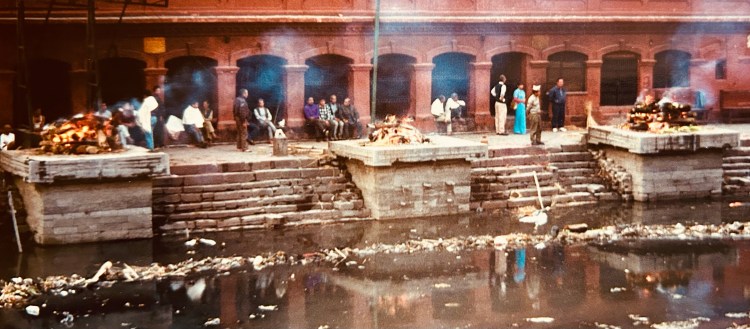
On Wednesday, 20th we visited Pashupatinath (the Shiva temple I wrote about in Part 3) and spent an extended time praying against the strongholds of that area. As before it was overwhelming and discouraging. With so much filth and chaos and so much darkness it was a struggle to even know how to pray!
By the time we returned to the guest house in Thamal I was feeling acutely sick. In the foyer I sat down at a small internet cafe to email home and inform our intercessors of a schedule change so they could be praying appropriately. I felt so ill that I could not even get the email address typed in correctly and had to call for Katie, who was again leading the team, to come and assist me. We all were undeniably feeling backlash from the spiritual battle upon which we had embarked. The oppression, however, began lifting during dinner (about 8:00 pm) and I believed that was evidence of the powerful prayers going up for us back home.
After dinner the men of our team, including Steven who was still unwell, along with four of the Nepali team departed for east Nepal by bus. Their estimated arrival time was 3:00 am however they would encounter a twelve hour delay on the road. We ladies would leave by car in the morning with the remaining Nepali team members. As I drifted off that night my heart was full of expectation as I joyfully anticipated the beautiful sights my eyes would behold, the wonderful people I would meet, the wealth of information I would learn, and the amazing opportunities that would present themselves over the next days of this wondrous adventure ahead.
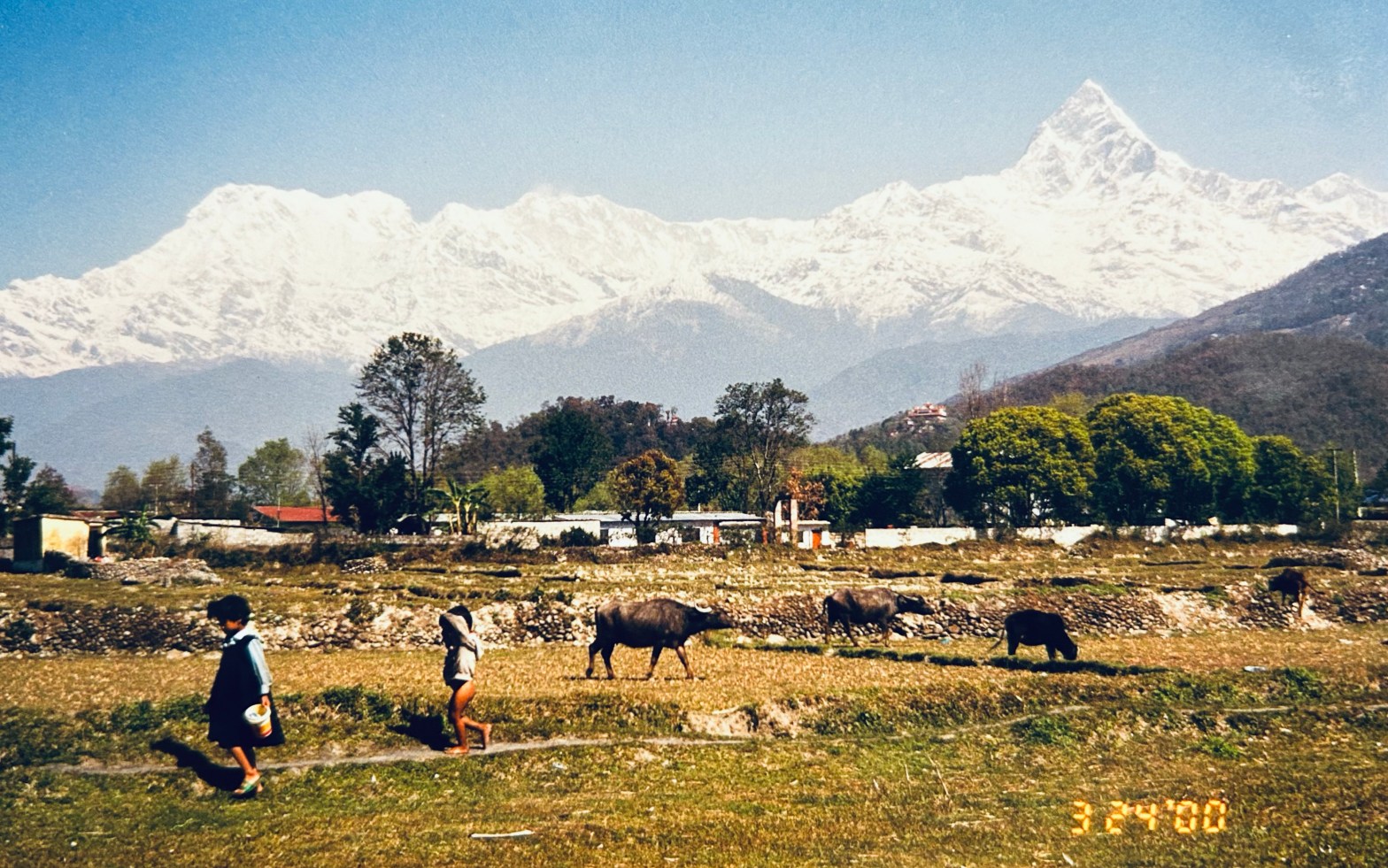
March 24-31, 2000. The weather was much improved on Friday morning and the trek down to Birethanti was quite pleasant. The bus would meet us at Naya Pul (meaning new bridge) at 4:00 pm. We spent the day in Birethanti going out in small groups and chatting with the locals. Julie, Stephen, and Bala were in a group with me and of course Bala helped us with language. The day was incredibly productive; we shared with many people and were able to pray with more than a few. I talked with one group of men who were very interested in the message of Truth. They accepted Bibles and allowed me to pray for them but said they wanted to read the Bible before taking a decision. A substantial list was entrusted to Robby for followup by the ladies from Kathmandu (as mentioned in WOTH-Part 10).
In 1 Corinthians 3:6,7 Paul says, “I planted, Apollos watered, but God gave the growth. So neither he who plants nor he who waters is anything, but only God who gives the growth.” Many teams walked this path before us and many more would follow. Only eternity knows what fruit was produced on our little trek. I have no need to know for that is God’s business and His alone. However, my heart was ecstatic to hear three or so years later that that one body of believers in the area had already increased to eight churches.
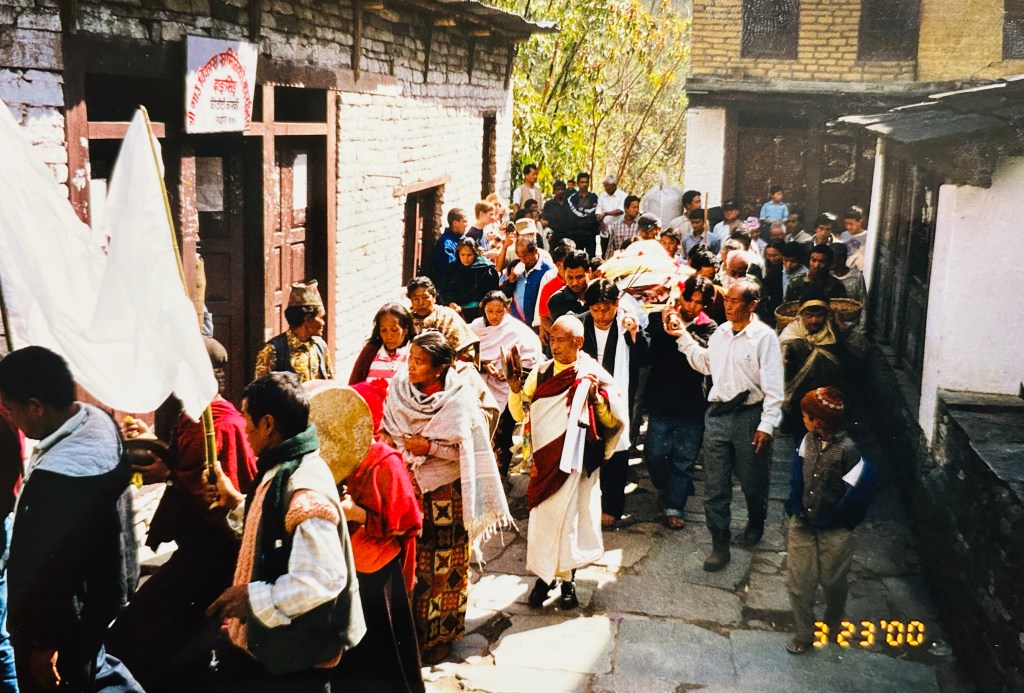
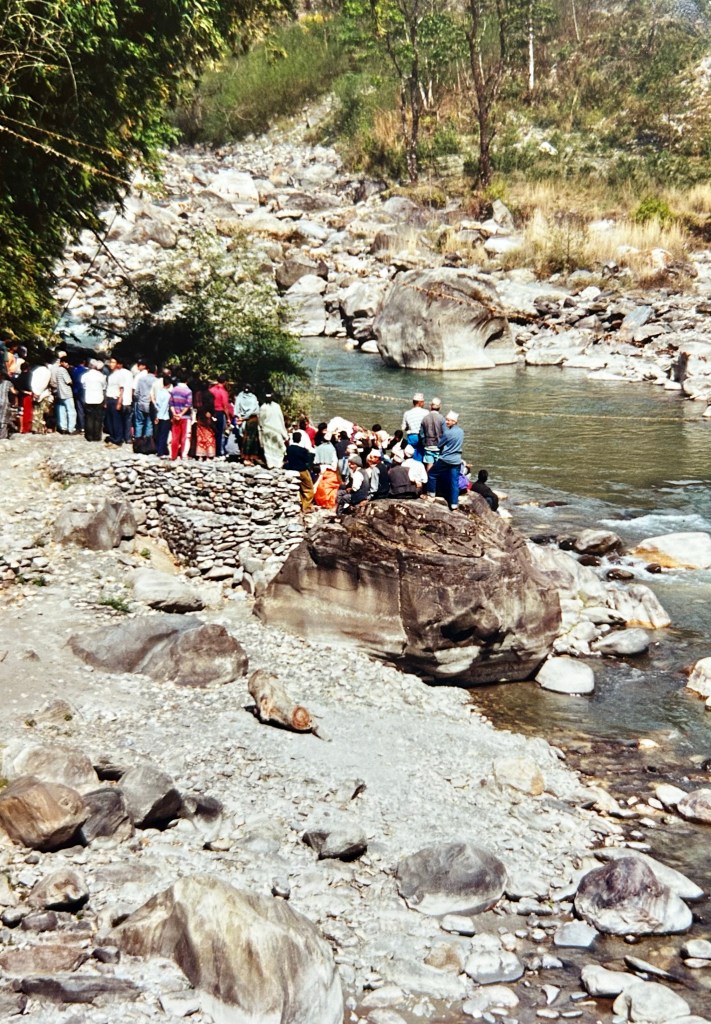
There had been a death in Birethanti before our arrival. Buddhists have various end of life customs. Burial is occasionally used in the case of contagion, murder, or to castigate the dead by lowering the corpse toward hell. Possibly the preferred method for a Tibetan is sky burial as Buddhists feel it is more honorable for another creature to take nourishment from the body than letting it decay. Water burial is sometimes used for commoners, beggars and others of low standing. Tree burial is reserved for children. It is believed that the body returns to the four elements – earth, water, air, and fire – while the soul reincarnates. Because it is believed that some time is required for the soul to reach its next reincarnation, there is concern that the departing soul may see their body and attempt to reanimate the corpse. Therefore open air ceremonies are conducted quickly so that the decomposition of the body is not delayed. Buddhist lamas carry out rituals to guide the dead so they do not get lost on their journey and also chant sutras to redeem the sins of the deceased.*
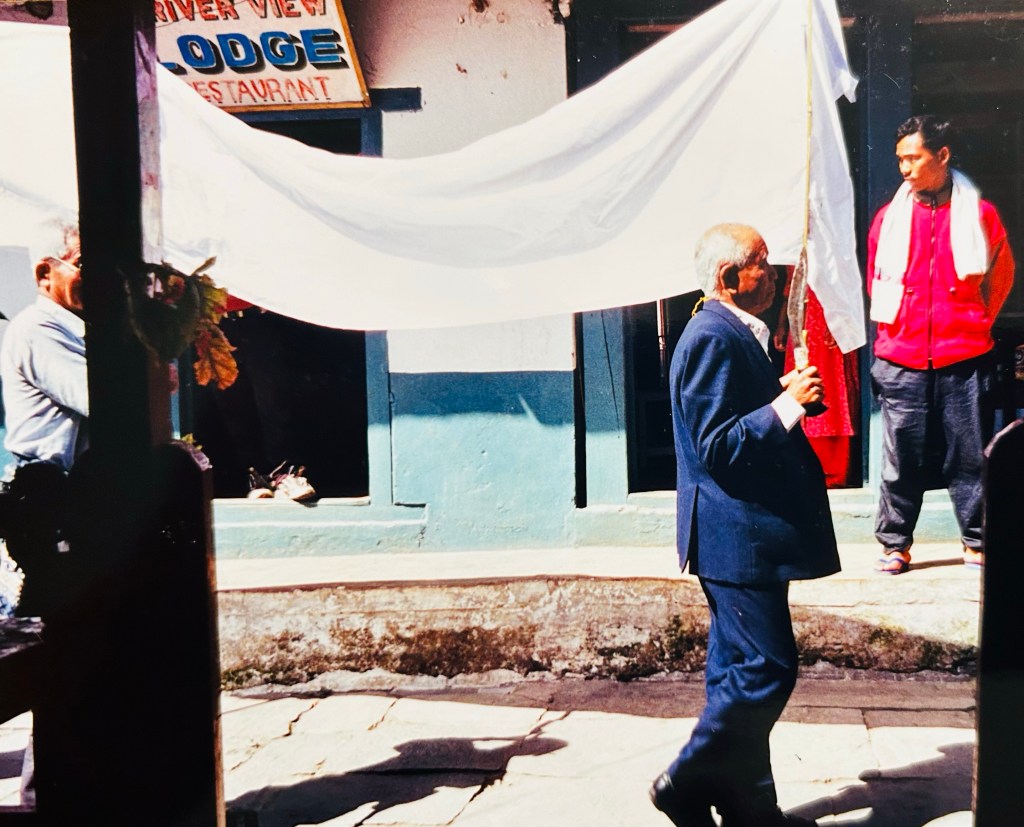
Buddhist funeral procession
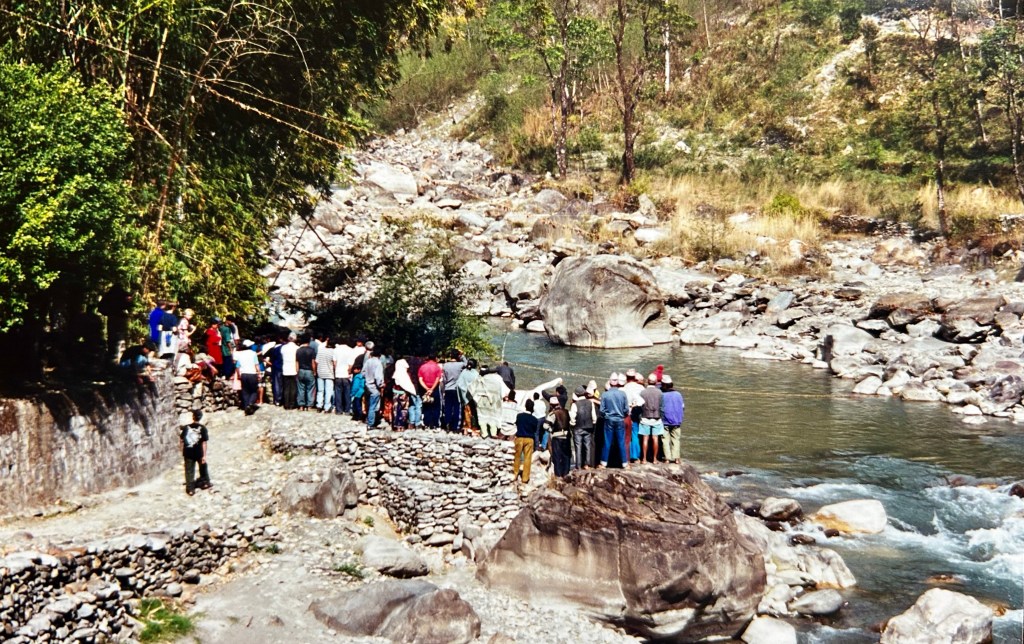
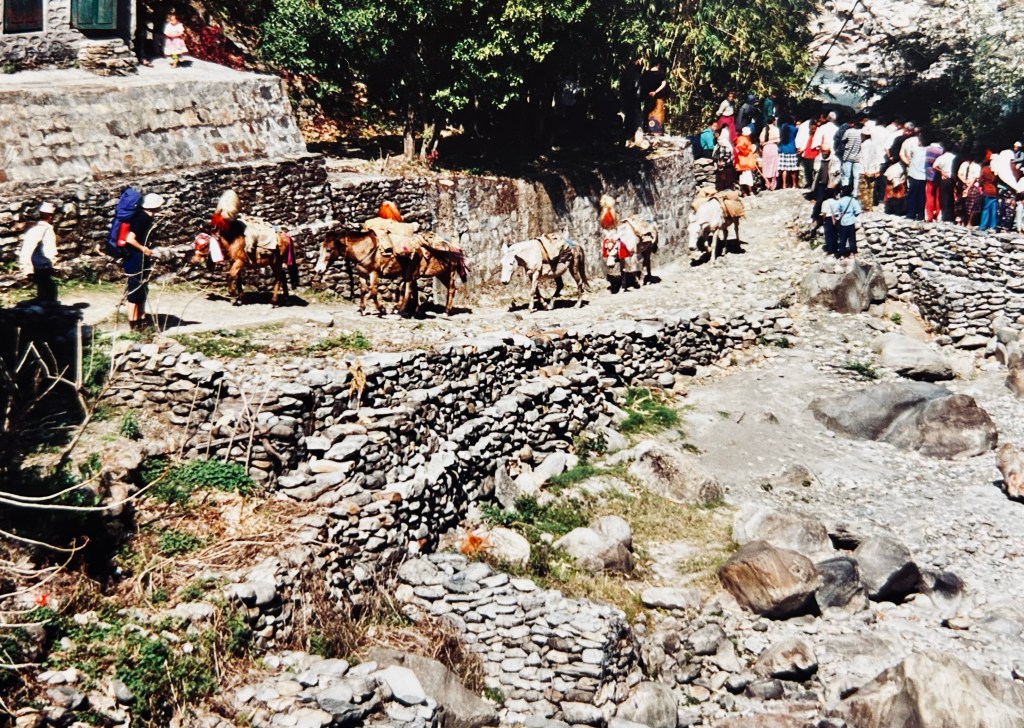
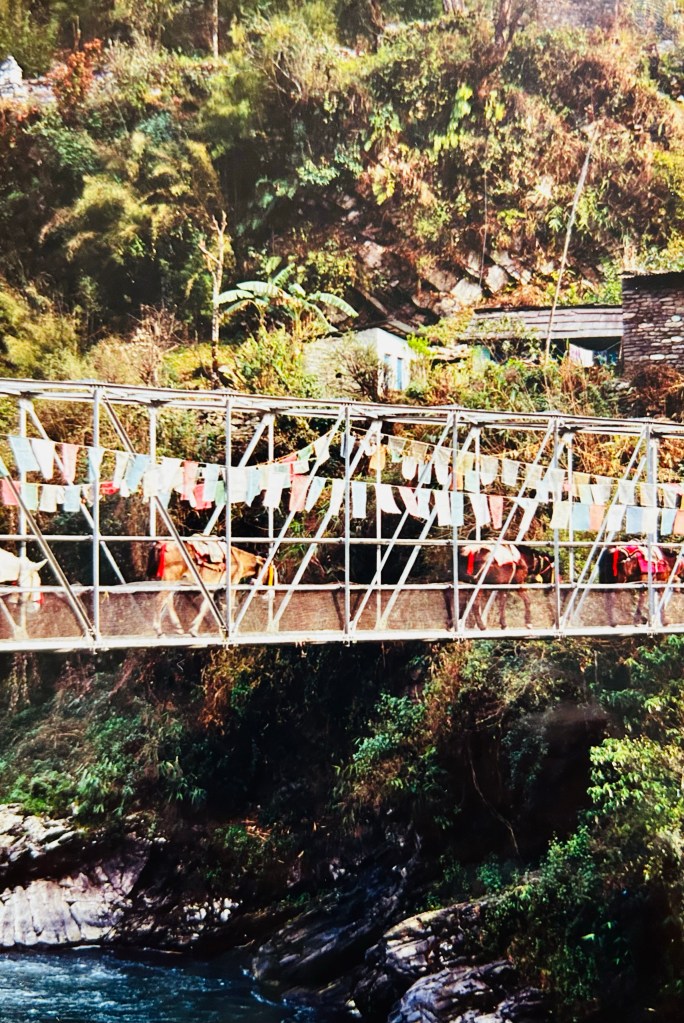
After lunch we saw the funeral procession taking the body down to the river for a Buddhist cremation. We gathered to watch the ceremony, most of us from a bridge which provided a good view from a respectful distance. Once the procession arrived at the riverbank they put a sheet around the deceased then removed his clothes and washed them in the river. The tinkling bells of an approaching mule train, rhythmic gongs from Tibetan musical instruments, and the pungent aroma of incense filled the air. The body was placed on the pyre in the Buddha position and then wrapped in a saffron cloth and covered in flowers. At that point, before the fire was lit, we had to start the trek to Naya Pul to meet the bus to Pokhara.
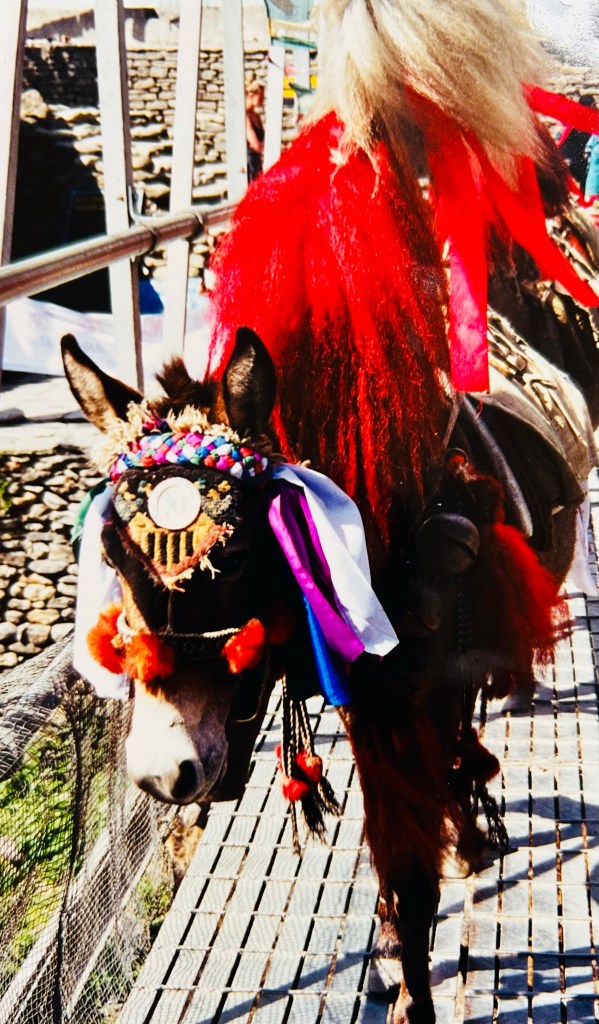
One last mule train – that guy in the closeup tried to push me off the bridge as I was watching the funeral.
After a six-hour bus ride on Saturday we arrived back in Kathmandu and checked into the Student Guest House. That evening we said goodbye to the porters and cooks. It was excruciating to bid farewell to those young men who not only had taken such good care of us but had become dear friends. Many tears were shed as we parted.
the Nepali team that trekked with us
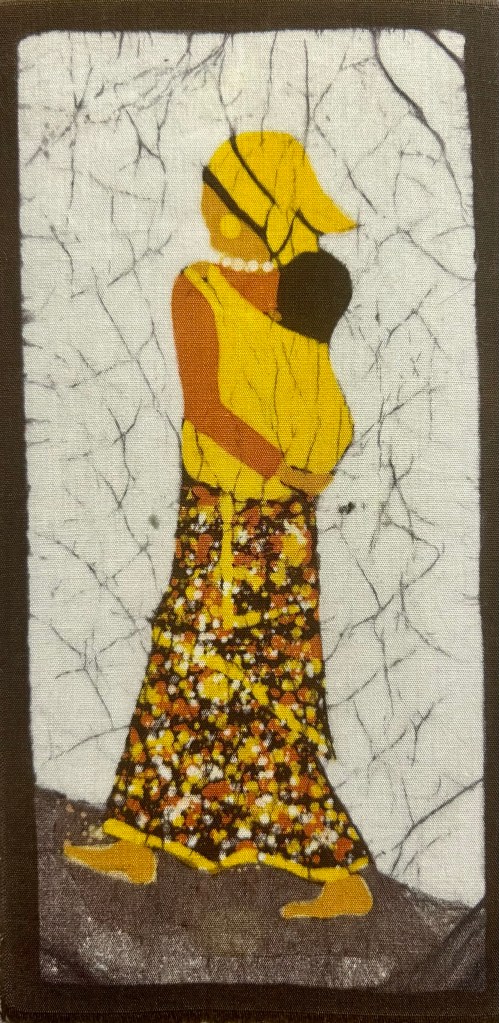
Sunday morning we attended Robby’s church along with a much smaller crowd than we had seen a couple weeks before at the Saturday gathering. Again, I was deeply stirred by their passionate worship, and I was also deeply emotional to be privileged to worship with them, having observed the deep commitment and perseverance of the Nepali believers. After lunch we visited two Bible training centers and went to Daniel G.’s house where we met his wife and two children. They presented gifts of handmade batiks to each team member and beautiful blankets from India to Katie and me. We enjoyed a couple days in Thamel, the tourist district of Kathmandu, savoring the food, visiting shops, etc. as well as prayer walking around key sites of the city. On Tuesday, 28th, we bade farewell to my beloved Nepal.
Tuesday night we slept near the beaches of Hua Hin, Thailand, where we enjoyed two days of rest and debriefing, gradually transitioning from the Himalayan Kingdom to the “modern world”. Then Friday, 31st, after a month of indescribable adventure we flew home to Alaska.
My husband met me at Kenai Municipal Airport and as we drove home I had trouble finding words to describe to him all that I had experienced. I opened the front door of our house and standing on the threshold looked into my modest living room and sobbed. It looked like a palace and I was overcome with how ungratefully I had lived my life. I managed to fight jetlag and stay awake until early evening. Once I fell asleep I did something that I would never have thought possible; I slept 24 hours straight through. After being awake for a few hours I slept another full night!
On Tuesday, March 28, 2000, I said my first goodbye to Nepal. However some part of me never left; to this day I know that part of me is still there. As I pen these memories my eyes are leaking. For many months I wept daily for Nepal. I still, almost a quarter of a century later, sometimes weep for her. The Himalayas became a part of who I am and walking with God, seeing Him act, feeling that heady sense of destiny on that trip changed me forever. The person I am today is meshed with my experiences among those incredible mountain people and that gloriously magnificent land and the sensing of the hand of my Wonderful, Almighty, Glorious, Creator God. The wonderment of the Himalayas is in my soul. And I miss her desperately.
The Christmas season before this trip I had become disillusioned with the whole American Christmas thing. Don’t misunderstand, I love Christmas, the traditions, the music, the food, the decorations, the Reason. But the commercialism had worn me out. I very clearly remember thinking that I didn’t want another Christmas in America, that I wanted to spend my future December 25ths taking Christmas to those who had never known a Christmas. Imagine my delight when one day, out of the blue, a couple months after our return from Nepal, Katie said to me, “Mom, I want to take another team to Nepal over Christmas break. You wanna go?”
My stories of trips 2 and 3 will begin in the fall after a short intermission!
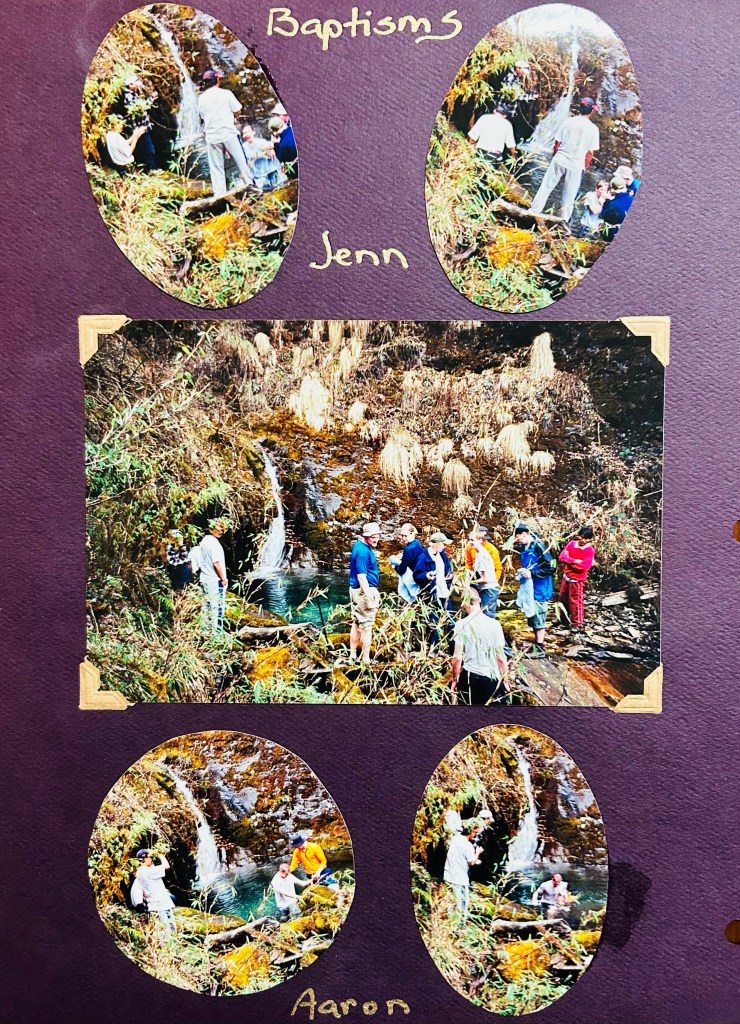
March 21-23, Tuesday – Thursday. Sharon started vomiting at 5 am and was still very sick at breakfast time. So we delayed our departure for Ghorepani and spent the morning prayer walking around the area. Finally at noon, because Sharon was still ill, we left Vivian, Puchanga, and Bala with her (they would meet up with us later) and headed out. Rain, sleet and hail pummeled us the entire day. An hour or so out in a lushly green area we passed a lovely waterfall tumbling into a frigid pool at the bottom. As we approached Jenn and Aaron said that they wanted to be rebaptized so we stopped for a bit and had a beautiful ceremony with them.
oncoming mule train
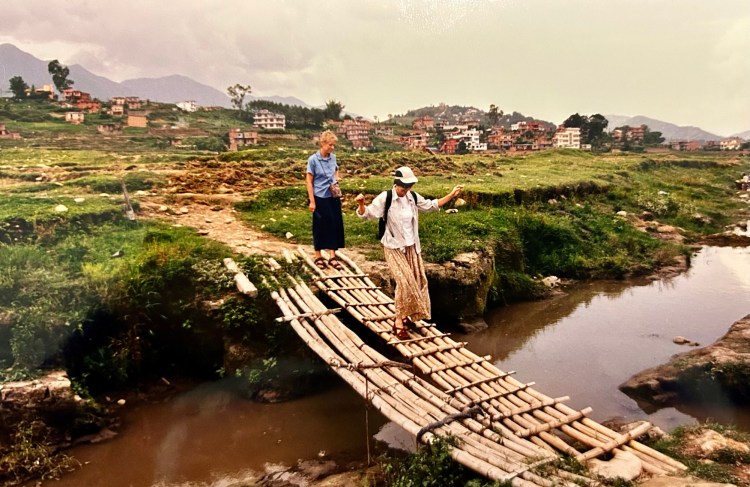
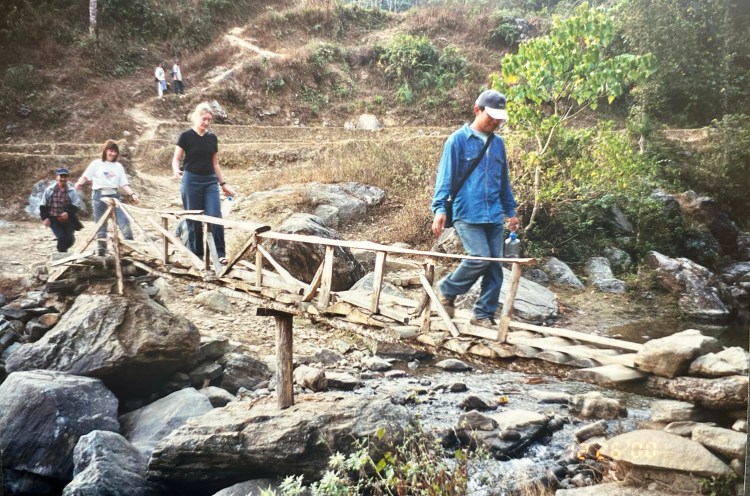
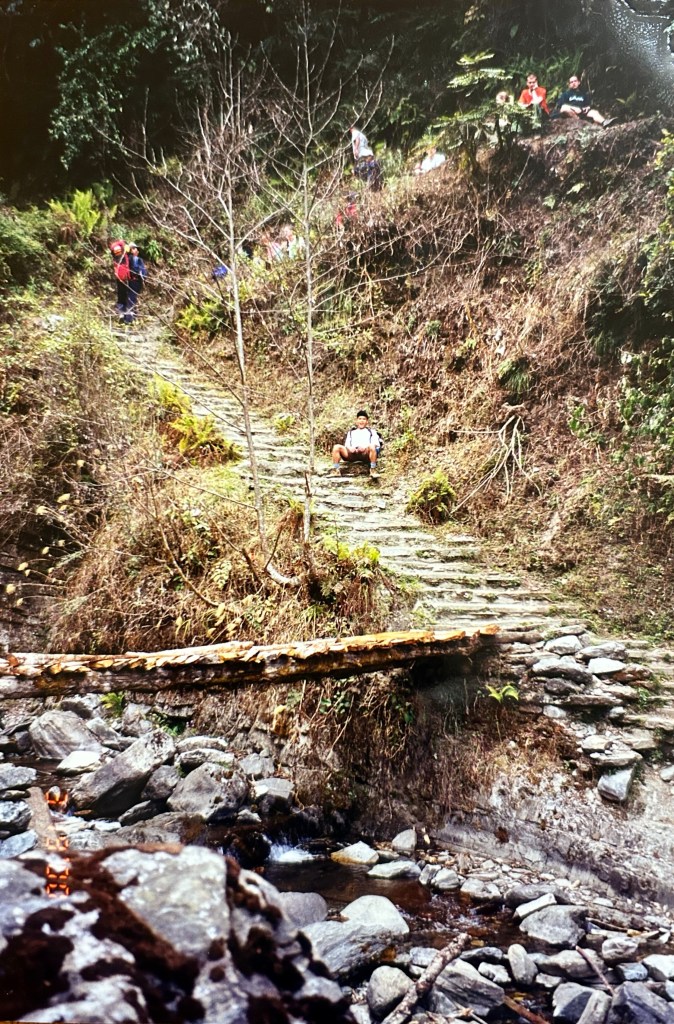
There were some iffy bridges on the trail.
As a day’s walk progresses and people are feeling tired they begin asking Robby, “How much farther?” Anyone who has trekked with Robby will know his standard response, “In ten minutes we will be closer.” An hour later the response will be the same. Tuesday was a hard day for me physically. I was not struggling with lack of oxygen but my legs were gone. Around midday Daniel L kindly took my pack and carried it on his front as well as the one he was carrying on his back. That helped me so much! A strange thing happens when one has carried a backpack for a long period of time and then puts it down. There is a bizarre lightness, the sensation of standing on your legs disappears and it literally feels like floating. Although I didn’t actually float my afternoon journey was then so much more enjoyable.
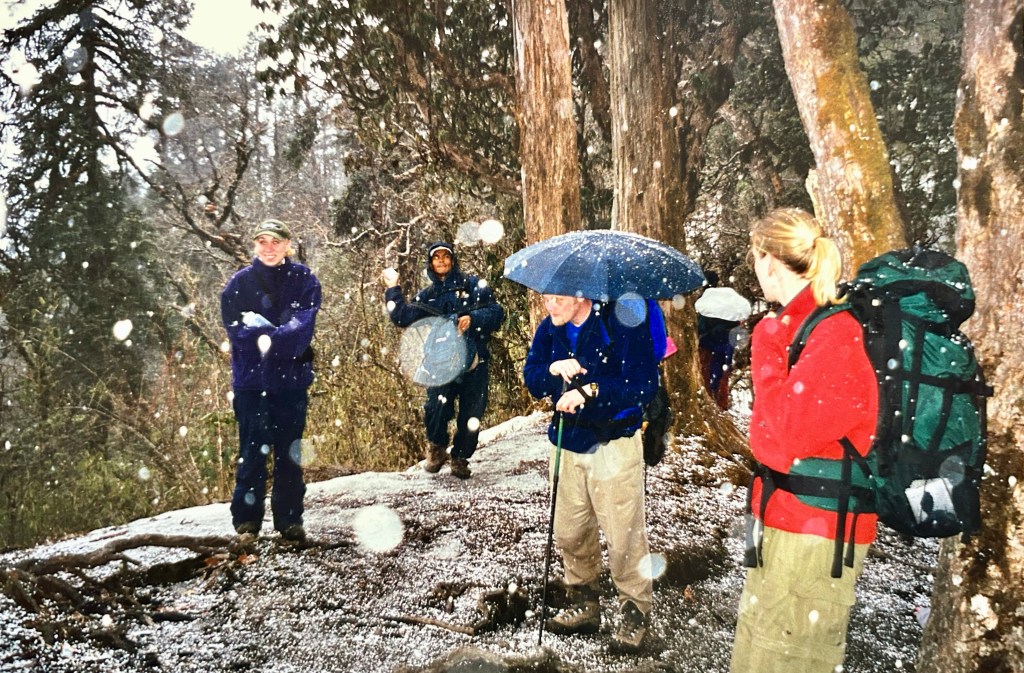
Just past Deorali we stopped at the high place from which we had prayed the previous week. An intense thunder/lightning/hail storm came up. In the mountains the rumble of thunder is greatly magnified as its sound bounces among the mountains, so that alone made for a majestic experience. But also, the atmosphere was like a soup of static electricity; the static in the air was so dense that when the lightning flashed our hair stood up. I supposed we should have been afraid but the experience had a holy feel that was quite invigorating. A scene from the movie, Braveheart, flashed into my mind where near the end William Wallace was being tortured to death. In one last act he mustered all his strength and at the top of his lungs screamed, “Freedom!!!” And I knew what I had to do. A few others and I climbed up onto a boulder and as loud as we could proclaimed “Freedom!” in all directions. I remember thinking what a target we were for a lightning bolt but it didn’t matter. We shouted. What I experienced that day was so spiritually incredible that it is hard to describe. However King David wrote a poem recorded twice in Scripture (2 Samuel 22:10-16 and Psalm 18:9-15) that very much describes what I was feeling.
“He opened the heavens and came down; dark storm clouds were beneath his feet. Mounted on a mighty angelic being, he flew, soaring on the wings of the wind. He shrouded himself in darkness, veiling his approach with dark rain clouds. Thick clouds shielded the brightness around him and rained down hail and burning coals. The Lord thundered from heaven; the voice of the Most High resounded amid the hail and burning coals. He shot his arrows and scattered his enemies; great bolts of lightning flashed, and they were confused. Then at your command, O Lord, at the blast of your breath, the bottom of the sea could be seen, and the foundations of the earth were laid bare.” Psalms 18:9-15 NLT
massive thunder and hail storm
view of Ghorepani from Deorali
Katie and Daniel G
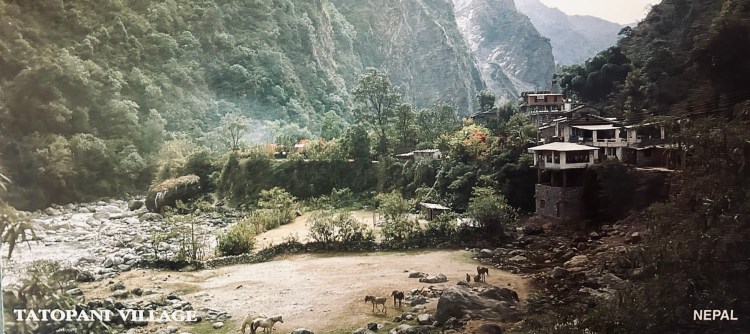
After a short walk we arrived at our teahouse in Ghorepani, meaning water for horses. (Tadapani means far water and Tatapani, which we bypassed, means hot water.) Physically I was done. Somehow I managed to get the only hot shower of the night and it did wonders to restore my soul. Others asked but since the house was full the kitchen was too busy with dinner to heat water for showers and I felt bad for those who braved the icy alternative. It was dark out and so as we waited for dinner, everyone settled into savoring copious amounts of Nepali milk tea, card games, and intense but unproductive conversation with a large group of Europeans also staying the night.
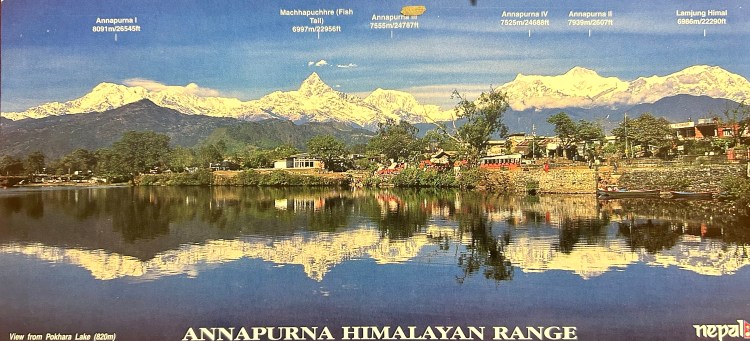
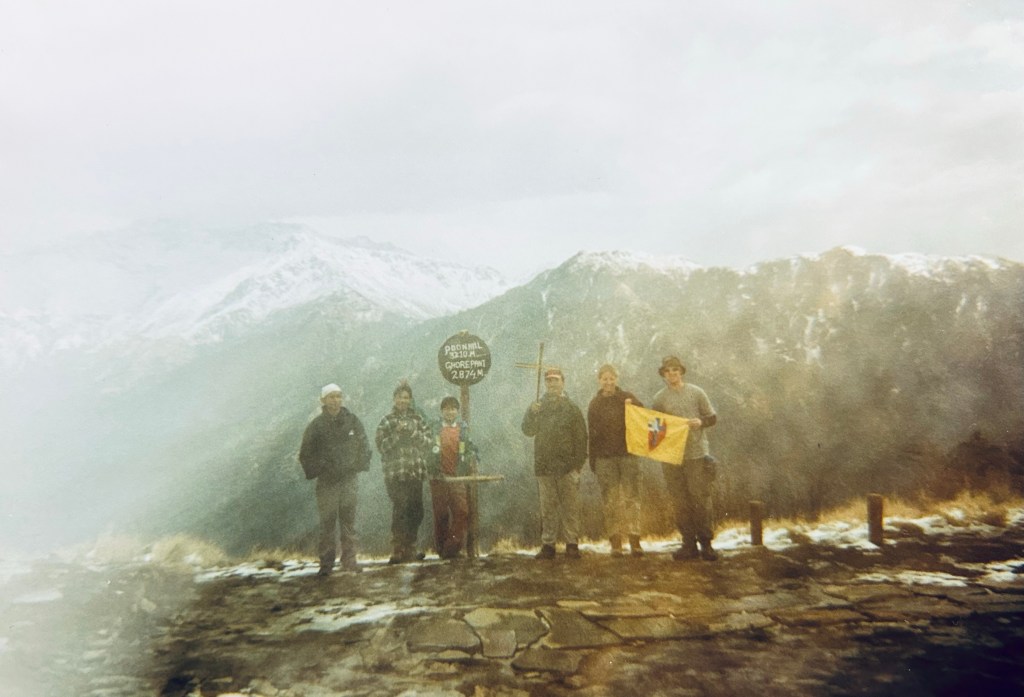
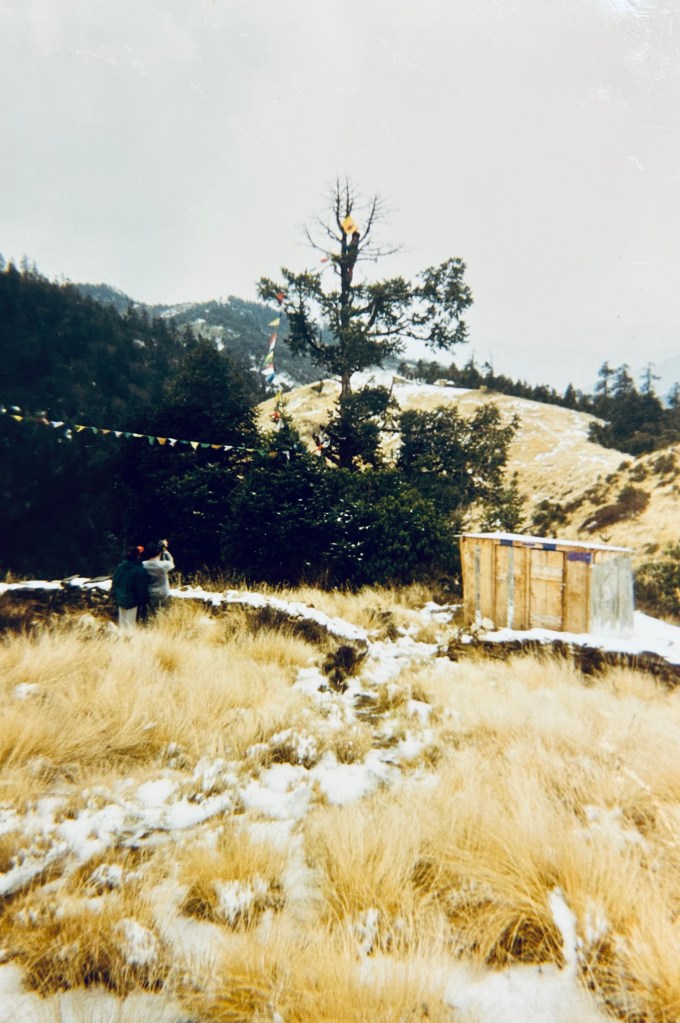
Nasty weather greeted us early Wednesday morning. Not to be deterred we climbed Poon Hill and facing the snowcapped peaks, somewhat obscured by weather, we prayed together and claimed the Annapurna region for Jesus. Bhim climbed to the top of a tree and high above the waving Tibetan prayer flags hung a dedicated banner as a prophetic act.
Poon HillCan you see Bhim at the top of the tree?
After tea and breakfast we hit the trail and arrived in Nangethanti in time for lunch at the Christian owned teahouse where we were housed the week before. They cooked us a yummy lunch that included chicken curry and we hungrily devoured every bite.
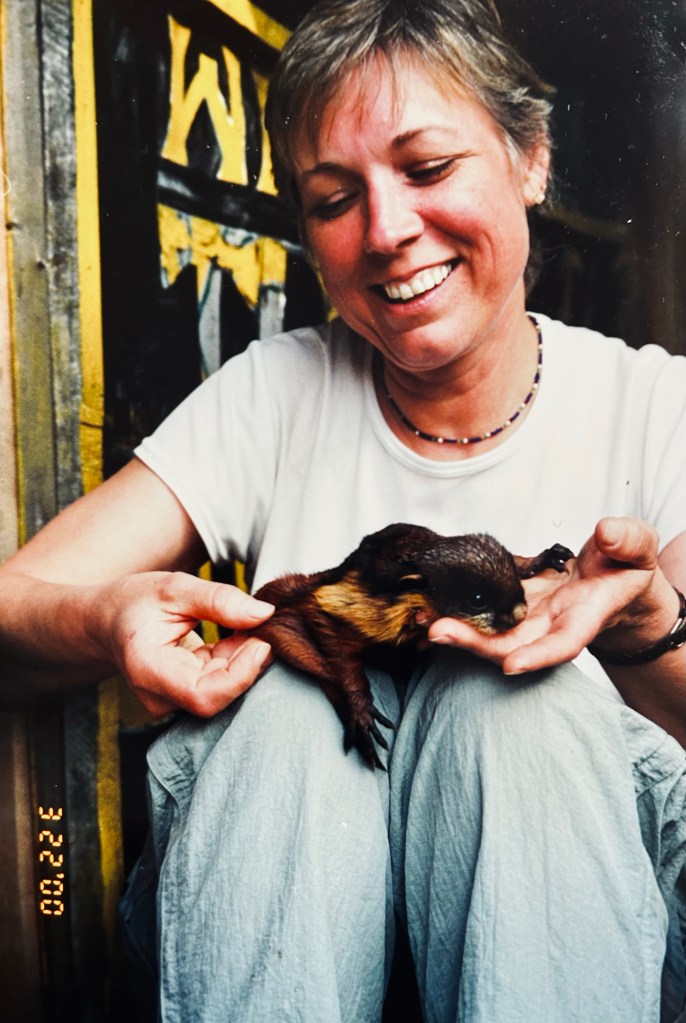
baby forrest creature
After lunch we trekked down to Banthanti and again settled into Hotel Trekking. It was wet and cold and we spent the evening huddled around the fire built in a metal vessel (a bit like a fire pit) that was situated in the open air dining room. As we sat around visiting Daniel G. shared his dream of starting a training center for pastors in the villages of Nepal. (Katie’s heart was stirred and her church would be a part of helping get Daniel’s center off the ground.)
Chicken was on the menu again tonight. Since it was raining out we had an up close view of the butchering. It was nothing like the way we did it in Arkansas when I was growing up. The teahouse owner squatted on the kitchen floor holding the chicken in his hand using his thumb to pin its head against its side. Then holding the chicken’s neck over a metal bowl on the floor he sliced off the head, carefully allowing all of the blood to drain into the bowl. There was no headless chicken flopping all over and squirting blood everywhere. Who knew it could be so simple..and tidy.
some preservice worship
At 8:30 pm or so, across the path from our teahouse believers gathered to worship at the only church in the region. The singing was heartfelt and stirring after which Stephen and Wes gave testimonies and Chris shared the Word. We then took communion together with the local Christians as a sign of support and unity.
Back at the teahouse it was discovered that rain had leaked through the roof and melted the kitchen’s clay stove. The owner quickly gathered a bucket of clay and rebuilt the stove while we were warming by the fire awaiting one more lusciously warming cup of chiya (tea) before bed. Some of the girls had seen spiders in their room and were nervous about going to bed. So weirdly enough bedtime conversation centered on whether or not spiders climb down our throats while we sleep.
morning ritual (ie toothbrushing)
Thursday we walked downhill to Matatati. It was pouring the entire way so we stopped and bought plastics (heavy-duty garbage bags), cut out holes for head and arms, and wore them as rain jackets. It was a nice walk but by the time we arrived at Shamjhana Lodge we were soaked. As I fell asleep it was hard to believe that this would be our last night on the trail.
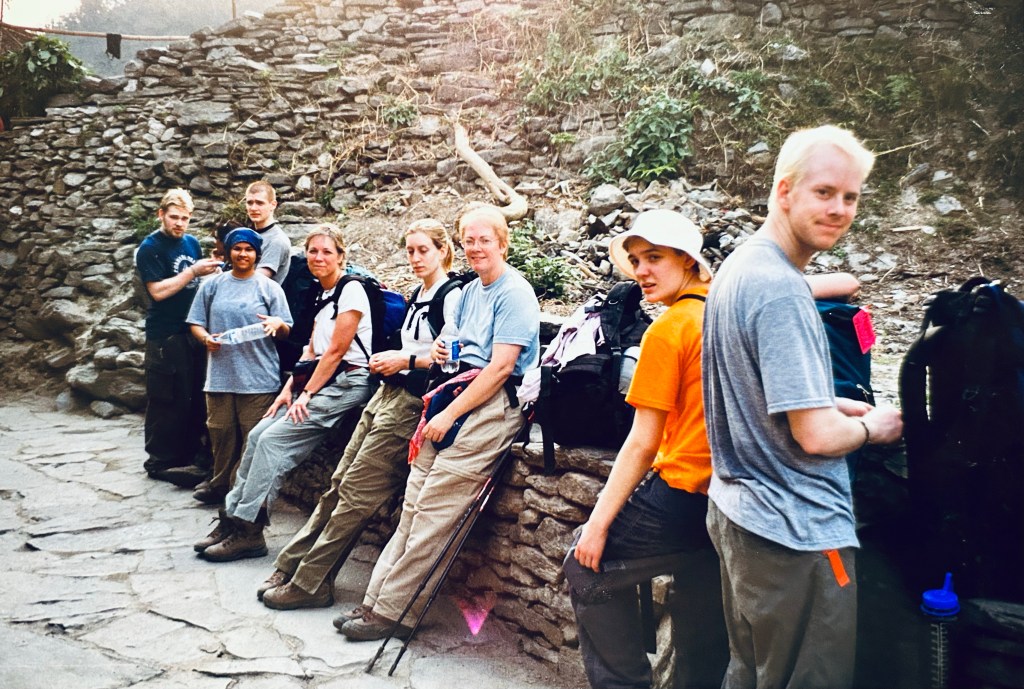
a few of our many rest stops along the trail (Julie found her Nepali doppelgänger.)
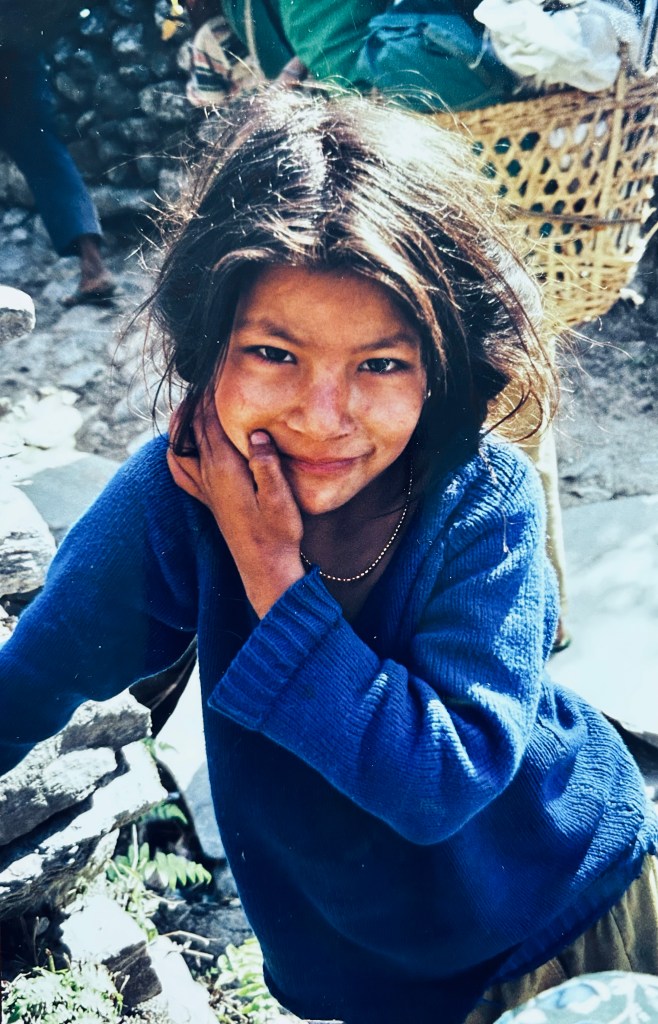
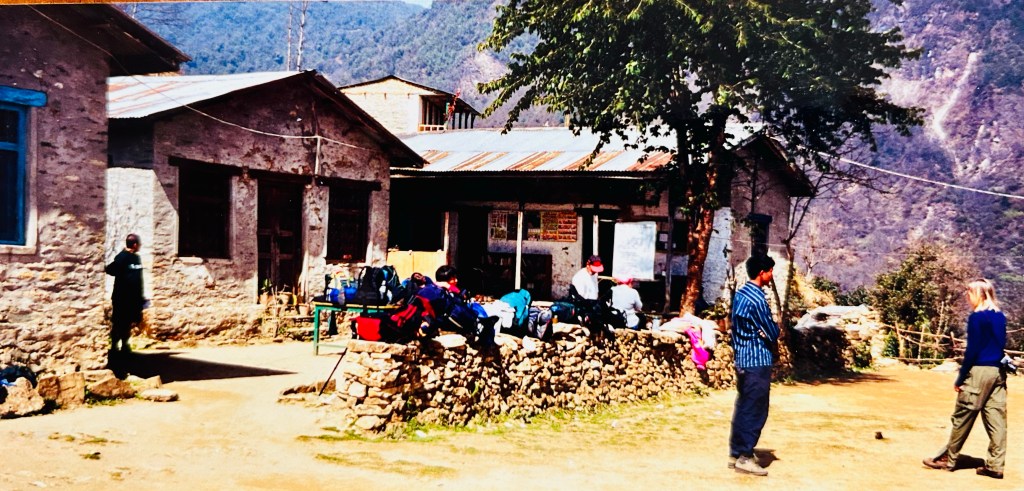
March 19 – 20, Sunday – Monday. Team devotion began at 8:00 am, brunch would be at 10:00, and we world face those 100 gazillion stairs at noon. We spent the morning praying around the area and relaxing. I met the cutest and quite precocious little girl as I was sitting on a rock by the trail. We had no spoken language in common but that did’t prevent a delightful interaction during which I prayed silently for her and her family. After brunch I relaxed on a patio behind the tea house savoring a gentle breeze and the calming melody of the rushing river just behind me while chatting with Robby, our Nepali leader. Across the patio an elderly Tibetan man was spinning a hand-held prayer wheel while chanting a mantra. Prayer wheels come in many sizes. They are filled with written mantras and it is believed that with every clockwise spin all the prayers ascend up into the atmosphere both creating a safe space from calamity and from demons and earning merit for the spinner. The merit earned is exponential according to the number of mantras in the prayer wheel and is part of a Tibetan Buddhist’s quest to attain nirvana, the end of the karmic cycle when it is believed that one ceases to exist as an individual and is absorbed into the cosmos. As I watched him Robby explained to me that Hindus worship at the rivers and Buddhists worship on the mountains.
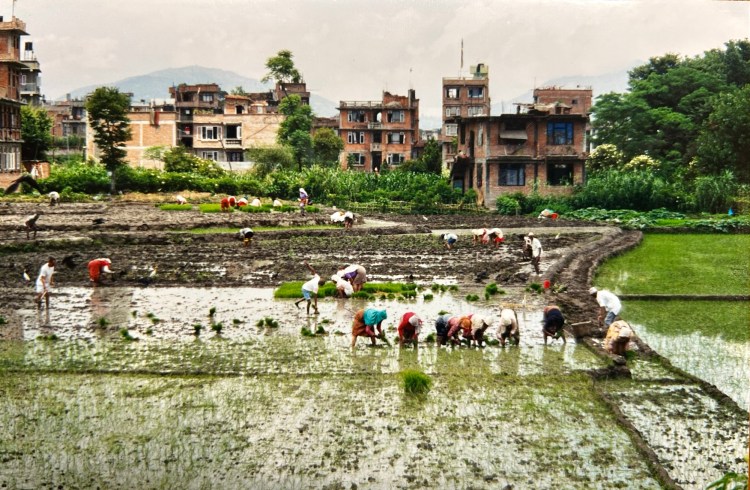
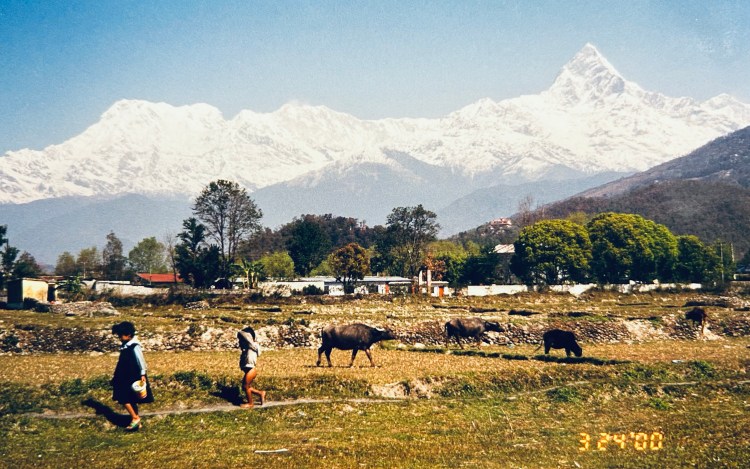
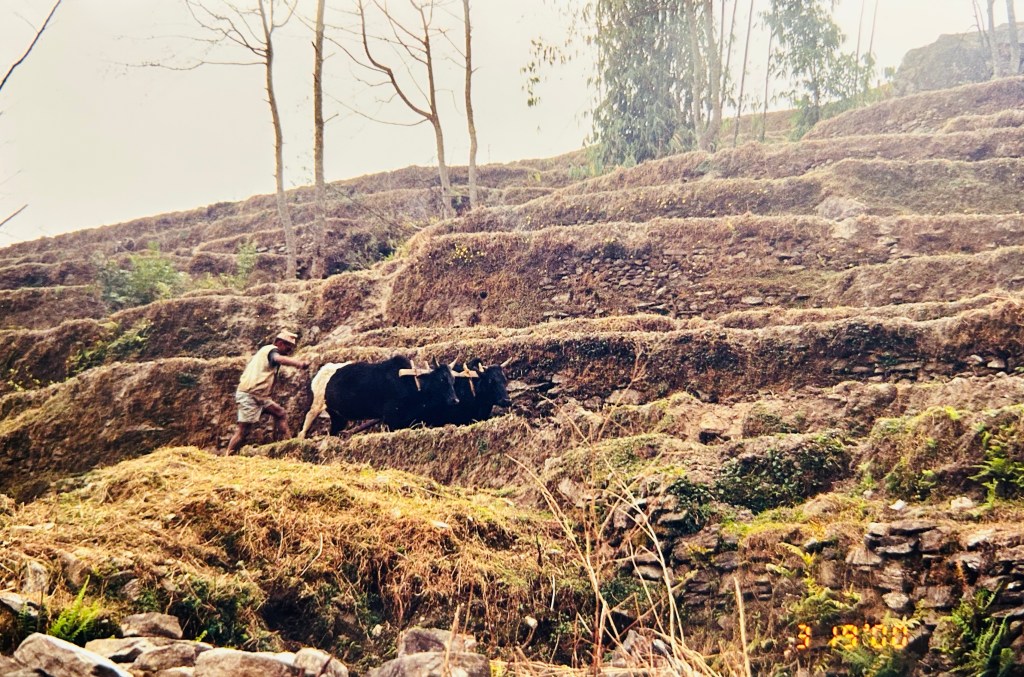
plowing with water buffaloes
On this second round there were many connections awaiting us on the trail. Just above Syauli Bazar was a restaurant. The woman attending it was open to conversation and after a bit Julie was able to pray with her. Just a little farther up the trail we met the headmaster for a school in Gandruk, different from the one we visited the week before. We learned that he had attended a Christian school in India and had become a believer but was no longer following Jesus. After some conversation Mark was able to pray with him. We offered him a Nepali language Bible but he preferred an English one so Julie gifted him with hers. The headmaster also invited our team to visit his school as we passed through Gandruk.
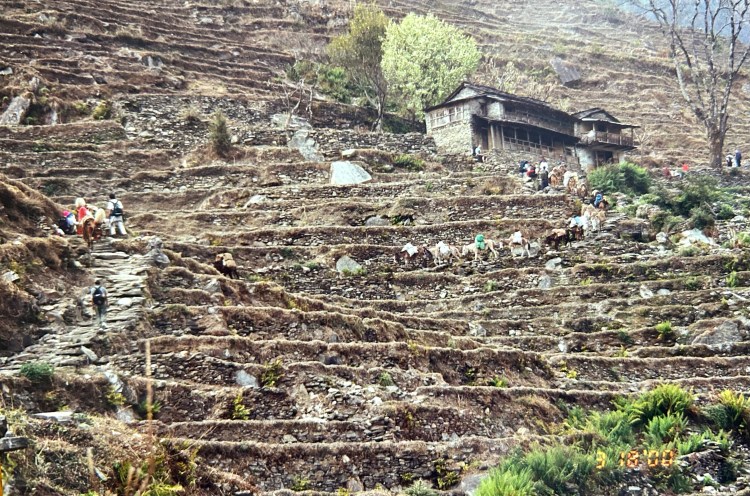
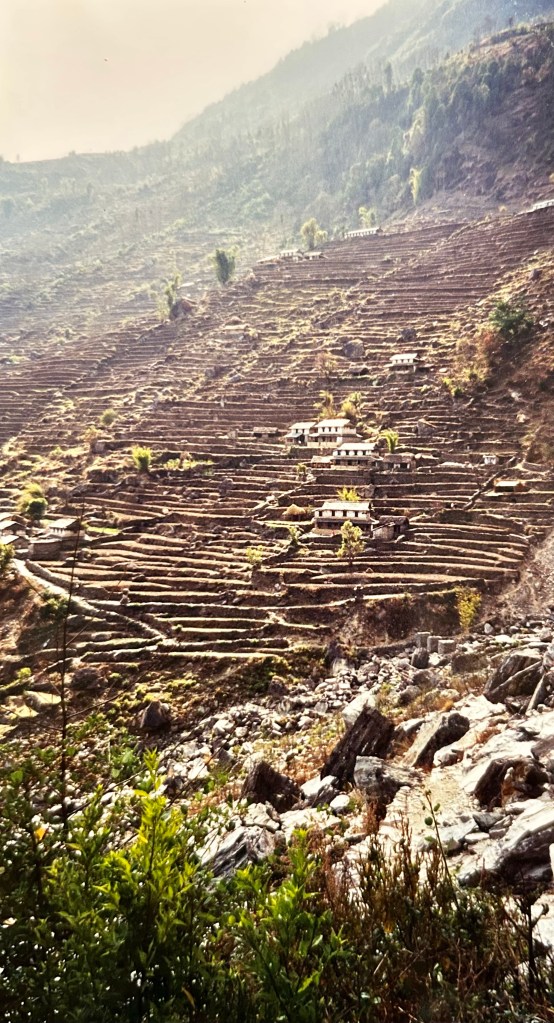
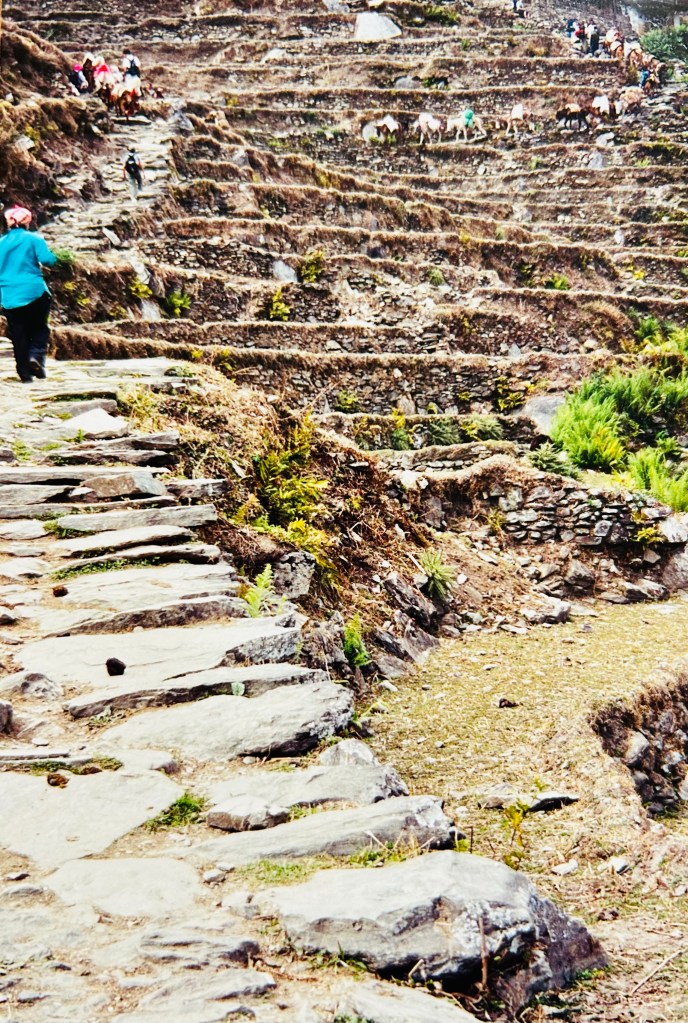
terraced fields, mule trains, and stairs
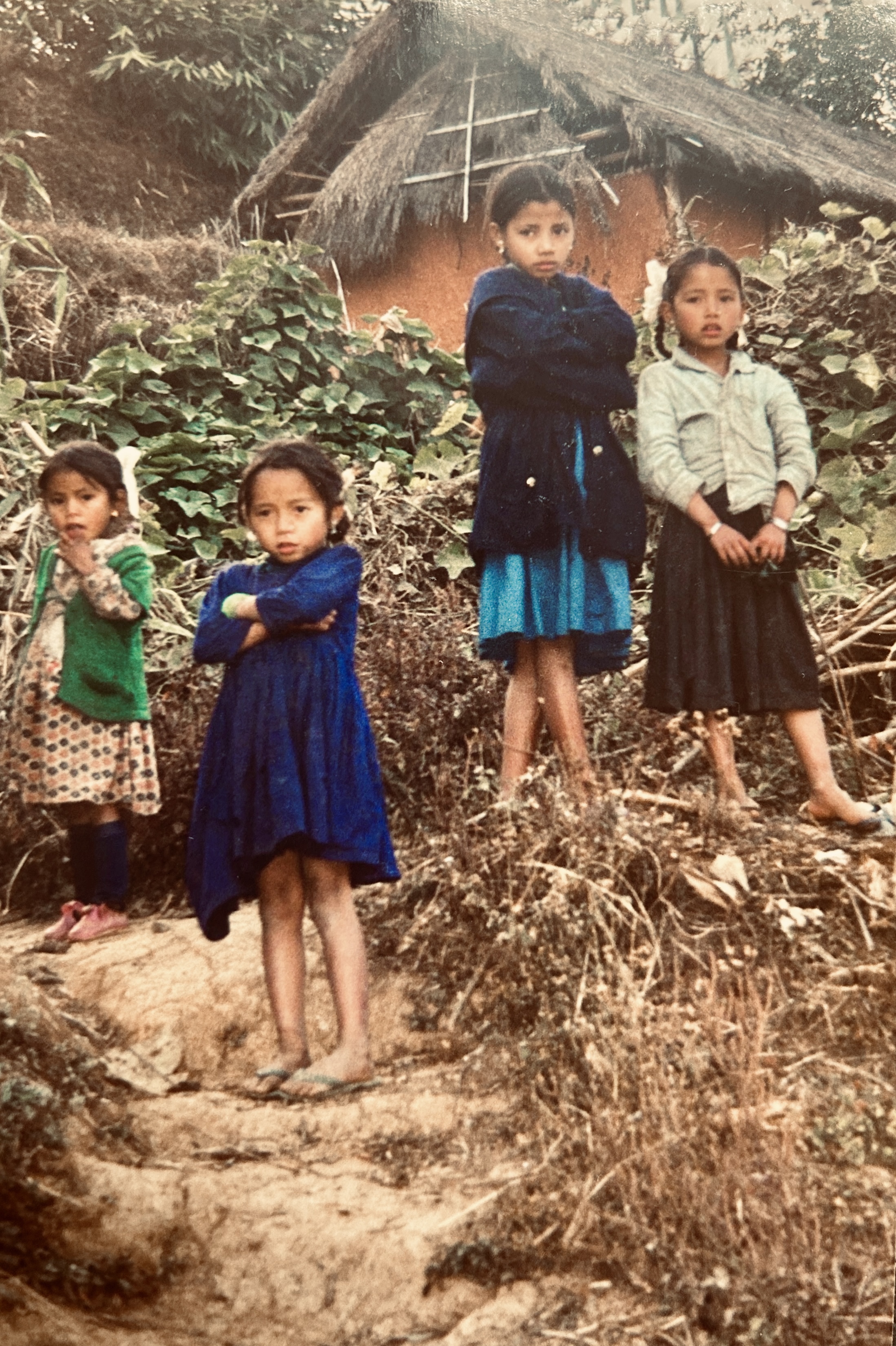
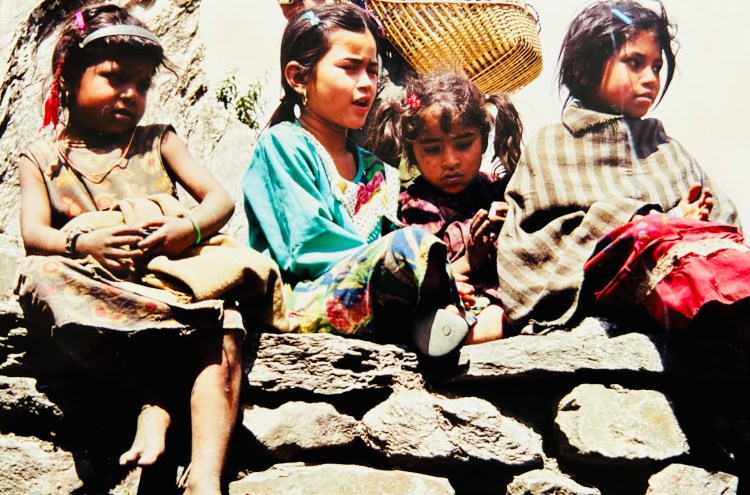
The group walking with Daniel G. found the father of the shop owner we prayed with the previous week. He was still adorned with signs of Hinduism but after some sharing prayed again to receive Jesus. (My observations through the years is that coming to Christ in a South Asian context is more of a process than an immediate experience. Perhaps that is the norm for everyone but it seems much more obvious there.) His daughter, the shop owner, was excited about her new relationship with Jesus and had made some cross earrings for her sister with whom she was sharing truth. We also passed children carrying goods in baskets hanging on their backs supported by a strap across their heads. Children almost always come to greet travelers usually with the word chocolate (pronounced cho-koh-lah-tay) their word for any kind of candy (chocolate is actually not a common sweet in Nepal).
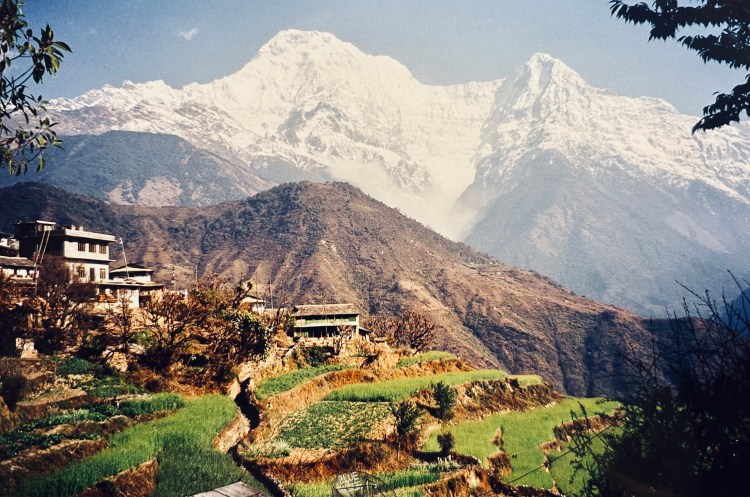
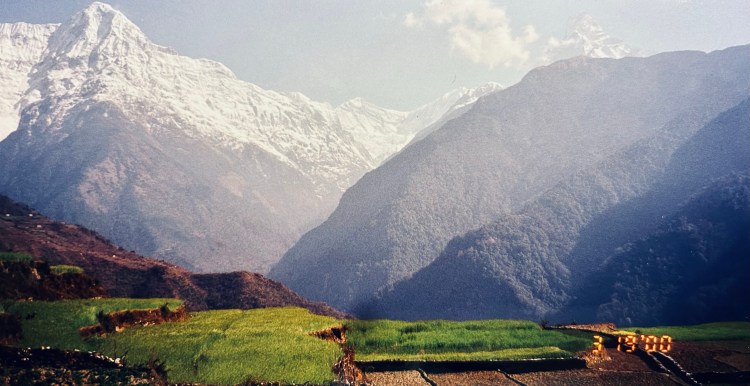
After climbing many, many stairs, meeting many mule trains, and taking in an abundance of breathtakingly stunning vistas of mountains terraced with Kelly-green rice fields we finally arrived at Ghandruk. Exhausted as I was I was weirdly excited to see Michael, the goat, again. Settled down on the patio and savoring a wonderfully comforting Nepali milk tea and biscuit (cookie) I realized that Michael was nowhere to be seen. I asked the British tea house owner about him. “Ah, we had him for dinner the other night,” he responded (which would explain why he had been tied up by the kitchen, lol). I was weirdly heart broken at that news. Dinner would again be the exotic (for Nepal) treat of pasta. And since it was Julie‘s birthday, dessert was a still warm, chocolate cake with chocolate icing. As there are no ovens I cannot say fresh-out-of-the-oven but I can attest that it was fresh off the wood-fired, clay stove of the tea house. And it was extraordinarily delicious.
Buddhist shrine in Vivian and my tea house room
Since there was an abundance of water at Sakura Tea House some of the team washed out clothes in a bucket and hung them to dry overnight. Three German girls were also staying at the tea house and were open to conversation with the two Daniels. After dinner they joined us in a worship time.
Monday morning several of our Alaskan team woke up sickish, weak and foggy brained, in a way that sounded to me like the feeling that comes with heavy spiritual oppression. Even though no one felt much like shouting, and definitely not like singing, I was positive that that was the Lord’s directive from last week and so was determined that we would shout. (See 100 Gazillion Stairs, Part 7: /https://jackietallent.com/2023/05/16/winds-of-the-himalaya-part-7/) To my dismay neither Chris nor Katie knew Shout to the North (Delirious) but I felt that was part of what we needed to do. So Chris suggested Shout to the Lord (Darlene Zschech) which as it turned out worked just fine. So as we headed out of Gandruk we found a place overlooking the valley with a majestic panorama of the Himalayas and we gathered in close together. Chris led us into a sadly feeble singing of “Shout to the Lord all the Earth, let us sing – Power and majesty, praise to the King – Mountains bow down and the seas will roar at the sound of Your name.” And then in possibly the feeblest shout ever heard we yelled out the Names of God over the Gurung villages surrounding us. As we were shouting there were two enormous avalanches across the valley on different mountainsides, one a couple of minutes after the other (we saw a total of three separate avalanches that morning). I knew with all my heart and being that God was showing us that the heavenlies were shaken, something was broken in the spirit realm, the mountains were bowing down, the mountains trembled (Delirious). It just goes to show that it was not our strength or power because we didn’t have much, but that God responded in His Power when we were faithful to obey.
view from Gandruk
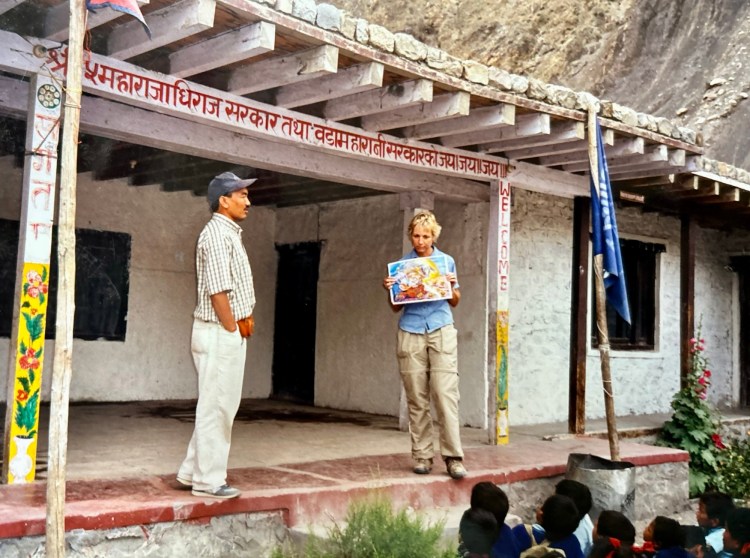
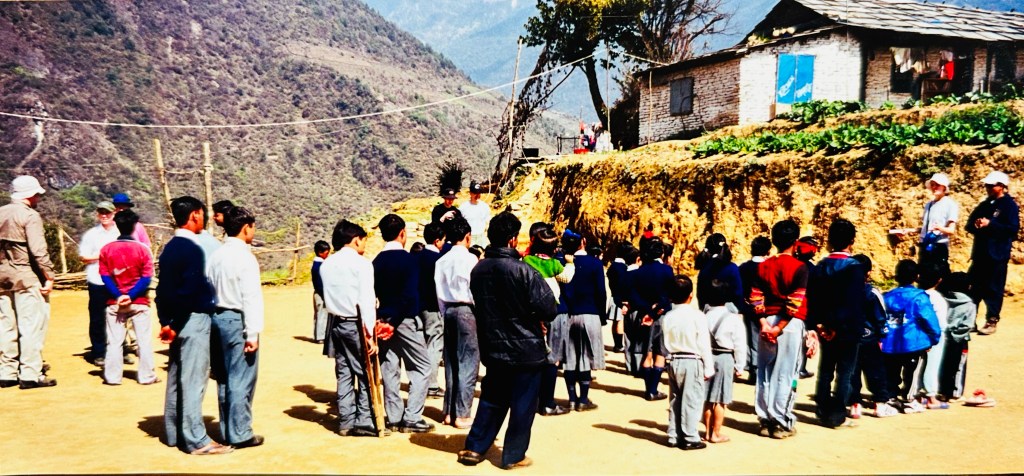
After a short trek we found the school of the headmaster we had met on the trail yesterday. When we arrived it was 10:00 am and the kids were all lined up and beginning their opening ceremonies. Then they handed it over to us to give a school assembly. We led them in some action songs. Jennifer shared from the Word and I told a story using Kasi from the Alaska team and Puchanga from the Nepali team as actors.
school assembly
After many, many more stairs we arrived in Tadapani in the afternoon. Everyone passed the afternoon playing games and resting. After dinner we spent an extended time talking, sharing our stories, and worshipping together. I noticed that a few people had slipped out but didn’t think much of it until someone came to get me and took me upstairs to the room of one of our girls. She had become very, very sick after dinner and was shaking violently and crying, clearly frightened. A small group was praying with her but she was not improving. I sat on the bed beside hers, watched for a bit, and silently prayed. I strongly felt that it was a spiritual attack. We continued to pray, sang some choruses, and then I felt led to read a Psalm (I don’t remember which one, perhaps it was Psalm 121). As I read and spoke the words of the Psalm over her and directly to her the trembling stopped and she slowly settled into a more peaceful state. I explained to her and the others that this attack was not a sign of weakness; that it was possibly the opposite, like a form of retaliation from the enemy for the strength she had exercised earlier in the day, a tactic of intimidation. She didn’t want to sleep alone so we moved her to the bed next to mine for the night.
Downstairs in the dining room there was a cultural show. After the show our Nepali team began singing and then there was a time of worship in English. Everything could be heard clearly in our room and it brought a wonderful, peaceful atmosphere to us as we drifted off to sleep in Jesus’s Presence.
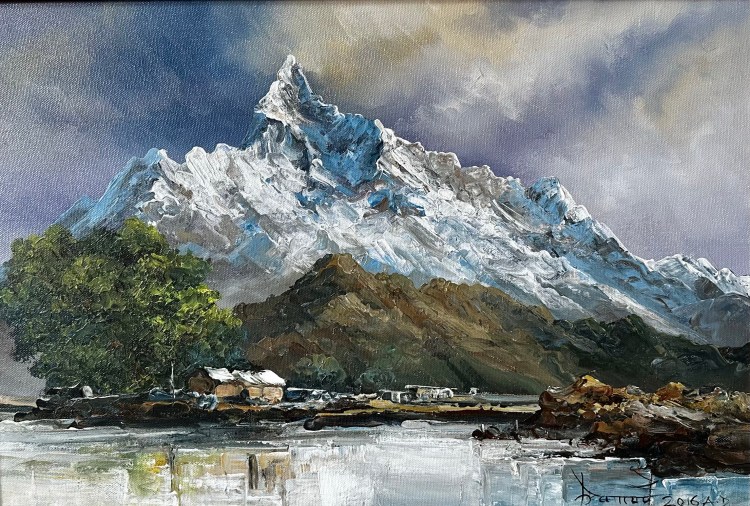
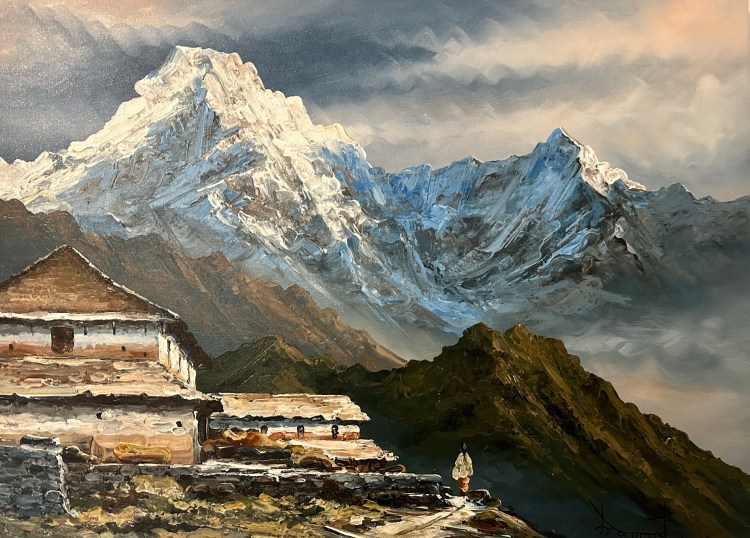
acrylic on canvas
“I look up to the mountains— does my help come from there? My help comes from the Lord, who made heaven and earth! He will not let you stumble; the one who watches over you will not slumber. Indeed, he who watches over Israel never slumbers or sleeps. The Lord himself watches over you! The Lord stands beside you as your protective shade. The sun will not harm you by day, nor the moon at night. The Lord keeps you from all harm and watches over your life. The Lord keeps watch over you as you come and go, both now and forever.” Psalms 121:1-8 NLT
























 Coffee, Tea, and Reverie